

Key Takeaways
- Agile is being employed by around 71% of software teams, but it has become common for many of them to combine Agile methodology with other approaches instead of sticking to a strict framework.
- Around 84% of developers are using or planning to use AI tools, which makes coding, testing, and sprint planning faster.
- AI-generated code poses certain security risks; thus, proper human review is a must.
When working on software projects, the initial query is always: How to make sure our software is built properly? When the wrong approach is chosen, even a strong team can overshoot deadlines and budgets and end up building a product nobody asked for.
Thus, it explains the great importance of software development methodologies. They help the team formulate a clear plan of action as far as building, planning, testing, and delivering a software product is concerned.
The problem is that there is not only one most effective methodology. The Agile method is used by up to 71% of teams, but nowadays they often mix it with other methodologies instead of taking clear one. On the other hand, AI has started changing the manner in which teams plan their sprints, write code, and review the results.
In this blog, you’ll explore the most popular software development methodologies, understand their key differences, and learn how AI is influencing each approach. You’ll also discover the factors to consider when choosing the right methodology for your team.
What Are Software Development Methodologies?
Software Development Methodologies can be described as structured approaches that provide a framework with which you can create, implement, test and maintain software programs.
Software methodologies definition consists of one unique approach and emphasizes its importance so that regardless of what role a member has within a specific team, is aware of the dos and don’ts as well as the order of which the tasks must be completed/fulfilled.
-
Why Do They Matter?
Missing a methodologies in software development, it is likely that tasks are not prioritized appropriately, work is duplicated, deadlines are missed and objectives are failed.
Using a good software development methodology is vital to make the work consistent, ensuring quality checks of work done and enabling to identify the risk before launching the product. Moreover, there is better communication among software engineers, testers, designers and clients and work is completed on time.
-
Methodology vs SDLC: What’s the Difference?
Sometimes people confuse the two terms. The Software Development Life Cycle or SDLC consists of the stages that every software development process goes through: planning, designing, development, testing, deployment and maintenance.
Software development methodologies differ in how they structure workflows, manage project requirements, assign responsibilities, and handle changes.While some follow a sequential process, others use iterative cycles, continuous feedback, or flexible task management to help teams deliver software efficiently.
Breakdown of Common Software Methodologies
There are certainly many different methods of project management out there, yet teams usually stick to the tested approaches. Each method has advantages and disadvantages, and can be used in specific situations.
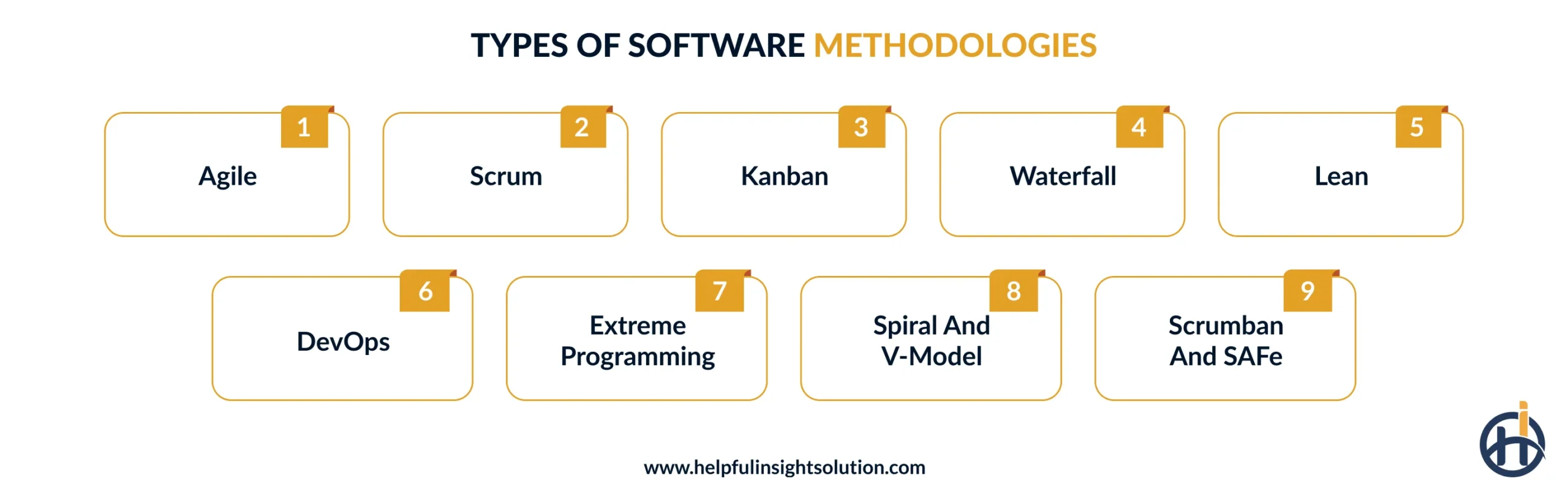
Here, you can find the highlights of the validation of software development methodologies list, featuring eight of the most well-known methodologies.
1. Agile
Agile is not the method, it is a way of thinking. This software product development methodologies does not imply developing the entire product, but rather delivering the product step by step, adjusting the process after each increment of work. Instead of following the plan and making exhaustive documentation, the Agile Manifesto states that customers, working software and responding to changes matter more.
Agile is the best option to stick to if the customer prefers to see the progress in the early stages of the project. However, the downside of this method is that it requires the customer to be active and the team disciplined.
2. Scrum
Scrum stands out as one of the most widely used frameworks within the Agile methodology. Tasks are done in fixed durations known as sprints, which usually last from one to four weeks and culminate in the delivery of usable software.
There are three vital roles in Scrum: the Product Owner (who is responsible for setting priorities), the Scrum Master (who removes obstacles), and the Development Team (who builds the product). It also has meetings such as daily stand-ups, sprint reviews, and retrospectives.
Scrum is perfect for teams that are working on projects with changing requirements. However, it can feel cumbersome for very small teams due to the number of meetings, especially when projects involve constantly changing tasks. Its simplicity may also present challenges in the long term.
3. Kanban
Kanban methodology is based on visualization of the work process. Tasks pass through the board from one stage to another set out in columns like To Do, In Progress, and Done, and work-in-progress limits help to avoid taking too much work.
Kanban is suitable for maintenance and support teams and projects with constantly coming tasks. It is its simplicity that may present problems in the long term.
4. Waterfall
Waterfall is an old, linear method of project management. A project goes through several stages such as requirements, design, development, testing, deployment and maintenance, and each stage has to be completed before the start of the next one.
Waterfall is suitable for fixed projects where requirements are well-established. For instance, government, health care, and construction software projects where documentation is an important part of development.
However, there is a significant downside of this method, that is inflexibility. In case anything needs to be changed towards the end of the project, the costs will be very high and users will have the chance to see the product only after the completion of the project.
5. Lean
Lean software development is based on the lean manufacturing principle. The main idea behind lean software development is to deliver maximum value using minimum resources. Thus, unnecessary features and delays should be avoided. The main principles of this approach are fast delivery, capable team, and quality development.
The lean method is perfect for startups and people with budget constraints. It is a philosophy rather than a detailed methodology and it can be combined with Scrum or Kanban.
6. DevOps
DevOps serves as a bridge between development teams and IT operations. By utilizing automation, along with continuous integration and continuous delivery, DevOps enables the teams to deliver fresh updates in a timely manner while ensuring valuable feedback for improvements is integrated back into development.
Many popular software development methodologies, like DevOps caters are good for SaaS products or mobile applications because it involves regular releases. However, it also necessitates specific cultural shifts as well as financial investments in automation.
7. Extreme Programming
Extreme Programming (XP) provides a unique Agile method used in extreme programming. The focus is made on ensuring top-notch code quality through pair programming, test-driven development, and mini releases.
This approach works well when requirements change frequently, but it relies on close collaboration among developers. Remote teams may face challenges with XP due to limited opportunities for direct interaction, although remote pairing tools can help bridge this gap.
8. Spiral and V-Model
The Spiral model involves looping through development with risk evaluation taking place at the beginning of each loop. While ideal for large, risk-prone projects, Spiral can prove costly.
The V-model is an advancement of the Waterfall model since it pairs each development stage with a testing phase, which makes it preferable in applications where reliability is key like automotive and medical software.
9. Scrumban and SAFe
Scrumban combines aspects of Scrum like sprints and retrospectives with Kanban aspects like boards and work-in-progress limits. This is a good model for teams that combine feature development with support tasks. SAFe is a useful way for big organizations to coordinate many Agile teams with the help of common planning sessions.
Top Software Development Methodologies by the Numbers
Opinions about methodologies are easy to find. Data is harder, and it shows where the industry is actually heading.
1. Agile Is the Default Choice for Software Teams
According to Scrum statistics in 2026 approximately 71% of software teams are utilizing Agile as it is very popular among the developers. On this note, it is important to add that though hard frameworks are available, they are becoming less and less common because now teams are using different approaches when working on projects rather than sticking to specific frameworks.
2. Agile Has Moved Beyond the IT Industry
The industries that are known for having the greatest number of IT and software companies are IT and software, which together account for 35% of Agile adoption, financial services with 22%, and healthcare with 17% reported by PMStudycircle. The remaining 26% makes up the manufacturing and other industries, showing that Agile is no longer a practice used only by software.
3. AI Tools Are Now Standard in Development
The 2025 poll conducted by Stack Overflow shows that 84% of developers use AI or will use it in the future, which is 8% more than in the 2024 survey. Now we can say that AI is actively used to make plans, code, and test things.
4. Faster Code Brings New Security Risk
According to Veracode conducted tests, AI models introduced a well-known vulnerability in 44% of coding tasks. For this reason, human code analysis still remains one of the most important parts of modern software development methodologies.
5. The Project Management Tools Market Is Growing Fast
It is anticipated that project management software revenue reported by breeze will rise from $10.56 billion in 2026 to $39.16 billion by 2035, with a compound annual growth rate (CAGR) of 12.8%. As companies invest more in the tooling, organizations will expect to have higher visibility and structure in their processes.
How to Choose the Right Methodology for Your Team?
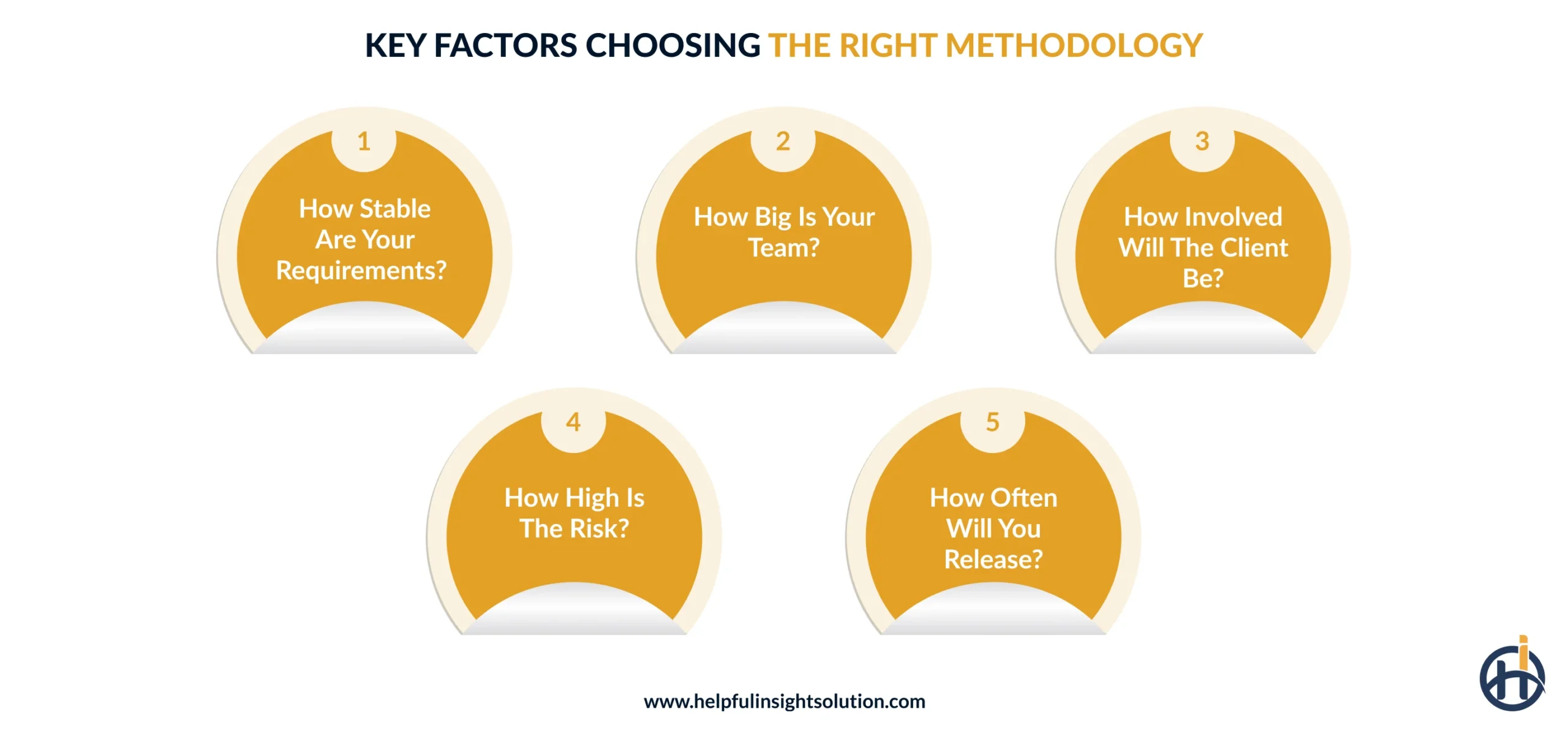
Knowing which options are available is only half of the task. The problem is to determine which one suits your needs the best, given your team, product, and budget. The best way is to think of several questions that will help work through the methodology that is most suitable for your organization.
-
How Stable Are Your Requirements?
This question holds the highest significance. If you have a fixed, definite set of requirements that are not likely to change, such as a compliance system with a defined scope, the traditional methodologies such as Waterfall or the V-Model.
It will be suitable for your project since they presuppose comprehensive planning from the very beginning of the project. If your requirements change as you interact with your users and analyze the functioning of the market, you need to choose Agile, Scrum or Kanban, which are built to accept modifications easily.
The best way to analyze what methodology to use is to assess the number of updates to the scope of your previous projects.
2. How Big Is Your Team?
The size of any team is an important consideration, as it will impact how various software development methodologies you can implement.
For example, the Kanban and Lean methodologies used in software development tend to be very beneficial for small teams, consisting of approximately three to five people, because they do not use too much overhead.
For teams with seven to ten members, Scrum is a good fit, as this methodology has clear guidelines and processes (sprint), which is ideal for such teams.
Moreover, large organizations tend to have a lot of teams, which requires them to implement a scaled or hybrid methodology so that all teams are involved in the process and know what is happening at all times.
3. How Involved Will the Client Be?
In Agile methodologies, feedback is of utmost importance. If the client or product owner can review the project every sprint, then Scrum will be a good option, since any mistake can be identified and fixed early in the process.
If the client can only approve the project at the beginning and end, a plan-driven methodology like Waterfall is a better fit.
4. How High Is the Risk?
Some projects are able to withstand a few mistakes. For projects such as healthcare or banking software, or anything else where a failure means a great deal of damage or problems, the Spiral or V-Model adds risk analysis and testing discipline to the approach you need.
For a less critical internal tool or an MVP, simpler methodologies for software development like Lean or Kanban might get you to the market faster.
5. How Often Will You Release?
If you release new features weekly or even daily, you will want to incorporate DevOps practices such as continuous integration and continuous delivery on top of your core methodology.
DevOps will not serve as a replacement for Scrum or Kanban. Instead, it will complement both of those methods in providing safe and repeatable releases.
Quick Comparison Table
| Methodology | Best For | Avoid If |
| Scrum | Evolving products, mid-size teams | Client cannot give regular feedback |
| Kanban | Support, maintenance, steady task flow | You need fixed deadlines |
| Waterfall | Fixed scope, compliance-heavy projects | Requirements may change |
| Lean | Startups, MVPs, tight budgets | You need detailed process control |
| DevOps | Frequent releases, SaaS products | Your team is not ready for automation |
| Spiral / V-Model | High-risk, complex projects | Budget or timeline is tight |
How to Know If Your Methodology Is Working?
Track four metrics: speed (throughput time, frequency of deployment), quality (number of defects, buggy software), team health (employee satisfaction, warning signals of burnout), and customer success (user engagement, retention). If indicators show improvement over the coming sprints, continue to work in the same mode. If not, change the process instead of blaming your employees.
Do Not Be Afraid to Mix
Many successful teams combine techniques; for example, they apply Scrum for planning and Kanban for everyday operations, or Waterfall for early design and Agile for actual development. Begin with a certain methodology and revise it from sprint to sprint adapting according to what works.
How AI Is Changing Traditional Software Development Methodologies?
Artificial intelligence is by no means a side gadget that software developers are experimenting with on weekends. It has already entered into the process itself and is transforming the way teams plan, create, test and review software. Different software development methodologies are still there but the processes today look pretty much changed compared to earlier practices.
1. AI Has Become an Integrated Part of Daily Processes
The survey conducted by Stack Overflow in 2025 showed that around 84% of developers use or intend to use artificial intelligence technologies, which is higher than 76% number from the previous year.
This shows that most likely your team is using artificial intelligence technologies already regardless of the official policy. The key question is whether your processes take it into consideration.
2. Sprints Are Getting Lighter
AI now plays a role in backlog grooming, story creation, estimation, and sprint reviews in Scrum and Kanban teams alike. Research by Softjourn indicates that companies adopting an AI-centered development process typically realize a 19% jump in pull requests when compared to traditional companies.
The research also suggests that teams that make use of AI save somewhere about two to three extra hours each week for each programmer, most of which they reinvest in improving code quality and documentation rather than in scope reduction.
3. Testing and Documentation Move Earlier
AI tools such as GitHub Copilot can help developers generate unit tests, document code, and identify potential defects during development. For example, automated tests can run whenever new code is committed, allowing teams to catch issues earlier.
This supports Agile and Extreme Programming (XP) practices, as well as DevOps workflows that use Continuous Integration and Continuous Delivery (CI/CD) to automate testing and software releases.
4. Speed Does Not Mean Stability
Faster delivery comes at a cost. According to Google’s DORA 2025 report, there is a link between the use of AI in software and faster application delivery, which can produce less stable versions of products and solutions. Veracode’s 2026 research confirms that AI models have introduced a known vulnerability into nearly 44% of codes.
5. Trust Is Still Low, So Review Still Matters
Despite the growing acceptance of AI, only about 29%-46% of those who use it actually trust it enough to rely on the output as is. This explains why it is necessary to incorporate in your methodology elements such as thorough code review, the clear definition of what work is finished, and checks for security issues, instead of implementing them later.
How to Improve Your Methodology for AI Use?
Three essential steps are common to all successful teams:
- Establish Clear Guidelines. Decide where AI can be implemented and where the approval of a human being is necessary.
- Enhance Review Procedures. Treat AI-generated code as code produced by a new team member, that is of great value but should be verified anyway.
- Measure The Right Parameters. Observe the stability of releases and the presence of defects and speed, since faster releases do not mean that problems have been solved.
AI development cannot replace Agile, Scrum, or Kanban but may let the teams that effectively adapt them win.

Conclusion
There is no perfect software development methodology, only the one that fits your team, your product, and your stage of growth: Agile and Scrum suit fast-changing products, Kanban keeps steady work flowing, Waterfall protects fixed-scope projects, and DevOps makes frequent releases safe. Most winning teams don’t strictly adhere to one framework. They blend practices, assess them regularly, and improve as they learn.
AI has now introduced another layer to the decision. It can speed up the software development processes and methodologies including planning, coding, and testing but requires a set of clear, sound rules and strong user review for it to be of any good quality.
Start small. Choose the methodology that suits your greatest challenge at that moment, work through a few sprints, and iterate from there.
FAQs
Waterfall presents an initial budget, but makes any changes costly during the project. Agile disperses expenses throughout the project phases and minimizes redo actions. Select according to how stable the scope of your project is.
The Agile methodology has been adopted by roughly 71% of teams who have applied its concepts in one way or another. The most commonly used Agile framework is Scrum, closely followed by Kanban.
The comparison of software development methodologies highlights that waterfall is a method in which the project is carried out without returning to previous phases. On the contrary, Agile focuses on short iterations that result in small software releases with plans adjusted after the feedback from users is received.
Scrum, Kanban, and Lean are popular because they allow teams with limited resources to operate quickly and with flexibility. Lean is especially useful when companies have constraints while developing a minimum viable product.
It is possible to integrate software development tools and methodologies, using a hybrid approach that is becoming quite popular. For example, one can use Scrumban (a combination of Scrum and Kanban) or Waterfall for initial planning and then switch to Agile in more specific phases of development.
AI helps speed up the planning process, coding, testing, and documentation, giving teams more time to do quality work. However, AI poses risks to security and requires human supervision and clearly defined rules for its use.