

Key Takeaways
- Mobile apps now handle everyday categories including food delivery, banking, ride booking, and payments, which makes business understanding as important as coding skills when selecting a developer.
- Four hiring routes are available, covering an in-house team, a freelancer, a dedicated team through a partner, and a fixed-scope contract with an app development company.
- Platform skills do not transfer, because the iOS side runs on Swift and Xcode while the Android side runs on Kotlin with Jetpack Compose.
- Hourly rates move with the developer’s experience level, the role held on the team, and the region the work is done from.
- The scope document, the ownership terms, the change request rate, and an AI clause covering generated code all belong in the same agreement.
Food delivery, banking, ride booking, payments, and messaging are handled through mobile apps in 2026. A business that wants to cash in on this growing popularity will hire mobile app developers to build it.
The people developing an application could be an employee, a freelancer, or an outsourced mobile app development partner.
The process of hiring these people varies according to choice, so do the timeline and cost. The choice between them decides who could manage the build day by day.
This blog is a comprehensive guide to hiring an app developer, covering skills, cost, vendor questions, and contract terms.
Mobile app development spending is set to grow
The mobile application market is growing continuously. According to Grand View Research, the market is valued at USD 322.6 billion in 2026, and the market is projected to reach USD 885.3 billion by 2033, at a compound annual growth rate of 15.5%.
As the mobile app development market continues to grow, the competition is also increasing. The Apple App Store and Google Play cumulatively have 51,61,979 apps published as of September 2026 (42matters).
When hiring a mobile app developer, it is now a now essential to consider their business knowledge and understanding of the market to ensure an app can stand out in the market.
User spending on apps is also increasing. Statista puts worldwide app revenue at USD 739.61 billion for 2026, with in-app purchases accounting for USD 475.84 billion of the total. The same forecast projects the market to reach USD 1.10 trillion by 2031.
Benefits of hiring mobile app developers
Hiring a mobile app developer creates an app development partnership between two sides. A business knows its own product and the customers it serves.
Platform rules, the code, signing keys, and store requirements are the developer’s side. This partnership, beyond meeting technical expertise, can have multiple benefits:
Store Submission Experience
Apple says it looked at 9,100,620 app submissions during 2025. Of those, 2,093,244 were turned down, and 1,354,418 of the rejections came under performance, according to its App Store Transparency Report.
App developers have prior experience of successfully publishing apps on the App Store and Play Store on the first attempt, ultimately saving the redevelopment cost.
Apple wants a privacy file with some of the outside code libraries an app uses. If people can create an account inside the app, there has to be a way for them to delete it as well. Google Play has its own data safety form, and it is filled in even when an app collects nothing. An experienced app developer can handle these requirements the way the store expects them to be.
One Agreement Instead of Several Hires
An app build needs developers working on iOS and on Android. It also needs someone for the backend, someone for design, someone for testing, and someone to manage the work.
Hiring for each of these roles internally is done one at a time. A single agreement with a software development partner covers all of these roles.
Flexibility on Team Sizing
An app development project requires multiple professionals at a time, but their needs never remain the same throughout the project. Once the app is live, the workload will be reduced to support bug fixing, new OS support, or small upgrades.
When working with an outsourced development partner, a team is billed per seat. When the number of seats is reduced, so does the cost. Also, when requirements go up, additional team members can be added to support additional requirements.
Access to Advanced Technologies
New features keep getting added to the mobile platforms every year. AI is used in apps now for search, recommendations, chat support, and content generation.
Retail and real estate apps use AR to place a product inside a live camera view. Wearable apps are another area where a version is built for the watch alongside the phone.
An established development team already works with these tools across different projects, so the learning is done. When hiring app developers, the choice between a native build and a cross-platform framework like Flutter or React Native is also made with some experience behind it.
Helpful Insight is a pioneer AI development company with experience working on both Agentic AI and Generative AI.
Different ways to hire a mobile app developer for your business
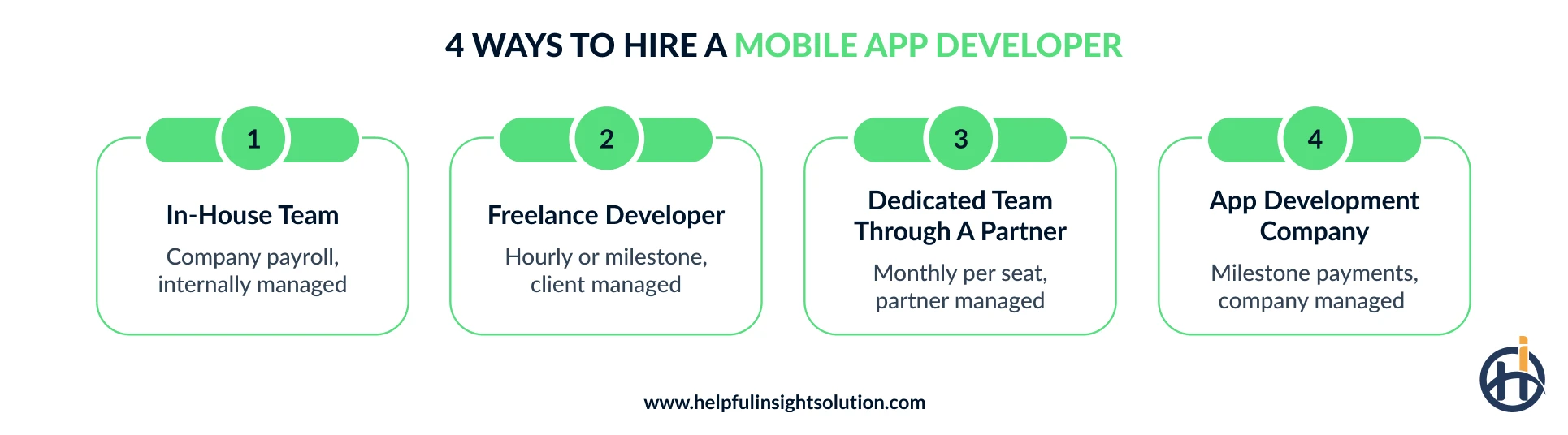
There are four common ways of bringing app developers onto a project. Every option has a different payment structure, and the person managing the work on a daily basis also changes with it.
Hiring In-House App Developers
An in-house team is hired by the company and added to its own payroll. Along with the monthly salary, the company also pays for the benefits, equipment, and the recruitment process itself. The delivery is managed internally by a manager who is already working there.
It is a good option for businesses that have a long product roadmap, where releases are required month after month. However, the recruitment part of it takes considerable time.
Interviews, notice periods, and onboarding are completed before the actual development work begins. Also, once the app goes live, the same team continues on the payroll, irrespective of the workload available at that time.
Hiring a Freelance App Developer
For a single feature or a small fix, hiring a freelance app developer is a simpler route. The payment is made on an hourly basis, or against the milestones that are agreed upon at the start of the work.
The client manages the developer directly, as there is no project manager involved in between. A freelancer works with more than one client at a time, so their availability has to be confirmed before the contract is signed.
Code ownership is settled in the contract before the work begins. Employment does not cover a freelancer, so the transfer of rights is written explicitly.
Hiring Dedicated Mobile App Developers Through a Partner
A dedicated team consists of developers who are provided by an external mobile app development company working exclusively on the client’s project. The billing is typically done per developer, on a monthly basis.
The hiring process, replacements when a team member leaves, equipment, and payroll are all handled by the partner, while control over what the team works on every day remains with the client.
The day-to-day execution is the responsibility of the partner’s manager. Team size can be increased or reduced as the work changes, and the notice period required for that is mentioned in the contract itself.
This model is particularly suitable for projects where the scope is still evolving, as the team size and priorities can be adjusted without requiring a new agreement each time.
Hiring an App Development Company on a Fixed Scope
In this model, the scope is agreed upon before the work begins. The features, platforms, deliverables, and the timeline are documented in a signed agreement.
The payment follows the milestones that are set out in it, and the delivery becomes the responsibility of the company, which also means that the risk of the build running longer stays with them.
Anything falling outside that list goes through a change request, which is priced separately. When a business decides to hire an app development company on a fixed scope, the price is known upfront.
The Four Models Side by Side
| Model | Who manages delivery | How it is paid | Where it fits |
| In-house team | The company’s own manager | Monthly salary plus benefits | A long roadmap with regular releases |
| Freelancer | The client, directly | Hourly or against milestones | One feature, a fix, or a design task |
| Dedicated team through a partner | The partner’s manager, on the client’s priorities | Per seat, per month | A build where the scope is still moving |
| App development company, fixed scope | The company | Milestone payments against a signed scope | A settled feature list with a fixed date |
Where to find mobile app developers
Where to find mobile app developers decides how much can be verified about them beforehand. Each of the sources below leaves something unchecked.
B2B Tech Directories
B2B tech directories are one place to find mobile app developers, with client reviews attached to each listing. Some of the most well-known directories are Clutch, GoodFirms, and DesignRush.
A listing confirms that the company exists, and some directories conduct a phone interview with the client before the review is published.
The vendor answers which developers worked on that project and whether those same people are available for the new work, which needs to be confirmed before hiring a software developer.
Freelance Marketplaces
On a freelance marketplace, the hourly rate is displayed on the profile itself. The payment is held by the platform until the milestone is approved, and a dispute process is available if the work is not delivered.
Upwork, Freelancer.com, and Fiverr are open markets, with Toptal having a screening process before a developer is listed on the platform for hiring.
The scope here stays limited to what one person is able to handle, with a platform fee added on top of the rate.
Open-Source and Code Repositories
A public code profile shows what somebody has been committing to, and when. The languages and frameworks in that history indicate whether the claimed Swift, Kotlin, or Flutter experience is current.
Client work stays private, though, so a thin profile does not mean the developer is inactive.
Referrals and Developer Events
A referral can be requested from a business that has already built something comparable, and the question to put to them is what went wrong during the project, as the positives are already covered in the review.
Developer meetups and conferences are another place where these introductions happen.
Steps to Hire a Mobile App Developer
The steps below explain how to hire an app developer, from a scope document to a signed contract.
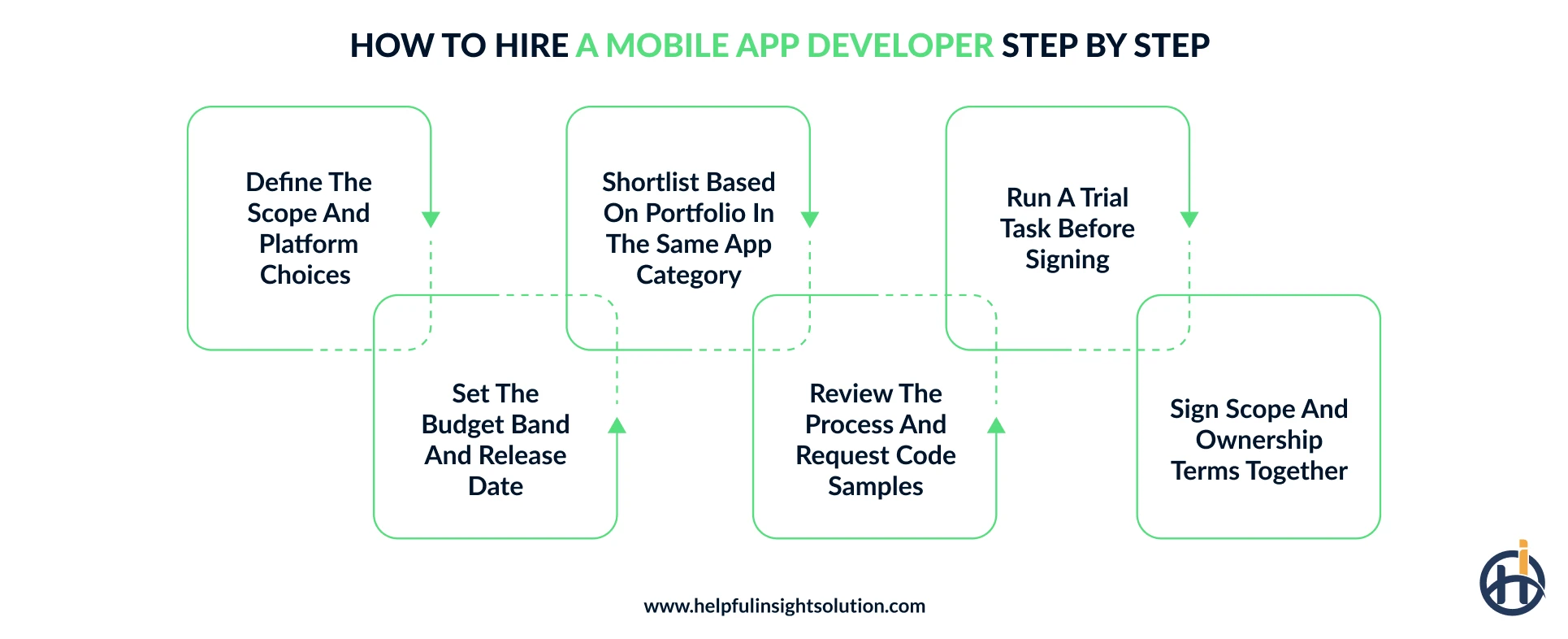
Define the Scope and the Platforms
The first step before connecting with a vendor is having a document for features and platform choices for the application.
An Android app development project has to deal with separate technologies from iOS app development or cross-platform development.
A defined scope brings in quotes from different vendors on the same basis, so comparisons can be made to make the right choice.
Set the Budget Band and the Release Date
The budget can be kept as a range along with the timeline for the project. A vendor who can meet both of these requirements can be shortlisted and reviewed further instead of a general estimate.
Shortlist Based On Portfolio in the Same App Category
Portfolio is the best way to know the technical capability of mobile app development firms. Go through the apps that are live in the same category as the planned app.
A company that has successfully delivered a similar app can deliver the next one with minimal to no supervision needed at each step.
Review the Process and the Code Samples
The questions here are about how the work is divided into stages, how long each stage is expected to run, and who is responsible for reviewing the code before it gets merged.
A code sample from a past project, or access to a repository, is requested during the same discussion. Screenshots of an app only show the design that was produced.
The engineering behind it is visible in the code, so it is best practice to review it before selecting a developer.
Run a Trial Task
The next step to hire mobile application developers is to give a trial task before a full contract is signed. The result shows the quality of the code, how proficiently the developer handles the instructions during the work, and whether the estimate given at the beginning was met or not.
Sign the Scope and the Ownership Terms Together
The scope document and the ownership terms should be signed together at the same time. Ownership of the code, design files, and the store accounts at the end of the project is settled in that same agreement.
A discussion around scope and ownership at this stage puts everything in writing before the development work starts.
Technical skills to check before hiring iOS and android app developers
When a business decides to hire iOS and Android app developers, it is choosing two separate skill sets. A developer who works on one platform might not be able to work on the other.
Technical skills checked before hiring app development partners bring specialization and assurance that the work will be delivered following best practices specific to the project.
iOS Technologies to Check Before Hiring an iPhone App Developer?
- Swift: Apple’s programming language for iPhone app development.
- SwiftUI and UIKit: SwiftUI is the way of building the screens on an iPhone app. UIKit is the older way, and plenty of live apps are still running on UIKit.
- Xcode: Apple’s development software. An iOS app cannot be built or submitted to the App Store without Xcode.
- App Store review guidelines: The rules an app is checked against by Apple before it goes live. A developer who has read the guidelines builds the app around the guidelines from the start.
- App Tracking Transparency: The permission prompt Apple requires before an app tracks a user across apps and websites belonging to other companies. Any app running advertising measurement has to handle this prompt.
Android Technologies to Check Before Hiring Android App Developers
- Kotlin: Google’s preferred language for Android app development.
- Jetpack Compose: The newer toolkit for building Android screens. XML layouts came before Jetpack Compose, and both are still in use across apps that are live today.
- Google Play Console: The account through which an Android app is published and managed. The data safety form, the signing key, and the release tracks are handled from the Play Console.
- Device and OS version testing: Android phones are made by many different manufacturers, and the screen sizes are not the same across them. A developer who has shipped Android development work before knows which device models the testing has to cover, and which Android versions still need supporting.
Cross-Platform App Development Technologies
A single codebase is written once and then released on both stores. Two frameworks are used for cross-platform app development.
- Flutter: Google’s framework, written in a language called Dart. The screens are drawn by Flutter itself, which keeps the app looking the same on both platforms.
- React Native: Meta’s framework, written in JavaScript. The screens here use the native components of each platform, so the app looks closer to a native app on each side.
Backend and Testing Skills Both Platforms Need
- REST APIs: The common way an app requests data from a server and receives it back. A large share of mobile apps are built on REST APIs.
- GraphQL: A way of asking a server for data, where the app requests the exact fields it needs in a single call. Fewer calls are made to the server because of that.
- Authentication: Login, tokens, session handling, and password resets. OAuth 2.0 is the standard a developer is expected to have worked with.
- Push notifications: Apple Push Notification service on the iPhone side and Firebase Cloud Messaging on the Android side. Both are set up by the developer during development.
- Cloud hosting and databases: Some of the most common options are AWS, Google Cloud, and Azure.
- Unit testing: Individual pieces of code are checked on their own.
- Functional testing: A feature is checked against what the scope document said the feature should do.
- Integration testing: The app and the server are checked together, because the two are built separately.
- Regression testing: An existing feature is checked again after new code is added, since new code can affect features that were already working.
- User acceptance testing: The client checks the app against the requirements before the release is approved. Nothing goes to the store until this testing is signed off.
- Automated testing tools: XCTest on the Apple side, Espresso on the Android side, and Appium, where one script covers both platforms.
Questions to ask before hiring a mobile app developer
Who will be working on the project, and what are their names?
A mobile app development company with in-house developers will explicitly mention the name and experience of the developer working on the project. The people named at the proposal stage should be the same people who start the work.
What development process do you follow?
A usable answer from a development team names the stages, average duration of each one, and what the deliverables are. Avoid hiring app developers and companies working without named stages.
Can we speak to your past clients?
Ask for references from projects in the same app category as the planned application. Mobile app development firms confident about their delivery will connect the call without hesitation.
Speak to the client about timeline adherence, communication during the project, and the support received after the launch.
What is the team size and structure for this project?
Ask for the number of developers, designers, and testers assigned, along with the person they report to.
Confirm whether these professionals are working on this project alone or across multiple projects at the same time, as a shared resource divides the working hours between clients.
What happens when a developer leaves the team midway through the project?
When working with a partner, ask about the replacement plans, the notice period, and the handover time. A partner sourcing developers from the market will have a longer time period to provide a replacement.
What approach do you follow for UI and UX design?
Ask whether wireframes are shared before development begins, and how many design rounds are included in the quoted price. Hire an app development company following a structured design process with explicit mention of the number of revision rounds included.
Who owns the code once the project is finished?
Ask for the ownership clause to be written into the agreement, as a verbal confirmation on a call cannot be enforced later.
Confirm that the repository, the design files, the build instructions, and the account access are each named in that same document. A partner following standard practice attaches this list to the scope
What is included in the quoted price, and what is billed separately?
Design, testing, project management, and store submission should each be marked as included or extra. Choose a partner that has transparency regarding the pricing with assurance of no hidden fees or charges.
What is the payment schedule tied to?
Milestones with named deliverables are the answer to look for, because a payment tied to a calendar date is paid whether the deliverable arrived or not.
Do you allow changes to the scope once development starts?
Changes are handled through a change request. The rate for scope changes and approval turnaround should be mentioned in the contract to ensure scope changes are handled in a predictable way.
What post-launch services are offered once the app is live?
Annual iOS and Android releases, store policy changes, bug fixing, and third-party updates are a few of the post-launch services offered by development companies. The signed contract should include information regarding the services and duration covered post-launch.
How much does it cost to hire a mobile app developer
The cost to hire a mobile app developer is one of the key factors that influences the overall app development cost. It is calculated based on the following factors:
- Experience: The platform-specific experience a developer has is one of the biggest factors.
- Role: A tech lead, a backend developer, and a designer are each billed at their own rate, and an app build needs several of these roles at the same time.
- The country the developer works from: The same role carries a different rate in India than in Australia, the USA, and the UK.
Hourly Rates by Experience Level – h3
| Experience level | Hourly rate |
| Beginner | $15 to $25 |
| Intermediate | $25 to $60 |
| Advanced | $60 to $120 and above |
Source: Upwork
Hourly Rates by Platform
Rates are published separately for each platform on the same marketplace.
| Developer | Median hourly rate | Typical range |
| iOS developer | $25 | $16 to $35 |
| Android developer | $25 | $15 to $35 |
| App developer, across platforms | $27 | $18 to $39 |
Hourly Rates by Region
Rates move with the salaries and the operating costs of the region the development team works from.
| Region | Junior developer | Senior developer |
| Asia | $15 to $30 | $30 to $50 |
| Europe | $25 to $40 | $50 to $80 |
| Latin America | $20 to $35 | $60 to $90 |
How ai-assisted coding changes what an app development partner delivers
AI-assisted coding, or vibe coding, is becoming common across all app development projects. The 2025 Stack Overflow survey found that 84% of developers are using AI tools or planning to use them.
AI can help write code for an application but can make it vulnerable to security threats.
Veracode tested more than 100 models, and 45% of the code returned had a vulnerability from the OWASP Top 10, the reference list of common web security flaws.
Between that report and the Spring 2026 update, the models got better at producing code that compiles, with syntax correctness passing 95%, while the security pass rate held near 55%.
When finding an app development company or looking to hire an AI developer, the following best practices should be followed to ensure vibe coding can be avoided in a project.
- Ask a developer to walk through code they wrote. Go through the portfolio and ask the developer about the logic behind the features of any application. A developer who wrote the code using AI will not be able to explain that logic.
- Ask for a security scan report from a recent project to ensure they are writing the code following best practices.
- Put an AI clause in the contract covering three things. Generated code is reviewed by a named developer, ownership transfers regardless of how the code was produced, and client code stays out of public tools.
Red flags to check before hiring mobile app development firms
Not all mobile app development companies work with the same level of transparency and technical rigor.
Identifying the potential red flags early in the evaluation process can help to prevent project delays, budget overruns, and unexpected communication breakdowns.
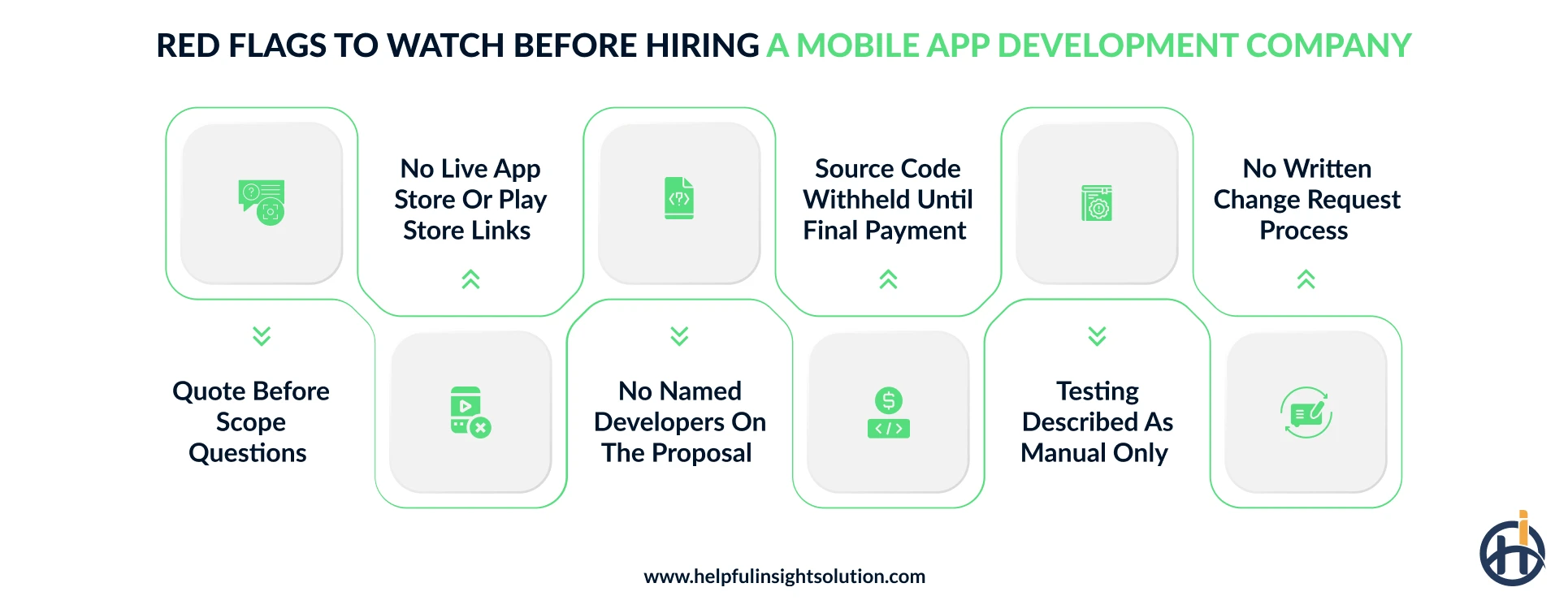
- A quote that arrives before any scope questions: Numbers put in front of a client who has not been asked what the app needs to do are working from assumptions. The parts assumed wrong turn into billable changes once development is underway.
- A portfolio with no live store links: Design mockups appear in every portfolio because mockups are easy to produce. An App Store or Play listing carries the publisher name on it, along with when the app was last updated.
- No named team on the project: Proposals written around a team of experts give the reader nobody to look up. With names on the document, a quiet swap of developers becomes something the client notices.
- Source access held back until final payment: Handing over the repository at the end removes any chance of looking at the work while it is being written. A project abandoned in the middle leaves the client holding nothing another developer could pick up.
- Testing described only as manual checking: QA team clicking through the screens will find the problems that occur to them. Automated tests get run again on the next release, which is how an older feature survives new code landing on top of it.
- No written change request process: Pricing gets discussed at the moment the client wants something added, which is not a moment of much bargaining power. Putting the rate into the original agreement moves that conversation forward by several months.
Hire Mobile App Developers from Helpful Insight
From developers on an hourly rate to a dedicated team to an outsourced development partner, Helpful Insight has been working with businesses of all sizes, enabling them to reach mobile screens. Four things stay the same across all three.
- Native and cross-platform delivery under one team: We have a team of in-house developers with specialization in Android, iOS, and cross-platform app development.
- Source access and store accounts are handed over at delivery. Repository, design files, build documentation, and developer accounts. Everything transfers to the client when the project closes, with no part of it withheld pending payment.
- Support that continues after the first release. Apple ships a major iOS version yearly. Google does the same on Android. A maintenance agreement covers those updates, plus store policy changes, once the app is live
Frequently Asked Questions
The answer depends on the size of the work. An individual developer fits a single feature, a fix, or a design task, with the client managing the work directly. A mobile app development company covers the iOS side, Android side, backend, design, and testing under one agreement. A company carries replacement coverage when somebody leaves, which an individual developer cannot.
React Native and Flutter specialists cost $24 to $45 an hour, against a median of $27 for app developers across platforms. A cross-platform build uses one codebase for both stores, which brings the development hours down.
The route decides the timeline. A freelancer found on a marketplace can start within days. Hiring app developers and companies takes longer because the proposal stage, the reference calls, the trial task, and the contract each add time. An in-house hire carries interviews and notice periods before any development work begins.
Yes, in two ways. A team with Swift and Kotlin skills builds two native apps from the same project, one for each store. A team using Flutter or React Native writes one codebase that runs on both, though new platform features reach the native tools first.
The scope document and the ownership terms are signed together. Ownership covers the code, the design files, and the developer accounts on both stores. The payment schedule ties to named deliverables rather than to calendar dates. A change request rate and an approval turnaround belong in the same document, along with the list of what arrives at handover.