

Key Takeaways:
- Businesses will learn an end-to-end development workflow, from industry planning to market release and app maintenance.
- An online medication app provides prescription upload, real-time order tracking, and secure payment features with HIPAA compliance.
- It is a must to use a tech stack that delivers scalable frameworks, cloud infrastructure, databases, and APIs to support high performance and business growth.
- The average cost of developing ePharmacy platforms ranges from $20,000 to $300,000+ due to app complexity, platform choice, and security requirements.
Have you ever encountered patients complaining about long waiting lines at medical stores or getting wrong prescriptions due to mismanagement?
This could be the reason for limited patient engagement, revenue loss, and a lack of trust among existing users. Several businesses in the USA have invested in medicine delivery app development services and experienced positive changes, such as on-time drug deliveries, increased reorders, and instant refills. Additionally, they have successfully reduced churn across pharmacies and enhanced inventory management efficiency.
According to Precedence Research, the USA’s ePharmacy app market size will reach $46.4 billion in 2027 at 16% CAGR due to increased adoption. The sale of over-the-counter products reached an all-time maximum of 61% in the last year. This indicates that the industry has a lot of growth potential while creating multiple opportunities for modern startups.
Before entering this market, a business investor must know various aspects like the development process, key features, cost, and challenges. In this blog, we will explore all the major topics along with sub-points with detailed information.
What is a medicine delivery app?
A medicine delivery mobile app allows patients to order prescribed drugs, over-the-counter items, and health products online, getting doorstep delivery.
People can easily upload prescriptions, find generic alternatives, and book other healthcare services, like lab tests and doctor consultations. Businesses invest in pharmacy delivery app development to target various user pain points and get increased ROI through constant engagement.
-
Current market insights
Let’s understand the market of medicine delivery platforms in this section with key stats, figures, and growth parameters.
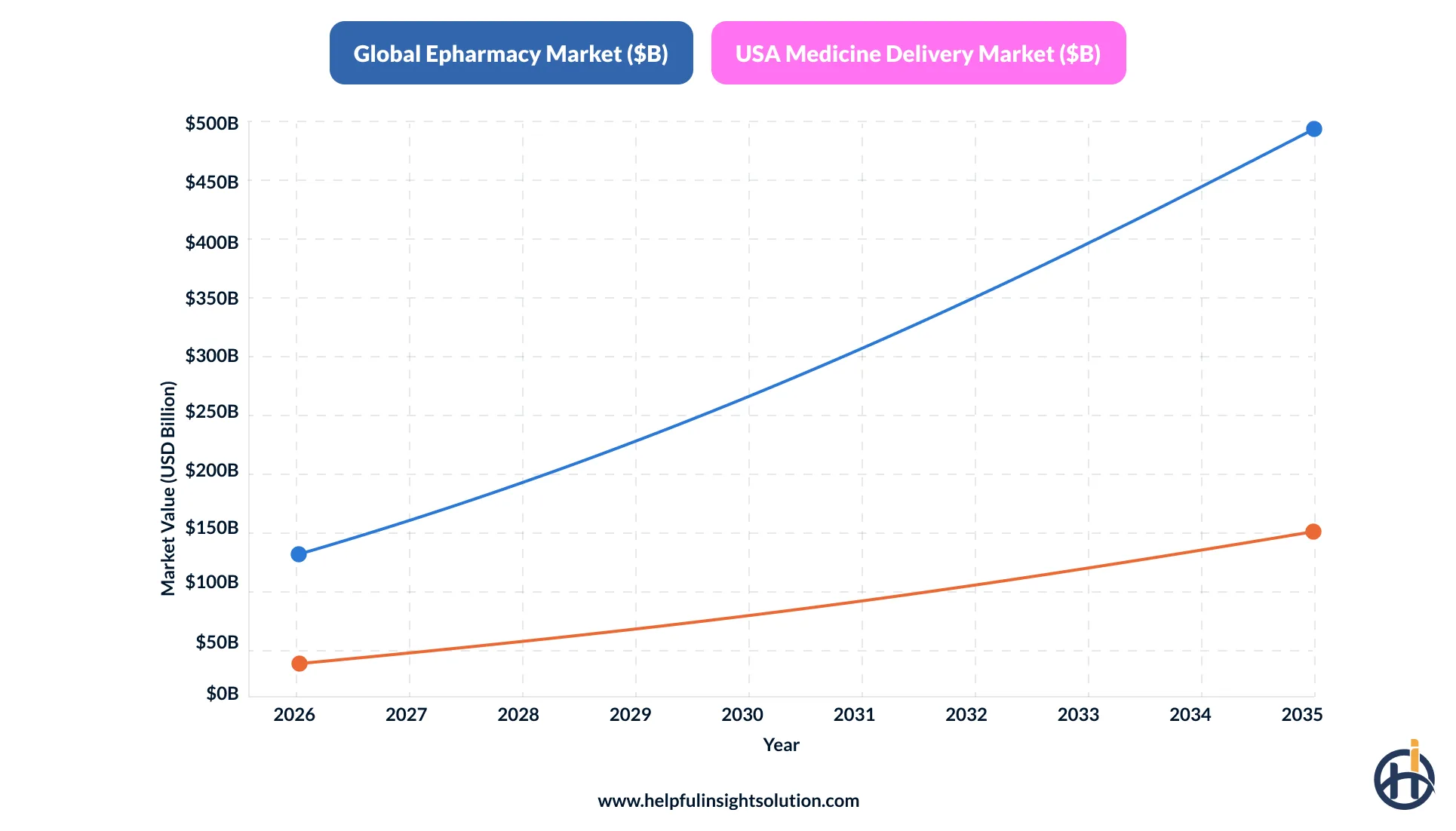
- The market value of ePharmacy apps is $133.3 billion in 2026, with North America having a share of 42% in this industry.
- The overall revenue of these platforms will reach $490.3 billion by 2035, as the market is growing at a 15.7% CAGR rate.
- The USA’s medicine delivery app market has a value of $39.5 billion in 2026, which will reach $147.7 billion in 2035.
- In 2026, prescription medicine has a share of 76.3% in the product segment, and generic drugs have a share of 65.5% in the drug segment.
Types of medicine delivery apps
Businesses use various types of pharmacy delivery applications according to their budget needs and market requirements.
- Pharmacy-owned apps: A business investor creates this solution, which can easily manage both the inventory and the delivery from their pharmacies.
- Aggregator apps: These apps connect local users with multiple pharmacies, allowing them to compare prices and also order medication from any preferred and accessible store.
- On-demand delivery apps: This type of enterprise app gets prescriptions from any pharmacy location and handles delivery logistics to the patients’ doorsteps.
How does it work?
An entrepreneur must know how digital pharmacy applications generally work before investing in the development process.
- Order placement: Users order medicines through the app either by searching them or by uploading the prescription via the app.
- Prescription verification: An order can be processed after verification of the prescription by an in-house licensed pharmacist.
- Order processing: The medicine is confirmed with the pharmacy and processed, packed as per the order, and ready to ship.
- Delivery assignment & tracking: A delivery partner is assigned for the order, and customers can trace the live location of the package till it reaches the door.
- Payment & delivery confirmation: Complete the online payment or avail COD on delivery for the order and get the delivered medicines with a feedback option.
Why must businesses invest in medicine delivery app development?
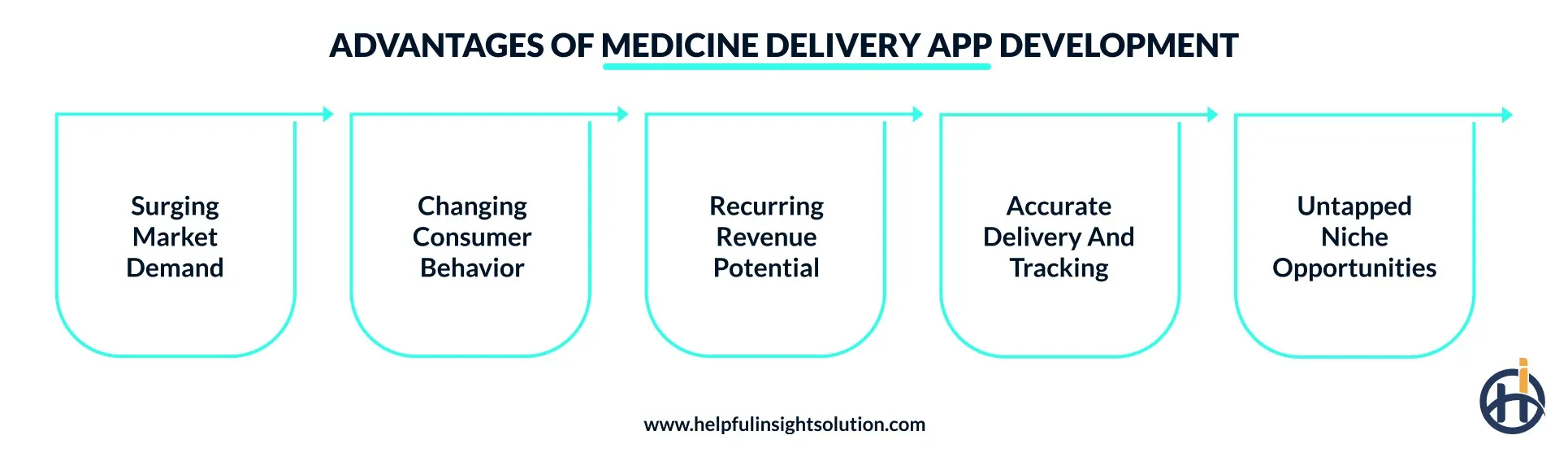
Most investors aren’t aware of the benefits they get by developing a medicine delivery mobile app. Here we focus on the best market advantages, such as revenue growth, user engagement, and delivery tracking.
1. Surging market demand
The online pharmacy market is expanding rapidly, with the global market projected to grow strongly due to increasingly common chronic conditions, aging populations, and digital health adoption. Companies investing now can take early share before fierce competition.
2. Changing consumer behavior
Today, consumers have become so used to ordering foods and groceries online that they now comfortably order medicines too. This trend of convenience-led healthcare is the major reason for the rise of medicine delivery apps.
3. Recurring revenue potential
Reliable repeat buying of both generic and limited drugs helps to balance the online medicine delivery app development cost. Various subscription schemes, auto-shipping, and loyalty schemes enable sellers to develop predictable, regular income streams rather than one-off sales.
4. Accurate delivery and tracking
Real-time GPS tracking and automated updates on delivery status foster transparency and build trust from customers. For medicine that is important to take at specific times, accurate delivery tracking minimizes delays and complaints while boosting the platform’s reputation.
5. Untapped niche opportunities
Outside metro cities, rural and semi-urban areas are still to be served by pharmacy delivery services. If you focus on these areas, the ones that fill such gaps, or on niches such as geriatrics or management of chronic diseases, you can tap into a great unseen demand.
Key steps to build medicine delivery applications
To make highly advanced online pharmacy applications, you must understand various development stages. From market planning to maintenance, we are going to cover every step in this detailed section.
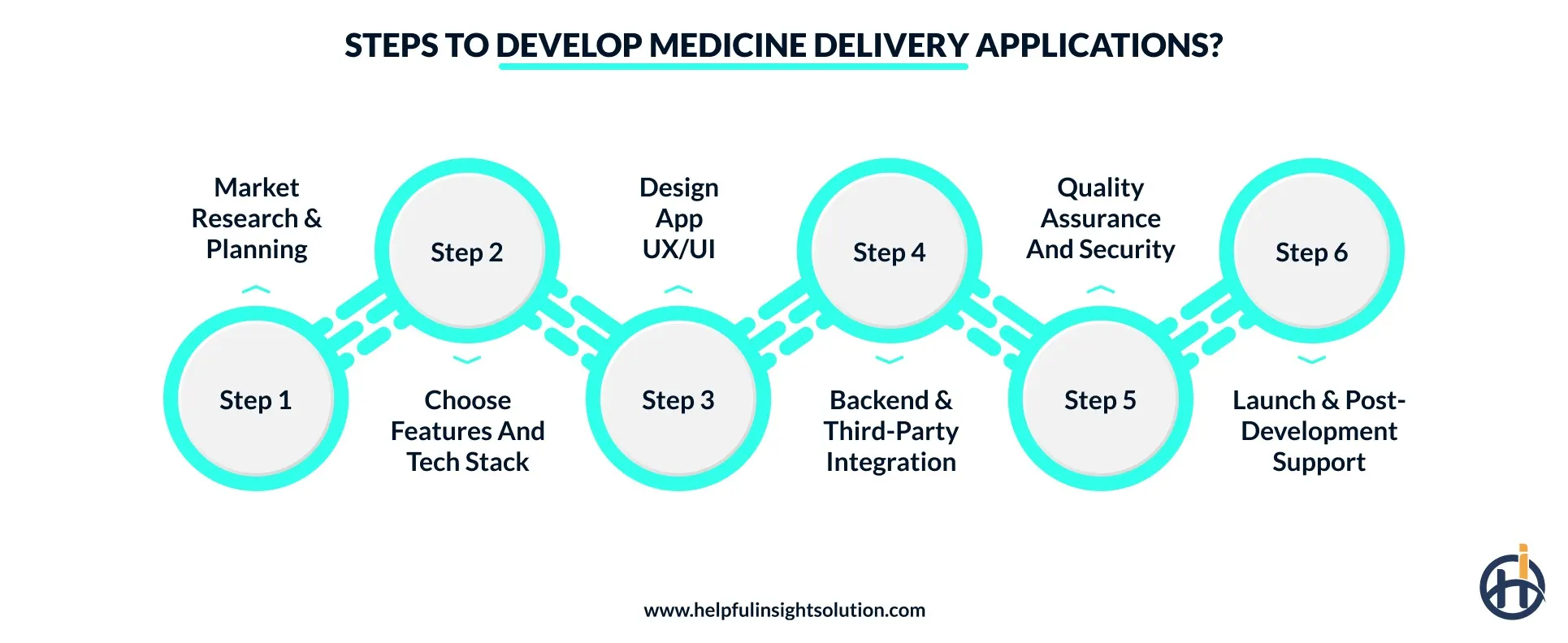
1. Market research & planning
First, do thorough market research of your target audience, competitors, and the local pharmacy legislation for any gaps that exist. Next, determine your business model, which can be a marketplace, an in-house pharmacy delivery service, or an aggregator. Defining the roadmap here will help save costly adjustments during development.
2. Choose features and tech stack
You should determine a set of must-have features such as prescription tracking, real-time payment systems, and an AI-driven recommendation engine. A medicine delivery app development company helps to identify a scalable tech stack that includes mobile technologies and cloud infrastructure. This step will greatly affect the app-making cost, timeframe, and overall maintenance.
3. Design app UX/UI
Design is the most important part for users, as most of them will be ordering to resolve various healthcare conditions. Design simple wireframes and mockups with usability and user flows because the user may not want to search and browse endlessly for medications. Ensure user-centric navigation with seamless and easy prescription uploads to simplify the process.
4. Backend & third-party integration
It is necessary to build a responsive backend that can easily manage inventory, order fulfillment, and sensitive user data at a large scale. You should integrate third-party healthcare app development services like payment gateways, SMS notification service providers, and delivery service tools. Proper API integration is important to establish a link between the user app, pharmacy app, and delivery partner app.
5. Quality assurance and security
Functional, performance, and load testing help businesses to eliminate any issues before going live, enhancing prescription flows and payment gateways. Focus on securing data with encryption, secure authentication mechanisms, and checks like HIPAA and GDPR adherence. Various security testing methods are fundamental and must be performed regularly to fix loopholes.
6. Launch & Post-development support
By following strict compliance standards, you can easily launch the app on public stores. You can start pilot programs to keep an eye on user feedback, crash reports, and performance issues during the initial software lifecycle. Continuous maintenance, new feature releases, and technical support are needed to ensure longevity and user retention.
Top examples of medicine delivery software in the USA
People use various prescription management apps in the USA and across the globe to buy medicines online. Here you will observe the top 5 drug delivery platforms that are most common and popular.
1. Amazon Pharmacy
Amazon Pharmacy deliver s prescriptions straight to the customer’s door, creating the most efficient prescription-sharing option for Prime users with common prescriptions and RxPass subscribers. It merges Amazon’s shipping capabilities with prescription fulfillment, establishing quick and timely distribution.
Downloads: 500M+
Ratings: 4.2
2. CVS Pharmacy
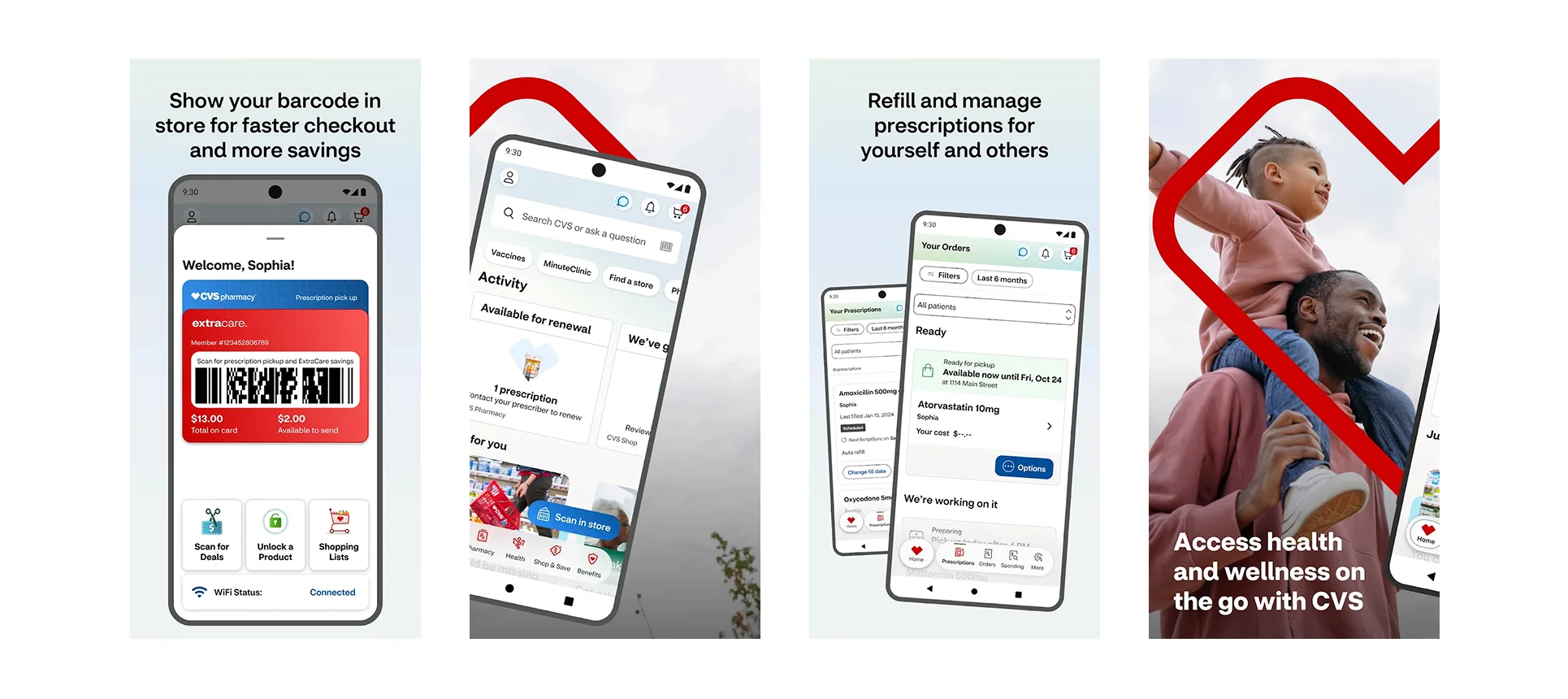
This pharmacy app is the number one retail drugstore mobile application in the USA. It includes refill services, a prescription tracker, a pharmacy deals system, photo services, and in-store refill pickups to fuse omnichannel convenience and prescription services with millions of established customers.
Downloads: 10M+
Ratings: 4.0
3. Capsule
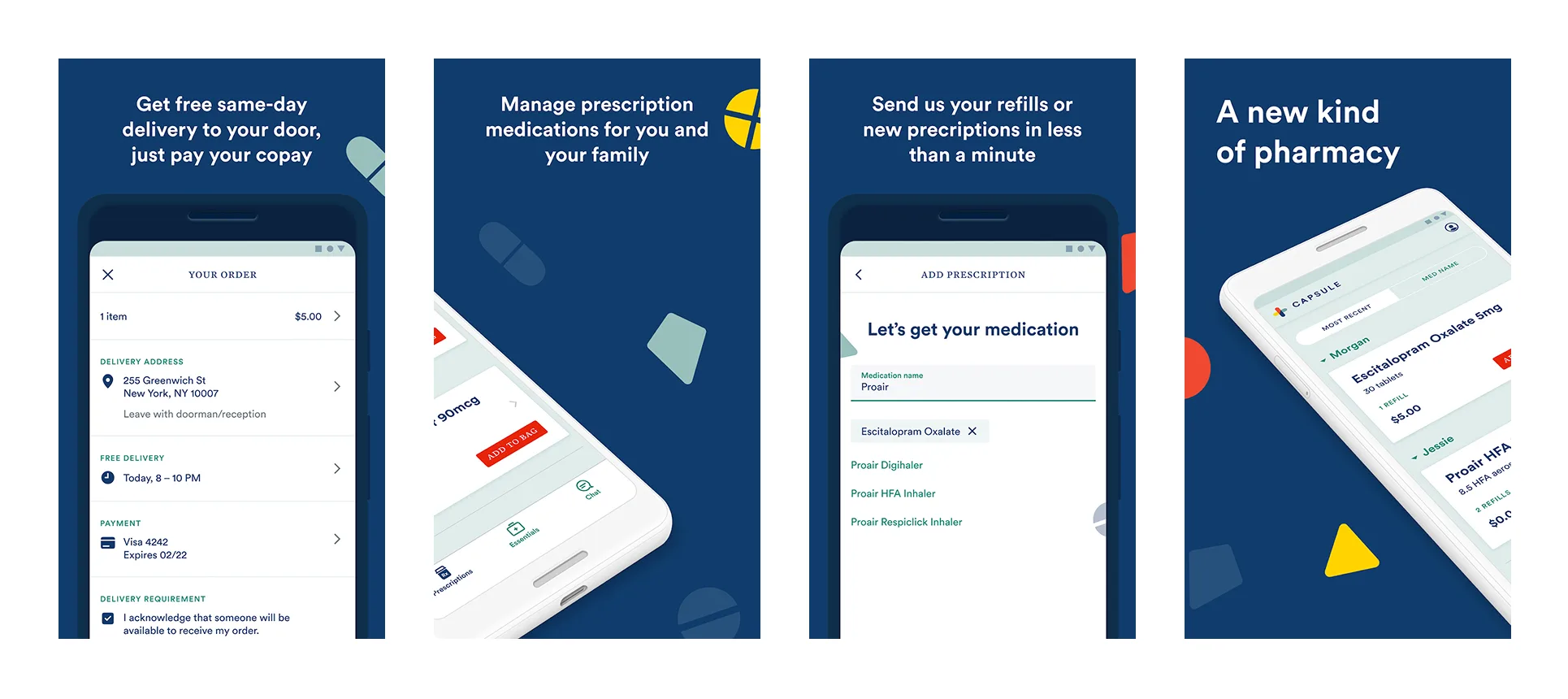
Capsule not only prescribes medicine but is also capable of diagnosing physical conditions and providing telehealth services. It also offers online pharmacy delivery services, which prioritize same-day prescriptions and in-app availability from the pharmacist for urban users.
Downloads: 50K+
Ratings: 4.0
4. Walgreens
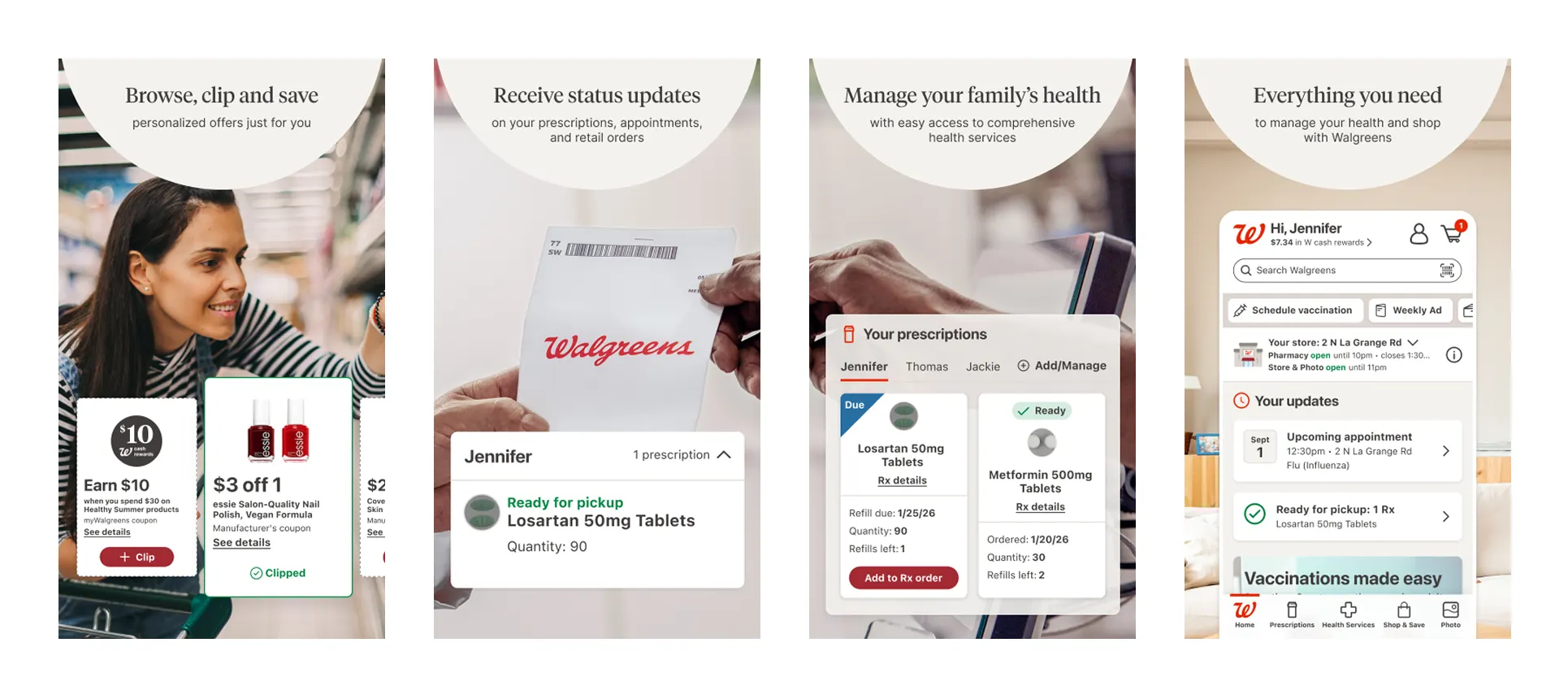
Walgreens is another dominant retail store that offers refills, myWalgreens rewards, photo developing services, same-day delivery for prescriptions, and clinic scheduling. It provides a fulfillment system that leverages its expansive, country-wide network of drug stores and in-store healthcare resources.
Downloads: 10M+
Ratings: 4.7
5. GoodRx
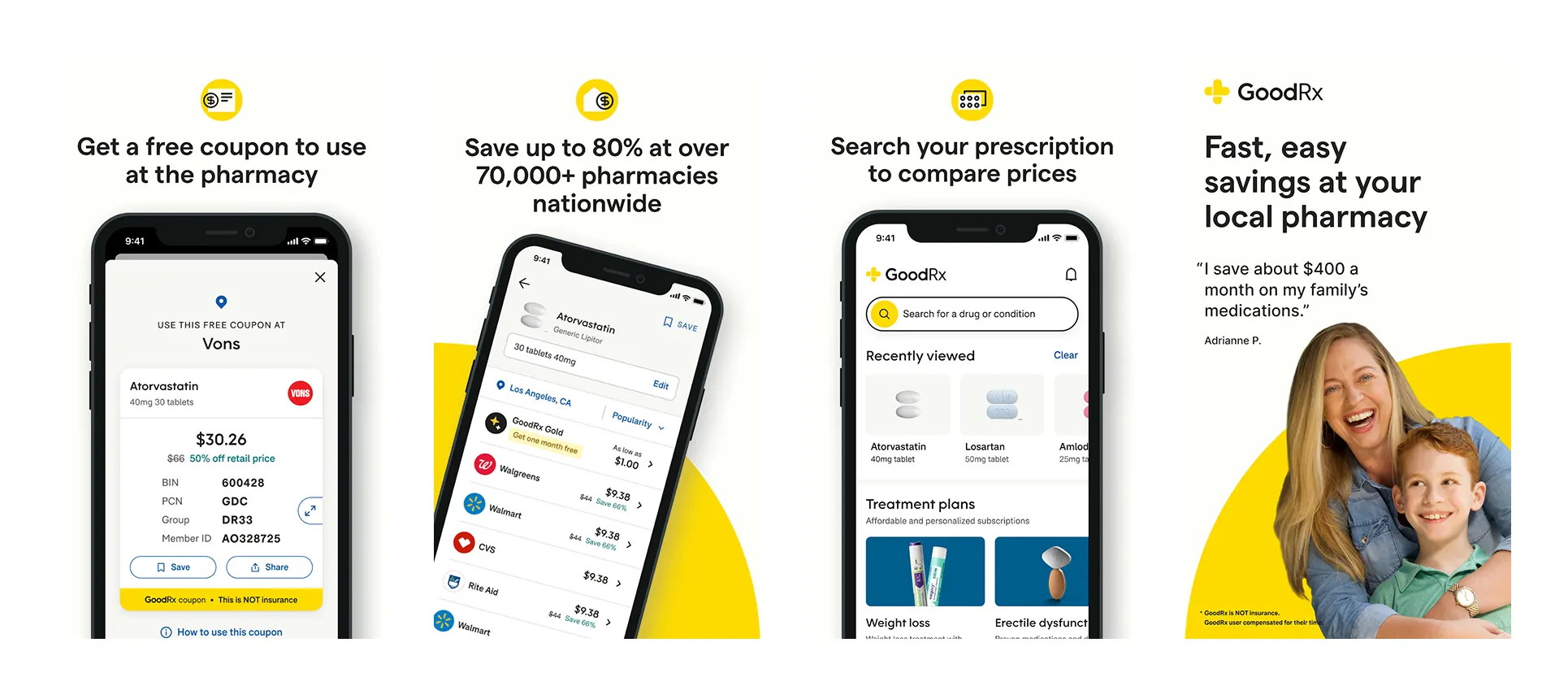
An app like GoodRx offers discount services that will compare cash prices across the entire network for any given prescription. Their discount card platform is free, can be used in mere seconds, and can greatly reduce one’s overall out-of-pocket medication expenses at the point of sale.
Downloads: 10M+
Ratings: 4.0
Understanding essential features of medicine delivery platforms
Medicine delivery app features are divided into different panels that target patients, pharmacies, and admins. We will study them in this section with some advanced features, which include AI capabilities.
1. Patient panel
These features allow patients to easily search for medicines, track their orders, and make payments instantly. The table below describes the key patient-panel features that are commonly integrated.
| Feature | Description |
| User registration & secure login | Allows patients to create accounts securely using email, phone number, or social login. |
| Prescription upload | Enables users to upload digital prescriptions for pharmacist verification before ordering medicines. |
| Medicine search & ordering | Lets patients search medicines by name, category, or brand and place orders quickly. |
| Real-time order tracking | Provides live updates on order status from processing to doorstep delivery. |
| Secure payments | Supports multiple payment methods, including credit/debit cards, UPI, digital wallets, and cash on delivery. |
2. Pharmacy panel
A pharmacy can manage inventories, assign delivery partners, and apply discounts on various medicines. Here are some of the major pharmacy panel features discussed with detailed descriptions.
| Feature | Description |
| Prescription verification | Allows pharmacists to review and approve uploaded prescriptions before dispensing medicines. |
| Inventory management | Tracks medicine stock levels and updates product availability in real time. |
| Order management | Enables pharmacies to accept, process, pack, and manage customer orders efficiently. |
| Pricing & discount management | Allows pharmacies to update medicine prices, offers, and promotional discounts. |
| Delivery coordination | Helps assign delivery partners and monitor shipment status until successful delivery. |
3. Admin panel
The following features help admins to manage traffic levels, analyze sales reports, and resolve patient queries. They are explained in this section to enable medical professionals to handle patients and vendors.
| Feature | Description |
| User & pharmacy management | Manages customer accounts, pharmacy registrations, and access permissions from a central dashboard. |
| Order monitoring | Tracks all medicine orders, payment status, cancellations, and delivery performance in real time. |
| Analytics & reporting | Provides insights into sales, customer behavior, revenue, and pharmacy performance through dashboards. |
| Commission & payment management | Manages platform commissions, pharmacy payouts, refunds, and financial transactions securely. |
| Security & compliance controls | Monitors platform security, manages user roles, and ensures compliance with healthcare regulations and data privacy standards. |
4. AI-enabled features
We are discussing some AI-driven healthcare app features that deliver personalized medicines and recommend doctors. They examine patient history and EHR to provide specific services in real-time.
- Smart refill reminders: AI tracks prescriptions and automates orders after a particular duration whenever dosage reaches a minimum value.
- AI chatbot: A virtual assistant helps patients to study their diseases, fix reorders, and apply for refunds or cancellations.
- Demand forecasting: AI helps pharmacies to examine medicine demands based on medical conditions and prevent delivery delays.
- AI symptom checker: This feature gathers various healthcare information from patients to provide symptoms of a disease, suggest doctors, and track progress.
Tech stack required for the development of ePharmacy apps
It is difficult for a business investor to choose a tech stack on their own because it requires specific domain knowledge and expertise. In this case, an online pharmacy app development company helps them to identify which tools and technologies will provide resources for developing delivery tracking, prescription management, and more advanced features. A tech stack includes multiple components that we will study in this section with their respective tools.
1. Frontend: It develops a mobile-first patient interface that is user-friendly, fast-access, and easy to navigate for patients, pharmacists, and delivery drivers.
Major tools: Flutter, React Native, Swift (iOS), and Kotlin (Android)
2. Backend: It can manage the order handling system, user logins and verification, order processing flow, APIs, and user requests between various app sections.
Major tools: Node.js, Django, Spring Boot, ASP.NET Core, and Laravel
3. Database: This offers efficient storage and retrieval of user profiles, prescription details, medicine repositories, transaction records, and all orders.
Major tools: PostgreSQL, MySQL, MongoDB, and Firebase Firestore
4. Cloud & hosting: It provides scalable app hosting and storage to accommodate traffic load and ensure performance with built-in high availability.
Major tools: AWS, Google Cloud Platform (GCP), Microsoft Azure, and Firebase
5. Security tools: They deliver secure access with a robust authentication and authorization system that prevents fraud and ensures the safety of critical patient and medical information.
Major tools: OAuth 2.0, Firebase Authentication, Auth0, JWT, and Okta
6. Third-party APIs: Integrates your custom mobile and web application with e-prescription tools, mapping solutions, payment partners, or messaging services.
Major tools: Stripe, Razorpay, Twilio, Google Maps API, FHIR APIs, and e-Prescription APIs
7. DevOps & analytics tools: They ensure reliable deployment through automated testing and monitoring, real-time analytics and reporting, and provide ongoing updates.
Major tools: Docker, Kubernetes, GitHub Actions, Firebase Analytics, Crashlytics, and Sentry
What is the cost of developing a medicine delivery application?
Entrepreneurs invest money to develop online pharmacy applications according to their budget specifications, market demand, and project needs. They must know that the medicine delivery app development cost is dependent on various factors such as platform complexity, features required, and integration capabilities.
You can easily estimate the average price by considering all these parameters and get an approximate result based on your requirements. In this section, we are observing a table that provides key factors with their respective market costs and expected timelines.
| Development Factor | Estimated Cost (USD) | Estimated Timeline |
| Basic MVP (Core ordering & user app) | $20,000–$40,000 | 2–3 months |
| Customer & pharmacy apps | $40,000–$70,000 | 3–5 months |
| Real-time delivery tracking & notifications | $60,000–$100,000 | 4–6 months |
| Prescription upload & healthcare integrations | $80,000–$140,000 | 5–7 months |
| Multi-vendor marketplace with admin dashboard | $120,000–$180,000 | 6–9 months |
| AI-powered features & enterprise security | $180,000–$250,000 | 8–10 months |
| Enterprise-grade medicine delivery ecosystem | $250,000–$300,000+ | 10–12+ months |
Major development challenges with medicine delivery apps
It is crucial to know different challenges that businesses face during the pharmacy mobile app development. These risk factors can cause system breakdown, reduce the number of patients, and affect logistics operations.
1. Regulatory compliance
It requires strict adherence to regional drug control acts, data privacy laws, and valid pharmacy licensing. A HIPAA-compliant pharmacy app ensures compliance with cross-border policies that demand complex legal frameworks before a feature launch.
Solution: Enterprises should build a digital interface, allowing licensed pharmacists to review and approve the uploaded prescription image.
2. Data security
As platforms handle highly sensitive PHI, digital prescriptions, and financial transactions, data breaches can expose personal identities and banking details. These risks may lead to severe legal penalties and loss of user trust across formats.
Solution: It is beneficial to implement end-to-end encryption methods like data locking and key control with role-based access limits to prevent data leaks.
3. Logistics & real-time tracking
The major issues include synchronizing live GPS data, handling temperature-sensitive supplies, and managing ad hoc routing. Inaccurate maps and weak network coverage in remote areas can cause user anxiety during critical medical deliveries.
Solution: Through smart batching techniques, IoT-enabled monitoring, and automated alert systems, businesses can handle their daily supply chain.
How to monetize a prescription delivery app?
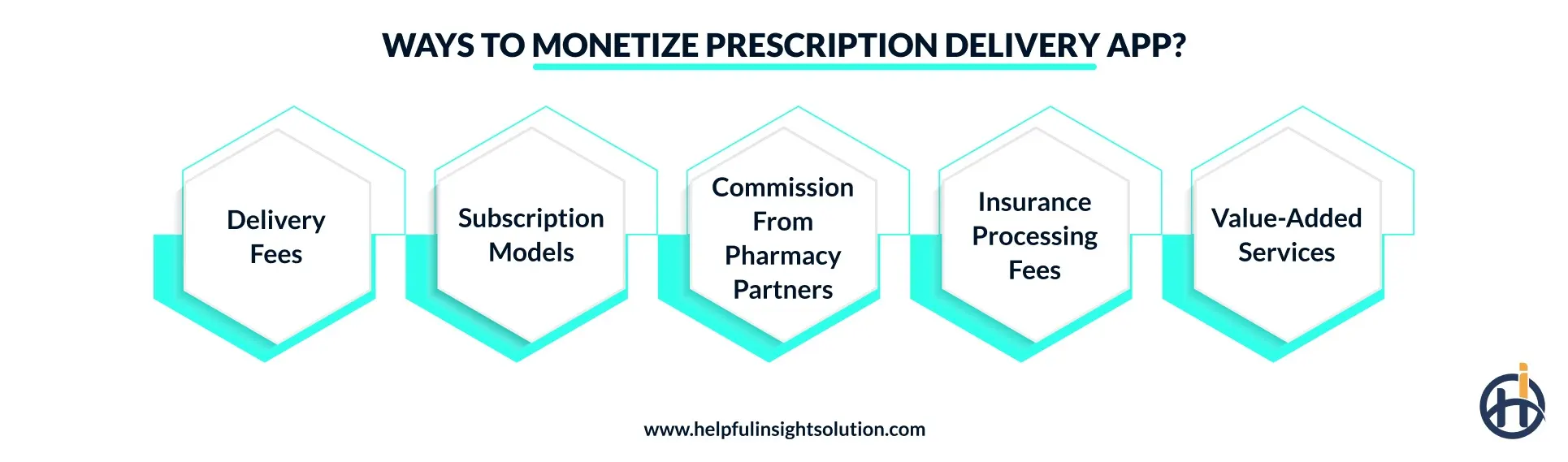
Business investors can easily generate revenue by following various monetization strategies. These include delivery charges, subscription plans, insurance fees, and more, helping them to invest wisely.
1. Delivery fees
You should implement a flat-rate or distance-based per-user charge, with an upcharge for express or same-day delivery service. A simple, direct fee model will ensure recurring income, while users can select based on speed and price.
2. Subscription models
Provide a monthly or annual subscription option for members receiving free deliveries or guaranteed priority discounts for recurring medication needs. This ensures reliable recurring revenue while increasing overall retention for chronic users.
3. Commission from pharmacy partners
Businesses must charge partner pharmacies a commission on every order placed through the app, as a percentage of the order value. The commission is proportional to total order flow, motivating growth and ensuring the success of partners.
4. Insurance processing fees
It is beneficial to charge a per-order fee for managing insurance pre-approvals and submitting to PBMs for coverage verification. This adds value for insured clients and presents an additional stream of revenue for major healthcare providers.
5. Value-added services
Collect revenue from additional in-app services, including telehealth consultation booking, home health monitoring, medication reviews, and diagnostic test scheduling. This not only generates alternative income but also encourages continued user activity.
Why choose Helpful Insight to create a digital medicine delivery platform with smart features?
Finding a suitable partner is important because it ensures complete support, domain expertise, and on-demand app development solutions. Businesses may approach Helpful Insight, as we provide a skillful team that can easily build drug delivery apps for multiple pharmacy chains.
Additionally, our experts specialize in selecting the right tools and technologies, preparing an achievable budget, and optimizing business outcomes. They help enterprises to understand various market trends in the medical and healthcare industry, such as AI route mapping and inventory automation.
We deliver the best medicine delivery app development services, allowing business investors to study competitors and predict futuristic growth models.
This enables consistent brand recognition across different regions worldwide, enhancing overall user engagement. If you want to gain patient trust, then it is the right moment to start your business with advanced medical solutions.
FAQs
Businesses can develop an MVP-based drug delivery application in 2-3 months due to limited features. A multi-panel platform may take 3 to 6 months with real-time delivery tracking and payment services. For an enterprise-grade solution, the timeline may increase to 9-12 months because of advanced security features.
A mobile app for medicine delivery must follow pharmacy licensing, prescription verification, and data privacy regulations. These standard laws include HIPAA and DEA compliance in the USA and GDPR in Europe. Additionally, it is crucial to ensure cold storage compliance for temperature-sensitive medicines.
Artificial intelligence provides smart route planning, fleet allocation, and real-time tracking services. It also ensures demand forecasting, stock optimization, and waste reduction through predictive analytics. AI can streamline last-mile logistics and manage inventory levels for pharmacies.
Most enterprises from across the globe use a hybrid marketplace-inventory model due to low overhead aggregation. This model offers high-margin warehousing for chronic care or private label goods. Leading platforms like GoodRx use this combination to balance high transaction volumes.
Various digital medicine transfer platforms allow patients to easily cancel orders from the app before dispatch. They enable returns for only damaged, expired, or incorrect items after verifying through photos. After reviewing the evidence, the refunds are allocated to eligible patients.