


Key takeaways
- Medical billing software automates claim submission, coding, and payment tracking so healthcare providers get paid accurately and on time.
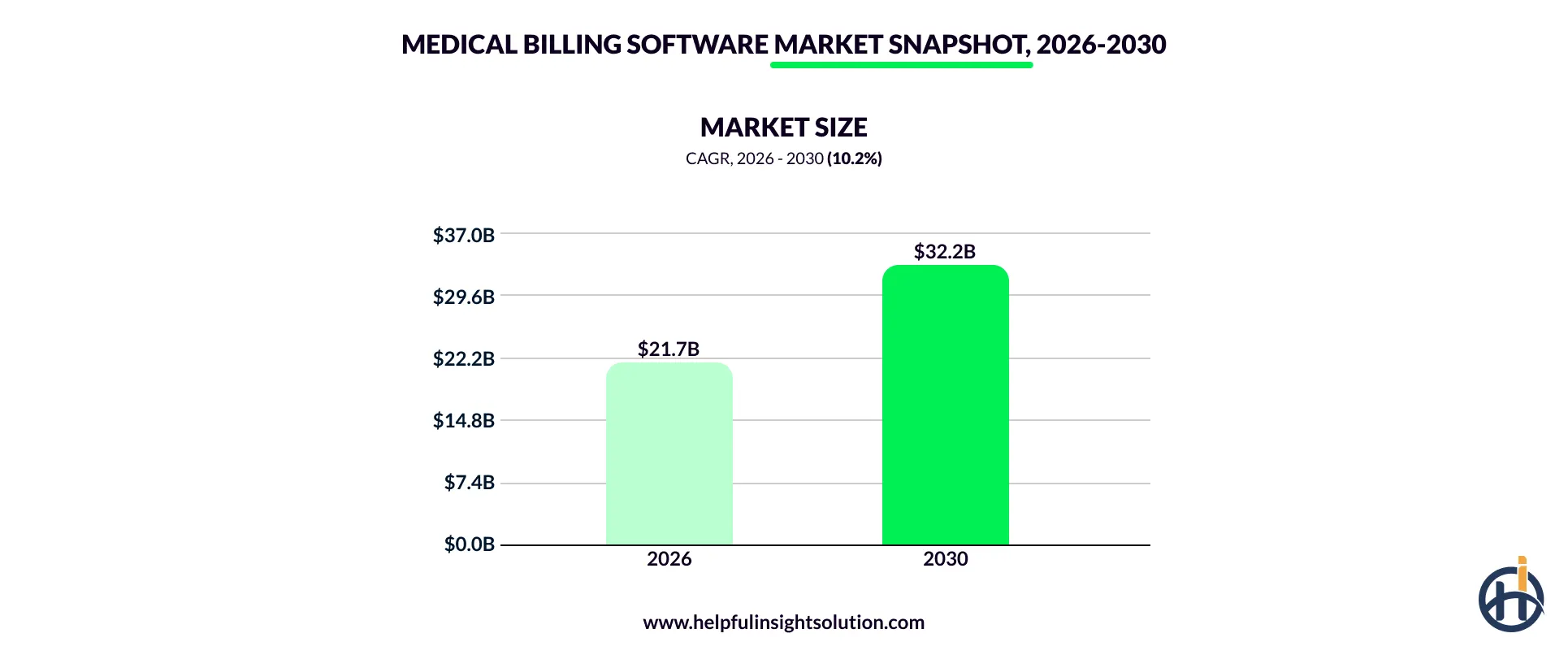
- The global medical billing software market is growing fast too, as it is projected to reach $32.2 billion by the year 2030.
- There are different types of billing software, from open and closed systems to isolated ones, each suited to different practice needs.
- The cost to develop medical billing software ranges from $25,000 for basic systems to $300,000 or more for enterprise platforms, depending on complexity and integrations.
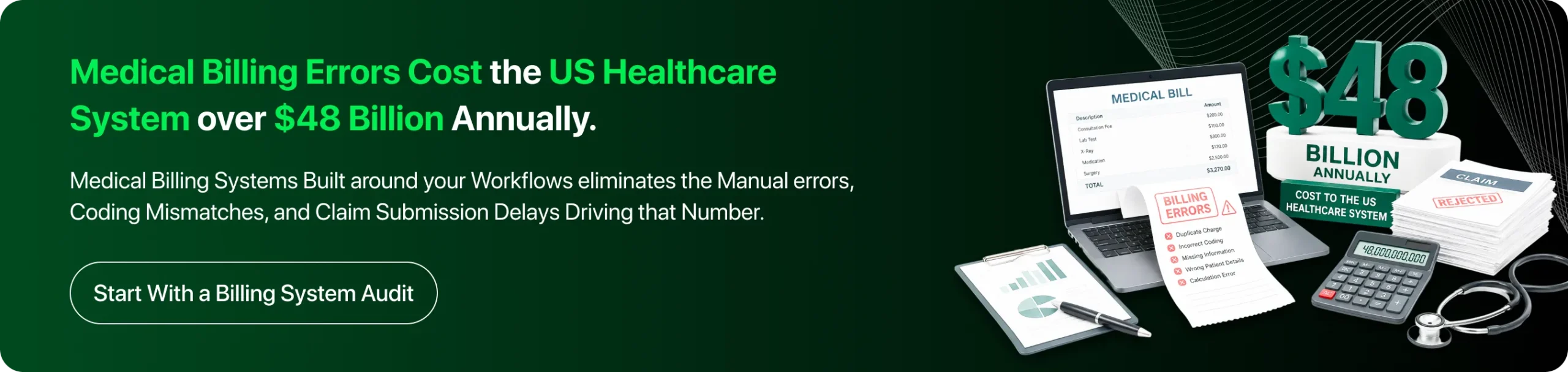
Healthcare organizations lose a meaningful share of their revenue to problems that have nothing to do with the quality of care they provide. A miscoded procedure, a missed eligibility check, and a claim submitted a day too late.
Medical billing software development exists to fix that gap. It’s the practice of building systems that automate the entire billing chain, from claim submission to patient invoicing to payment tracking.
That shift is already visible across healthcare businesses, from independent clinics to larger provider groups. According to a Grand View Research report, the global medical billing software market is expected to reach $32.2 billion by 2030 from $21.7 billion in 2026.
Behind that growth is a fairly ordinary problem which are claim volumes are up, denial rates haven’t improved much, and compliance requirements shift often enough that a lot of older billing tools simply weren’t built to handle it.
For founders and practices in the healthcare space outgrowing their current setup, the real question isn’t whether to invest in better billing software. It’s whether an off-the-shelf platform can handle specialty-specific coding, EHR integrations, and daily revenue cycle demands. In this blog, we’ll explore everything you need to know to develop healthcare billing software.
What is medical billing software?
Medical billing software is a tool that helps healthcare providers automate tasks like insurance eligibility checks, medical coding, claim submission, and payment posting, all in one system. In simple terms, it replaces what used to be a manual, paper-heavy process. Custom billing systems go further, adapting to a practice’s specialty, EHR setup, and existing revenue cycle management workflow.
How does medical billing software work?
Turning a treated patient into a paid claim takes several coordinated steps. This section breaks down exactly how billing systems in healthcare handle that process from start to finish.
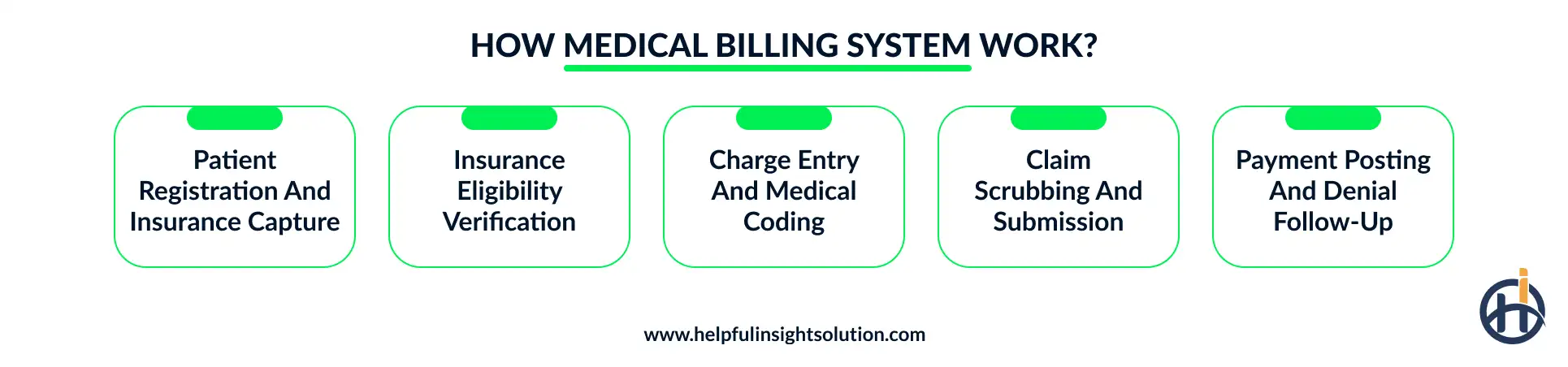
1. Patient registration and insurance capture
The billing software logs patient information and insurance policy details, often syncing with the EHR to avoid duplicate entry. This record becomes the foundation every later claim depends on.
2. Insurance eligibility verification
The software queries the payer’s database to confirm what’s actually covered under a patient’s insurance plan. Running this check upfront means providers aren’t left absorbing the cost of a service insurance never approved.
3. Charge entry and medical coding
Every diagnosis and procedure gets converted into a specific code before a claim can move forward. Most insurance software relies entirely on this step, since even a single wrong code can delay payment.
4. Claim scrubbing and submission
This step checks each claim against payer-specific rules, flagging wrong codes, missing fields, or data mismatches before it ever reaches the insurer. Getting this right is often what separates a claim that pays out in days from one that bounces back entirely.
5. Payment posting and denial follow-up
Once payment arrives, medical billing software matches it against the exact services billed and updates patient records automatically. Denied or partial claims get flagged immediately, so staff can correct and resubmit them without losing track.
Key benefits of custom medical billing software development
Generic software rarely fits every practice the same way. Building a custom system means providers aren’t paying for features they’ll never use, or missing ones their specialty actually needs.
Let’s have a look at the major advantages that healthcare enterprises and startups gain from investing in custom medical insurance billing software.
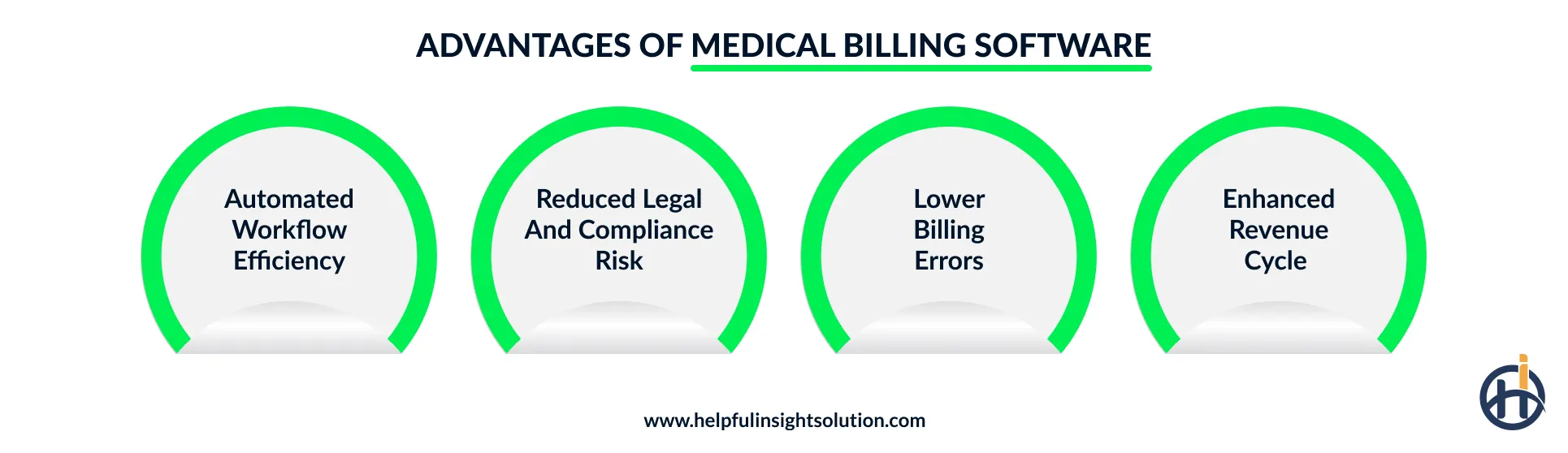
1. Automated workflow efficiency
A lot of billing work is just repetition, as the same data is entered and the follow-ups sent, over and over. Custom software handles that part on its own, and when it’s connected to medical scheduling software, patient and appointment info moves through the system without staff re-typing anything. That alone gives hospitals and clinics hours back every week.
2. Reduced legal and compliance risk
Every healthcare business carries some compliance risk, but manual billing makes it worse since regulations change fast. Billing systems for medical handle this differently by checking each claim against HIPAA compliance standards and audit requirements before submission.
That reduces the odds of a costly violation reaching an insurer or regulator in the first place.
3. Lower billing errors
Manual data entry is where most billing mistakes start, and those mistakes are what get claims denied. An AI-powered billing platform reduces that risk by validating codes and patient data against actual medical records before anything gets sent out. This helps protect revenue.
4. Enhanced revenue cycle
A healthcare business using customized medical billing solutions sees its revenue cycle improve almost immediately. How does that happen? The software monitors every dollar owed, catching delays before they turn into losses. This level of revenue cycle management (RCM) keeps cash flow predictable.
Types of medical billing systems
Not every healthcare billing software works the same way; each type is built around a different level of data access and control. Before software development starts, a business needs to figure out which model actually fits how it operates. Below is a breakdown of each type.
1. Open billing system
With an open billing system, data flows freely between departments, EHR, and often medical scheduling software, so nothing has to be re-entered or cross-checked manually. Larger healthcare organizations benefit most here, since the collaboration this system enables reduces delays.
Unlike most breakdowns of this model, it’s worth noting this structure only saves time if departments actually use shared workflows, not just shared data.
Example: A multi-specialty clinic where a scheduling change automatically updates billing and clinical records.
Closed billing system
Closed billing software keeps patient and billing data locked within a single provider or office; nothing gets shared outward, even with connected medical scheduling software in some setups. This tightens security significantly, though it can slow things down if a patient’s care involves multiple specialists.
This system works best for solo or small medical practitioners than growing ones, since scaling later usually means migrating data out of a closed structure entirely.
Example: A solo dermatology clinic that bills only for in-house visits, with no external data sharing.
2. Isolated billing system
In an isolated billing system, patients manage their own billing records entirely on their own; no clinic, physician, or scheduling system has visibility into that data. This gives patients full transparency but can create real gaps in coordinated care.
This type of software best suits individuals seeking autonomy over healthcare billing without involving providers in data management.
Example: A patient-only medical app where someone logs their own medical expenses across multiple providers.
3. Cloud-based billing system
Cloud-based billing platforms skip the local server entirely. Everything runs online, so claims get submitted, records get updated, and staff log in from whatever device they’re using that day. There’s no hardware to maintain on-site, which is part of the appeal for smaller teams.
One thing that doesn’t get talked about enough is that you’re trusting a vendor with your data security here, not just your IT team, so that vendor’s track record actually matters.
Example: CureMD is a highly popular billing system that helps hospitals and clinics manage billing and patient accounts entirely online.
Key features to build into medical billing software
Getting medical billing software development right starts with picking the right features, not the most features. Some are non-negotiable, others depend on practice size and specialty. If narrowing that list feels difficult, dedicated developers can help you decide what’s essential.
| Feature | Description |
| EHR/EMR integration | With this feature, the system syncs patient records directly with billing, removing duplicate manual data entry between systems. |
| Insurance eligibility verification | Confirms active coverage and benefits in real time before patient’s treatment or claim submission begins. |
| Automated claims submission | Sends verified, error-free claims electronically to insurance payers without manual intervention required. |
| Payment processing and posting | This functionality of billing software for medical helps payments get matched to the right claim and logged the moment they arrive. |
| Secure payment gateway | Integrating this feature assists in handling patient payments online, cards, ACH, and digital wallets without compromising security. |
| Patient billing portal | Lets patients view statements, pay balances, and track billing history independently online right in the system. |
| Reporting and analytics dashboard | Shows revenue trends, denial rates, and outstanding balances through real-time visual reports. |
| Role-based access control | Only lets staff see the patient and billing data that’s actually relevant to their specific job role. |
| Multi-location support | Manages billing for every clinic or branch location from one central system, instead of several separate ones. |
How to develop a medical billing software: Step by step
Building medical invoicing software involves following a series of steps in the right order and treating each stage from planning to development and deployment as equally important. Here’s how the process breaks down.
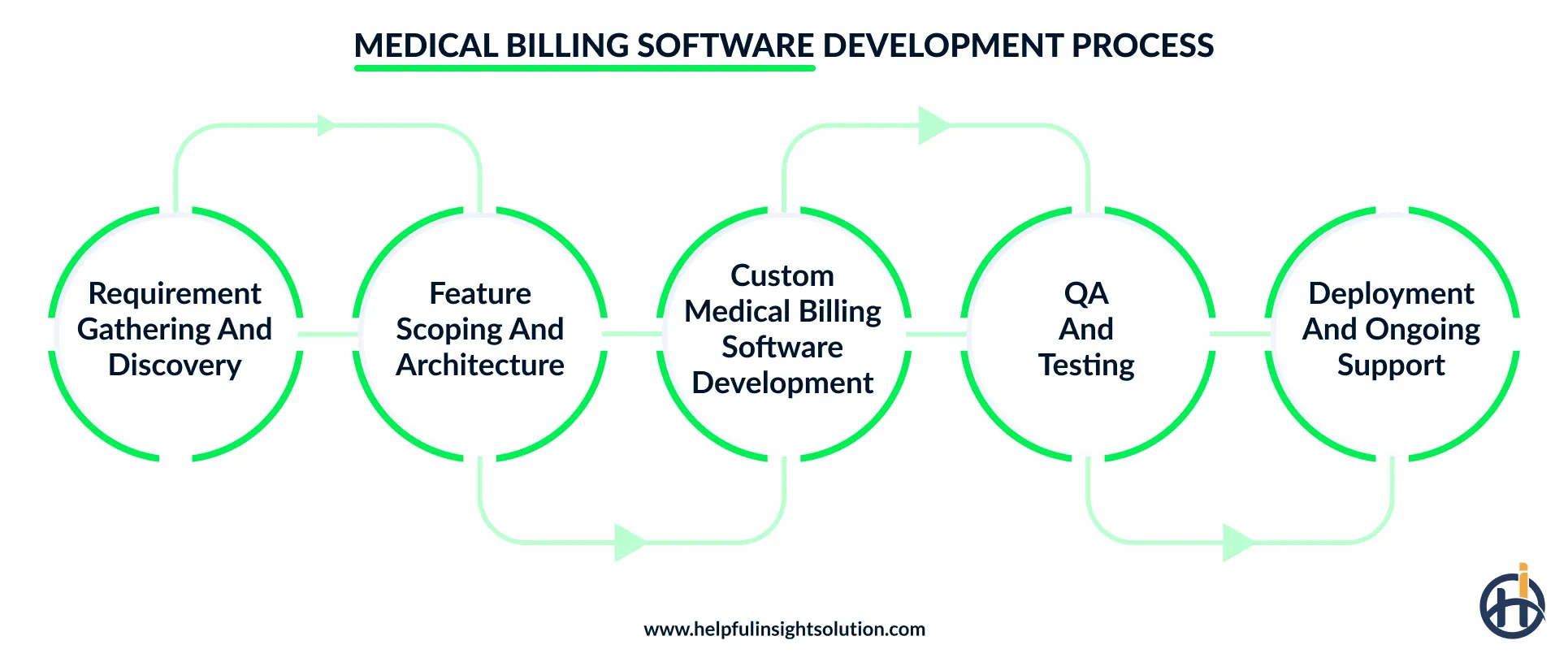
1. Requirement gathering and discovery
Start by understanding why you need medical insurance billing software and what problems it should solve. Talk to the people who will use it every day, especially the billing team. Ask them what challenges they face with their current system and which tasks take the most time.
Their feedback helps you decide what features the software should include and creates a clear roadmap for the next stages of development.
2. Feature scoping and architecture
Now you decide what features will go into your billing and coding software, such as claim generation, eligibility checks, and payment processing. You’ll also need to map out how the database and system architecture will handle it. This is also where compliance and data security requirements need to shape the design.
3. Custom medical billing software development
This is where healthcare software developers build the actual system, backend logic, database, claim workflows, and the user interface. It also involves connecting the software to your existing EHR, scheduling, or payment tools instead of replacing them entirely.
Many teams start with an MVP first, testing core billing functions before committing to full-fledged development.
4. QA and testing
Before launch, the QA team will test the medical billing and e-booking system to identify bugs, glitches, and data leaks. This includes running your software through actual hospital-scale traffic, not just small test cases. Security audits happen here too, since patient financial data can’t afford a vulnerability slipping through.
5. Deployment and ongoing support
Once testing wraps up, the medical claims management software goes live in the actual working environment. The work does not stop there.
Monitor performance continuously, patch bugs as they occur, and update the system whenever compliance requirements shift. Without that continued support, even a well-built platform starts falling behind over time.
What is the cost to build a custom medical billing software?
Investing in a billing system demands a significant investment, so it’s completely normal for healthcare businesses to be concerned about medical billing software cost.
A basic system typically falls between $25,000 and $60,000, covering core functionality. A mid-level system usually runs $60,000 to $120,000, while enterprise-grade software can range from $120,000 to $300,000 or more. The right choice really depends on what your practice actually needs.
Several factors directly influence where your project lands within these ranges, including:
- Project scope and billing workflow complexity
- Feature set and automation requirements
- UI/UX design depth and user role requirements
- Third-party integration needs including EHR, insurance payers, and payment gateways
- Compliance and security requirements including HIPAA and ICD coding standards
- Development team location and engagement model
- Ongoing maintenance and support structure
So, a straightforward billing module for a single practice costs very differently from a multi-payer enterprise platform built for a hospital network. The most accurate way to scope your medical billing and coding software cost is to share your specific requirements with our team for a detailed estimate.
How Helpful Insight supports your custom medical billing software development
A medical billing system isn’t just an operational upgrade; it’s what determines whether a healthcare business actually gets paid for the care it provides, on time and without unnecessary disputes. As regulations shift and patient volumes grow, having a system built around your specific workflow becomes a must-have. If you’re ready to build one, we can help.
We are a trusted healthcare software development company with hands-on experience in developing customized billing solutions for healthcare providers, from small clinics to larger multi-location practices.
Our team manages the entire project in-house, from initial planning and architecture through development and launch, so you’re not stuck coordinating multiple vendors or explaining requirements twice. Every solution we build accounts for HIPAA and other regulatory standards from day one.
Connect with our team today to share your medical billing system project details.
FAQs
The timeline to build medical billing software ranges between 3 and 12 months or more. A basic billing tool typically takes 3 to 6 months, while enterprise-level systems with advanced integrations can take 9 to 12 months or longer to build and test properly.
Several factors affect this timeline, including:
- Project complexity
- Number of features
- UI/UX design
- App testing
- Third-party integrations
- Regulatory compliance requirements, and more
Yes, custom billing systems connect with EHR platforms through APIs or HL7 standards, pulling patient data automatically instead of requiring manual re-entry.
Strong data encryption, restricted user access, and detailed audit logs are essential security measures for protecting sensitive billing and patient details.
Buying off-the-shelf tools works for simple setups with basic billing needs. If you’re dealing with specialty workflows, deeper EHR integration, or want more control over compliance long-term, custom software usually ends up being the better call.