

Key Takeaways
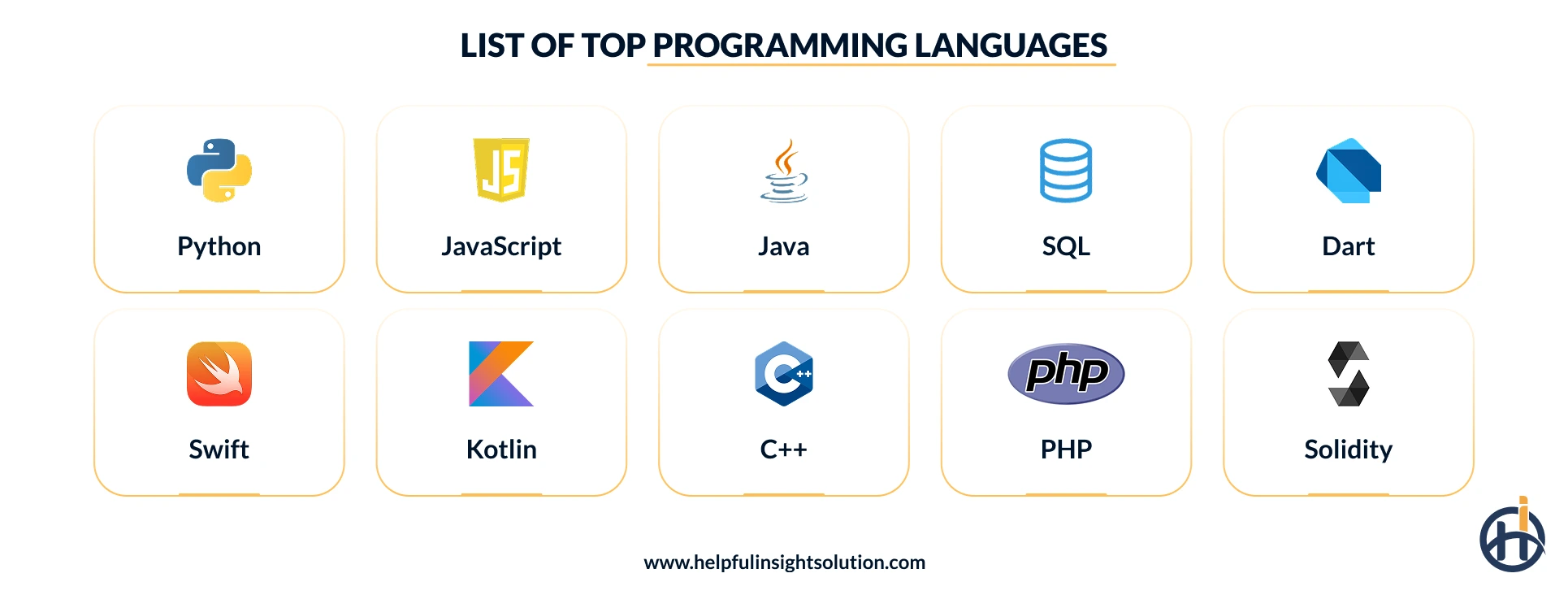
- The top programming languages in 2026 are Python, JavaScript, Java, SQL, C++, PHP, Swift, Kotlin, Dart, and Solidity.
- There is no single best language. Each one suits a particular kind of work, like web, mobile, data, or blockchain.
- Python is the number one language on the TIOBE Index in 2026 and the top choice for AI and data work.
- JavaScript runs the front end of 98.8% of all websites, while PHP runs the server side of 70.9% of them.
- Swift and Kotlin lead mobile development for iOS and Android, and Dart powers cross-platform apps through Flutter.
- Java and C++ remain the backbone of enterprise systems and high-performance software.
- SQL stays essential as businesses collect and depend on more data.
- Solidity is the most-used language for writing blockchain smart contracts.
- Future demand follows growing markets like AI, web, mobile, data, and blockchain, where all ten languages already sit.
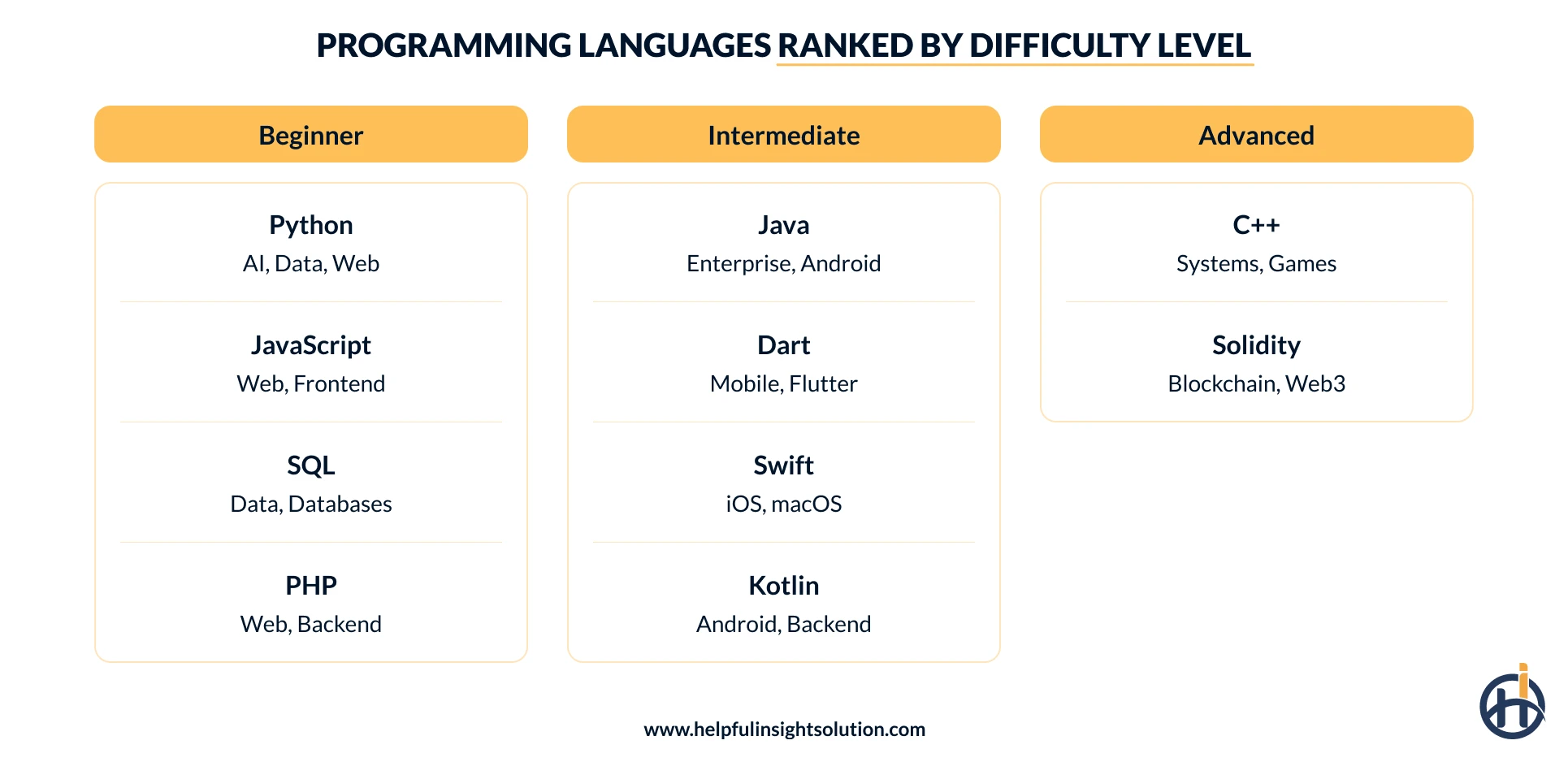
- For beginners, Python, JavaScript, SQL, and PHP are the easiest to start with, while C++ and Solidity are the most advanced.
The most popular programming languages in 2026 are Python, JavaScript, Java, SQL, C++, PHP, Swift, Kotlin, Dart, and Solidity. Together, they cover almost everything being built right now, like web platforms, mobile apps, data systems, and blockchain.
There is no single best language, because each language has its best use for a particular kind of work. For example, Swift is the best choice for iOS app development, while Kotlin is preferred mostly for Android app development.
This blog will help you with a list of the top programming languages in 2026, along with their use cases, pros, cons, and which language will be in high demand in the future.
Top 10 Programming Languages in 2026
Here is a summary of the top programming languages in 2026 and where they stand.
| Programming language | 2026 statistic | Source |
| Python | Ranked number one on the TIOBE Index in June 2026 with an 18.96% rating, nearly double its closest rival. | TIOBE |
| JavaScript | Used as a client-side language by 98.8% of all websites. | W3Techs |
| Java | Holds 4th place on the TIOBE Index in June 2026 with a 7.90% rating. | TIOBE |
| SQL | 8th most popular programming language in 2026 | TIOBE |
| Dart | Ranked #28 on the TIOBE Index in June 2026 and powers Google’s Flutter toolkit for cross-platform apps. | TIOBE |
| Swift | Jumped to 15th on the TIOBE Index in June 2026, ten places higher than a year earlier. | TIOBE |
| Kotlin | Most preferred language by Google, around 60% Android developers are using it. | Android Developers |
| C++ | It is ranked in 3rd position on the TIOBE Index in June 2026 with an 8.03% rating. | TIOBE |
| PHP | Powers the server side of 70.9% of all websites with a known server-side language. | W3Techs |
| Solidity | The most-used primary language among smart contract developers at 39%. | Solidity Developer Survey 2025 |
1. Python
Difficulty level: Beginner-friendly
Python is a high-level general-purpose programming language. It is beginner-friendly thanks to clean and readable syntax that reads almost like simple English. Additionally, it allows code to run without the need for a compiler.
Python also has pre-built libraries such as NumPy and Pandas for data work and TensorFlow for machine learning, which is why it sits at the core of most AI app ideas being built today.
The availability of pre-built libraries makes Python one of the most popular AI programming languages in 2026.
Python Statistics
- Python is the #1 language on the TIOBE Index in June 2026, with an 18.96%. (TIOBE)
- It also holds the #1 ranking on the PYPL Index in 2026 with 45.23% share, which measures how often a language’s tutorials get searched on Google. (PYPL)
- IEEE Spectrum ranked Python first in 2025, both overall and in its jobs ranking that looks only at what employers are hiring for. (IEEE Spectrum)
- In Stack Overflow’s 2025 survey of more than 49,000 developers, 57.9% reported using Python, a 7-point increase from the previous year. (Stack Overflow)
- Python leads AI and data science work on GitHub, with around 2.6 million contributors and 48% growth in a single year. (GitHub Octoverse)
Python Use Cases
- Developing and training AI and machine learning models through dedicated AI development services.
- Data analysis, reporting, and data pipelines.
- Django and Flask are backend web development frameworks built using Python.
- Backend web development with frameworks like Django and Flask.
- Writing automation and scripting for repetitive tasks.
- Scientific computing and research projects.
Pros and Cons of Python
| Pros | Cons |
| Simple, readable syntax that is easy to learn | Slower at runtime than compiled languages like C++ or Java |
| Pre-built library and community support | Not the right choice for mobile app development |
| Works across AI, data, web, and automation | Higher memory use, so it is a more vulnerable choice for memory-intensive tasks |
| Cross-platform and free to use | Dynamic typing can let some errors reach runtime |
2. JavaScript
Difficulty level: Beginner-friendly
JavaScript is another beginner-friendly general-purpose programming language that is part of almost every kind of web development project.
It allows developers to control everything that happens inside a browser, from buttons, forms, animations, to pop-ups and more. In simple words, it is a programming language that makes a website interactive, and it responds when a user clicks, types, or scrolls through the page.
JavaScript can work as both a frontend and a backend programming language, thanks to the number of frameworks available.
JavaScript Statistics
- JavaScript is used as a client-side language by 98.8% of all websites, making it the most used language on the web. (Source: W3Techs)
- In the Stack Overflow Developer Survey 2025, JavaScript was extensively used by developers, and 68.8% of them will continue to do so.
- JavaScript ranked at the 6th position in June 2026 with a 3.04% rating. (Source: TIOBE)
JavaScript Use Cases
- Add interactive elements to websites, such as forms, menus, and live updates
- Developing single-page applications with React, Angular, or Vue, which are also the frameworks driving the shift from HTML to modern frontend technologies
- Writing backend services and APIs with Node.js
- Building hybrid applications with cross-platform app development frameworks such as React Native.
- Developing real-time features like live chat and online games
Pros and Cons of JavaScript
| Pros | Cons |
| Runs in every browser without any setup | Loose typing can cause errors that show up only when the code runs |
| One language works for both the front end and the back end | The same code can behave differently across browsers |
| Huge collection of libraries and frameworks | Too many frameworks make it confusing for beginners |
| Large community and steady job demand | Single-threaded, so heavy processing needs extra handling |
3. Java
Difficulty level: Intermediate
Java is yet another of the in-demand programming languages that has been the preferred choice for developing large and reliable software.
It is a high-level, class-based, object-oriented programming language that is compiled into bytecode. These bytecodes are not specific to any platform, therefore, they can run on any platform that has a Java Virtual Machine installed.
It has been used to develop from enterprise applications and banking systems to Android app development and backend services.
Java Statistics
- Java has 4th place on the TIOBE Index in June 2026 with a 7.90% rating. (Source: TIOBE)
- Java has been ranked among the top 5 programming languages since the early 2000s, which is an obvious sign of the language’s steady growth. (Source: TIOBE)
- Java is used as a server-side language by 5.4% of all websites with a known server-side language. (Source: W3Techs)
Java Use Cases
- Building large enterprise and business applications
- Developing Android apps alongside Kotlin, which is one reason Java still appears in most mobile app development processes as part of the core backend stack
- Backend systems for banking and financial services
- Big data tools like Apache Hadoop and Spark
- Cloud-based and server-side applications
Pros and Cons of Java
| Pros | Cons |
| Runs on almost any device through the JVM | More verbose, so you write more code for simple tasks |
| Stable, mature, and backed by decades of use | Slower to start and uses more memory than some languages |
| Large ecosystem of libraries, frameworks, and tools | Not the first choice for quick scripts or small projects |
| Big community and steady enterprise demand | Licensing and updates have grown more complex over the years |
4. SQL
Difficulty level: Beginner
SQL is yet another of the in-demand programming languages, and it has been the standard choice for storing and managing data in databases.
Being a domain-specific language, it works with relational databases, where data is kept in tables made of rows and columns. It allows you to write simple queries to add, read, update, or delete this data, therefore, almost every application that stores information depends on it in one way or another.
It has been used to manage data in everything from banking and e-commerce systems to data analytics and software development projects.
SQL Statistics
- SQL has 8th place on the TIOBE Index in June 2026 with a 1.77% rating. (Source: TIOBE)
- SQL reached 8th place in June 2026 from 12th a year earlier, which is an obvious sign of the growing demand for data skills. (Source: TIOBE)
- SQL was one of the most used languages in the Stack Overflow Developer Survey 2025, used by around 59% of developers. (Source: Stack Overflow)
SQL Use Cases
- Storing and managing data in relational databases
- Running queries and reports for business analytics
- Backend development for web and mobile apps
- Data analysis and business intelligence tools
- Managing data in banking, e-commerce, and ERP systems, where it remains central to most e-commerce development projects
Pros and Cons of SQL
| Pros | Cons |
| Uses a standardized query language supported by most relational databases | Works only with structured data stored in relational tables |
| Declarative syntax, so you state what data you need rather than how to fetch it | Syntax differs between database systems, with dialects like T-SQL and PL/SQL |
| Supported by every major database, including MySQL, PostgreSQL, Oracle, and SQL Server | Cannot build a full application on its own, as it only manages data |
| Backed by decades of tooling, documentation, and community support | Standard SQL has no procedural logic without database-specific extensions |
5. Dart
Difficulty level: Intermediate
Dart is one of the modern programming languages introduced by Google in 2011, and since then, it has been leading cross-platform mobile app development using Flutter.
It is a client-side, object-oriented programming language that can compile to native machine code as well as to JavaScript. Therefore, Dart code can run as a mobile app, web app, or desktop app from a single codebase.
Dart Statistics
- Dart has 28th place on the TIOBE Index in June 2026 with a 0.53% rating. (Source: TIOBE)
- In the Stack Overflow Developer Survey 2025, Flutter was the most-used cross-platform app development framework, ahead of React Native, and it runs entirely in Dart. (Source: Stack Overflow)
- Flutter’s GitHub official repository has 177k stars. (Source: GitHub)
Dart Use Cases
- Building cross-platform mobile apps with Flutter
- Developing Android and iOS apps from a single codebase
- Creating web and desktop applications
- Building UI-heavy apps that need smooth animations
- Prototyping apps quickly with hot reload
Pros and Cons of Dart
| Pros | Cons |
| A single codebase runs on Android, iOS, web, and desktop through Flutter | Mainly used within the Flutter ecosystem, with little use outside it |
| Compiles to native machine code and to JavaScript | Smaller community and fewer third-party libraries than older languages |
| Developed and maintained by Google | Ranks low on general popularity indexes such as TIOBE |
| Supports hot reload, so code changes show without restarting the app | Flutter bundles its own rendering engine, which adds to the app’s base size |
6. Swift
Difficulty level: Intermediate
Swift is one of the in-demand programming languages used by Apple for iOS app building across its devices.
It is a compiled, general-purpose language introduced in 2014 to replace Objective-C. The language is fast and safe, with a simple syntax that can identify errors while you write the code. So, developers can build scalable, fast, and secure applications with less effort.
Swift Statistics
- Swift ranked at the 15th position on the TIOBE Index in June 2026, up from 25th a year earlier, which is one of the biggest increases among all languages. (Source: TIOBE)
- Swift ranks among the top 10 languages on the PYPL Index in 2026, which suggests its popularity among developers looking for its tutorials. (Source: PYPL)
- Apple lists Swift as the primary language for building apps across iPhone, iPad, Mac, Apple Watch, and Apple TV, which is why most iPhone app development companies now build exclusively in Swift. (Source: Apple)
- Apple’s installed base passed 2.5 billion active devices in the quarter ending December 2025, and Swift is the primary language for building apps on them. (Source: Statista)
Swift Use Cases
- Building iOS and iPadOS apps with dedicated iOS app development expertise
- Developing macOS desktop applications
- Apps for Apple Watch and Apple TV
- Server-side development with frameworks like Vapor
- High-performance apps that need native Apple integration
Pros and Cons of Swift
| Pros | Cons |
| Official language for all Apple platforms, with full Apple support | Works almost entirely within the Apple ecosystem |
| Compiled to native code that runs on Apple hardware | Limited use for Android, web, or backend projects |
| Memory-safe by design, which prevents common classes of bugs | Younger than Java, so some older apps still run on Objective-C |
| Modern, concise syntax compared to Objective-C | Smaller talent pool beyond Apple-focused development |
7. Kotlin
Difficulty level: Intermediate
Kotlin is yet another of the best programming languages to learn, and it has become the preferred choice for Android app development.
It is a statically typed, modern programming language created by JetBrains that runs on the Java Virtual Machine and works fully with Java. This means you can mix Kotlin and Java in the same project; therefore, teams can move to Kotlin gradually without rewriting their old code.
It is one of the mainstream programming languages for Android app development, which can also work for backend services, web, and cross-platform apps through Kotlin Multiplatform.
Kotlin Statistics
- Kotlin is used by over 60% of professional Android developers, according to Google. (Source: Android Developers)
- Android apps built with Kotlin are 20% less likely to crash, which is one reason it has become the default choice at every stage of the mobile app development lifecycle. (Source: Android Developers)
- Kotlin is among the top five languages developers most want to adopt next, at 6%, in JetBrains’ State of Developer Ecosystem 2025. (Source: JetBrains)
- Kotlin ranked in 23rd position on the TIOBE Index in June 2026. (Source: TIOBE)
Kotlin Use Cases
- Building native Android apps with professional Android app development teams
- Backend development with frameworks like Ktor and Spring
- Cross-platform apps with Kotlin Multiplatform
- Server-side and web applications
- Extending or modernising existing Java codebases
Read Also:- Best 15 Android Libraries to Explore
Pros and Cons of Kotlin
| Pros | Cons |
| Officially supported by Google as the preferred Android language | Most of its use is tied to Android and the JVM |
| Fully interoperable with Java, so both can run in one project | Smaller community and talent pool than Java |
| Concise syntax that reduces boilerplate compared to Java | Often relies on Java libraries rather than its own |
| Built-in null safety that prevents many null pointer errors | It is a modern programming language, so some teams still default to Java |
8. C++
Difficulty level: Advanced
C++ is one of the most powerful programming languages introduced in 1985. It is a general-purpose, object-oriented programming language that works on the concept of classes and inheritance.
The language is built on the older C language by adding object-oriented features. It has been the preferred choice for developing high-performance software.
It has been used in performance-centric software development, like operating systems, game engines, web browsers, and trading systems.
C++ Statistics
- C++ ranked at 3rd place on the TIOBE Index in June 2026 with an 8.03% rating. (Source: TIOBE)
- C and C++ together ranked in 3rd position on the PYPL Index in 2026. (Source: PYPL)
- C++ has stayed in the TIOBE top 4 for more than two decades and won TIOBE’s Programming Language of the Year award in 2022. (Source: TIOBE)
C++ Use Cases
- Building operating systems and system software
- Game development and engines like Unreal Engine
- High-performance and real-time applications
- Embedded systems and IoT app development for connected devices and smart hardware
- Software that needs direct hardware or memory control
Pros and Cons of C++
| Pros | Cons |
| Compiles to native machine code for high performance | Requires manual memory management, which makes it one of the complex programming languages for beginners |
| Gives direct control over memory and hardware | Has complex, low-level features like pointers, references, and templates |
| Works for both low-level systems and large applications | Larger and more complex than C, with a big language specification |
| Backed by a mature ecosystem, standard library, and tooling | No built-in memory safety, unlike newer languages such as Rust |
9. PHP
Difficulty level: Beginner-friendly
PHP is one of the best in-demand programming languages, introduced in 1995. It is a server-side scripting language that runs on the web server to create dynamic web pages.
The language generates the HTML that a browser then displays, which is what makes a website respond differently for each user. It has been the preferred choice for building websites and content management systems for many years.
PHP is powering the world’s most used websites, such as WordPress and Wikipedia. It was also the language behind the early version of Facebook.
PHP Statistics
- PHP is used as a server-side language by 70.9% of all websites with a known server-side language. (Source: W3Techs)
- PHP ranked at 14th place on the TIOBE Index in June 2026 with a 1.17% rating. (Source: TIOBE)
- PHP ranks among the top 10 languages on the PYPL Index in 2026. (Source: PYPL)
- WordPress, which is built on PHP, powers around 42% of all websites on the internet, making PHP expertise a common requirement when evaluating web app development companies. (Source: W3Techs)
- About 60.9% of all PHP websites now run PHP 8, the current major version, which shows the language is still actively modernised. (Source: W3Techs)
PHP Use Cases
- Building dynamic websites and web applications
- Content management systems like WordPress, Drupal, and Joomla are often delivered as part of custom web development projects
- e-commerce platforms and online stores
- Server-side scripting and backend APIs
- Web apps built with frameworks like Laravel and Symfony
Pros and Cons of PHP
| Pros | Cons |
| Built specifically for the web, so it is quick to deploy | Mainly used for web and server-side development, with minimal use elsewhere |
| Runs on nearly every web server and hosting plan | Known for inconsistent function names and argument order in its standard library |
| Large ecosystem, including Laravel and WordPress | Dynamically typed, so some errors only appear at runtime |
| Free, open-source, with a very large community | Older PHP code often mixes application logic directly with HTML |
10. Solidity
Difficulty level: Advanced
Solidity is one of the most used programming languages for blockchain, introduced in 2014. It is a statically typed, contract-oriented language used to write smart contracts.
The language runs on the Ethereum Virtual Machine, and its syntax is influenced by C++, Python, and JavaScript. It has been the preferred choice for building smart contracts on Ethereum and other compatible blockchains.
Solidity Statistics
- Solidity is the most-used primary language among smart contract developers, at 39%, ahead of TypeScript at 16% and JavaScript at 13%. (Source: Solidity Developer Survey 2025)
- 49% of these developers use Solidity daily, and another 32% use it weekly, making it the most actively used language in blockchain development services. (Source: Solidity Developer Survey 2025)
- Ethereum mainnet is the top deployment target for Solidity developers, at 52%, followed by Base and Arbitrum. (Source: Solidity Developer Survey 2025)
Solidity Use Cases
- Writing smart contracts on Ethereum
- Building decentralised finance (DeFi) applications
- Creating crypto tokens and NFTs
- Developing decentralised exchanges and marketplaces
- Building apps for EVM-compatible blockchains like Polygon and Base
Pros and Cons of Solidity
| Pros | Cons |
| Purpose-built for writing Ethereum and EVM smart contracts | Limited to blockchain and smart contract development |
| Runs on every EVM-compatible blockchain, not just Ethereum | Contract bugs can be costly, since deployed code is hard to change |
| Large ecosystem of tools, libraries, and documentation | Smaller talent pool than mainstream languages |
| Backed by an active developer community and regular updates | Still evolving, with frequent breaking changes between versions |
Which Programming Language Will Be in High Demand in the Future?
The market for programming languages is highly volatile. Also, AI is disrupting each programming language; there is no certainty regarding the in-demand programming languages in the future.
However, the current data can help us to predict which will be the best in-demand programming languages in 2026 and beyond. It follows the areas that keep growing, like AI, web, mobile, data, and blockchain, and the 10 languages covered above already sit across all of them.
- AI and machine learning (Python): The global AI market is projected to grow from USD 539.5 billion in 2026 to about USD 3,497.3 billion by 2033, at a 30.6% CAGR. Since Python is the main language for AI work, its demand should rise along with it. (Grand View Research)
- SQL (data): Nowadays, companies of all sizes, be it startups or large enterprises, run on data. SQL is one of the most used programming languages to extract the required information from the collected data; its demand will grow in the future. Furthermore, the market for big data is projected to reach USD 862.31 billion by 2030, which is an obvious sign of the rising demand for SQL. (Grand View Research)
- JavaScript and PHP (web and eCommerce): Nowadays, companies are becoming digital-first by moving their sales and services online. JavaScript and PHP are among the mainstream programming languages for web development; their demand will surge.
- Dart, Swift, and Kotlin (mobile): The demand for mobile application development is not seeing any decline, especially after the COVID era. According to Grand View Research, the market is projected to reach the value of USD 626.39 billion by 2030, growing at a CAGR of 14.3% from 2026 to 2030. As companies are investing in mobile app development, the demand for languages supporting it, like Dart, Swift, and Kotlin, will not fade.
- Java and C++ (enterprise and systems): Large organisations still prefer to run their core systems on Java and C++. As the market for enterprise software is growing consistently, expecting to reach USD 750.03 billion by 2033, organizations will keep investing in these programming languages to ensure their needs are met. (Grand View Research)
- Solidity (blockchain): Blockchain is a technology that has been powering payments, contracts, and records for organizations of all sizes, and Solidity, an open-source programming language, is powering it. The blockchain market is projected to grow at around 88% a year through 2033, organizations will invest in Solidity. (Source: Grand View Research)
FAQs
The best programming languages to learn in 2026 are subject to what you want to build. For example, if you want to work on AI development services, then Python might be the right choice. Similarly, JavaScript is the right choice for web development.
C++ is often said to be one of the most powerful programming languages, as it enables developers to have direct control over the memory and hardware. Also, it runs fast, making it the first choice for operating systems, game development, and other performance-intensive software.
C++ and Solidity are complex programming languages as they have advanced-level difficulty. C++ is complicated because of its manual memory management and low-level features, while Solidity needs a good understanding of blockchain and smart contract security. Languages like Python and PHP are far easier to start with.
The most popular free and open-source programming languages include Python, PHP, Kotlin, Dart, and Solidity. Swift is also an open-source language, while Java is free to use, though some commercial uses of its official toolkit now need a paid licence.
Java and C++ are the most trusted choices for enterprise software, thanks to their stability, scalability, and fast performance they offer. Both are fully-fledged programming languages that can handle complex, large-scale applications. Many banks and big businesses still run their core systems on them.