

Key Takeaways:
- AI has now become an integral part of all businesses, delivering automation, personalization, and predictive analytics.
- AI-powered websites can transform business growth through integrated chatbots, reducing operational expenses.
- It is important to maintain structured and relevant information that helps to build robust AI-enabled frameworks.
- The adoption of various AI-powered tools enhanced performance monitoring, user engagement, and revenue cycle management.
Websites and web apps have been helping entrepreneurs to expand their businesses through advanced automation and prediction. Earlier, their work was to gather audience attention, ensure responsiveness, and bring in more trust through robustness.
But now, the use of AI in web development has changed this perception, allowing websites to think and make decisions accurately. According to the National University, 77% of businesses are using AI as a core technology in their systems.
In another report by Digitalsilk, a study shows that 90% of users say that AI enables them to save their time and increase working efficiency. This is just a start, as AI can easily handle multiple operations, increasing business revenue, brand value, and user engagement. It can be used in sales & marketing, logistics, healthcare, media, and banking sectors to automate various tasks.
Whether you have a large enterprise or a startup, AI is helpful for all types of business investors. This blog will guide you to understand the role of AI in making web-based solutions through valuable topics. Let’s understand them with deep information in this blog.
What is Artificial Intelligence in Web Development?
In general terms, artificial intelligence in web development means the use of advanced technologies like machine learning, NLP, and generative AI for creating smarter websites. This technology helps in code generation, advanced content research, and automated testing through integrated chatbots and voice assistants. These AI-driven websites help business investors to make decisions instantly and accurately, without any human interference.
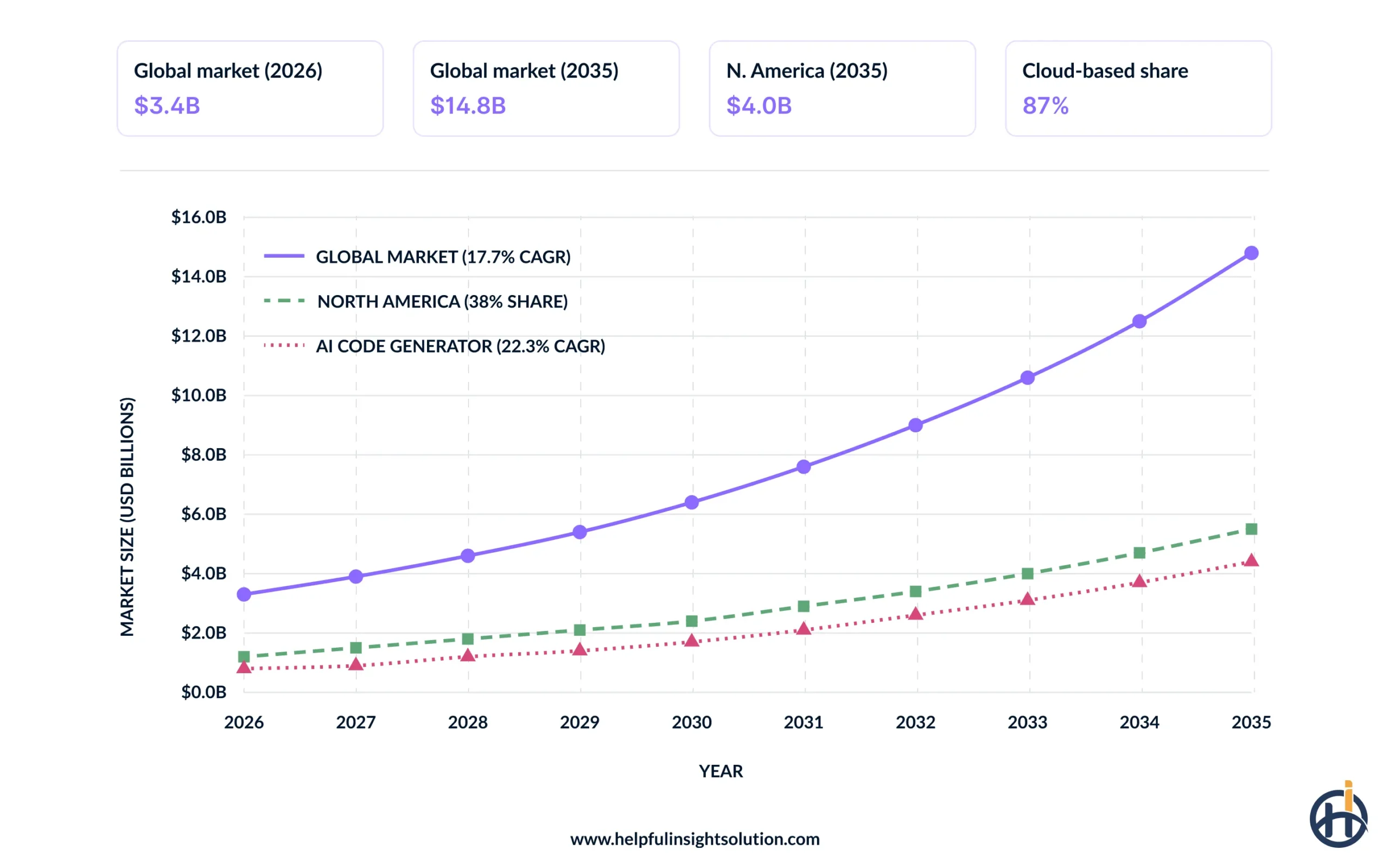
- The global market for AI-powered website development is 3.4 billion in 2026, which will reach $14.8 billion at a 17.7% CAGR between 2026 and 2035.
- The custom AI code generator segment is growing at a 22.3% CAGR rate, whereas the cloud-based market has taken an 87% market share.
- North America has a share of 38% in the market, which will reach $4 billion in revenue by the end of this tenure.
How is AI influencing web development in 2026?
Businesses are investing in AI website development due to its increasing demand and growth-driven approach. In this section, we will understand the key benefits of artificial intelligence in website-making. Additionally, we will also explore some interesting market facts with estimated figures.
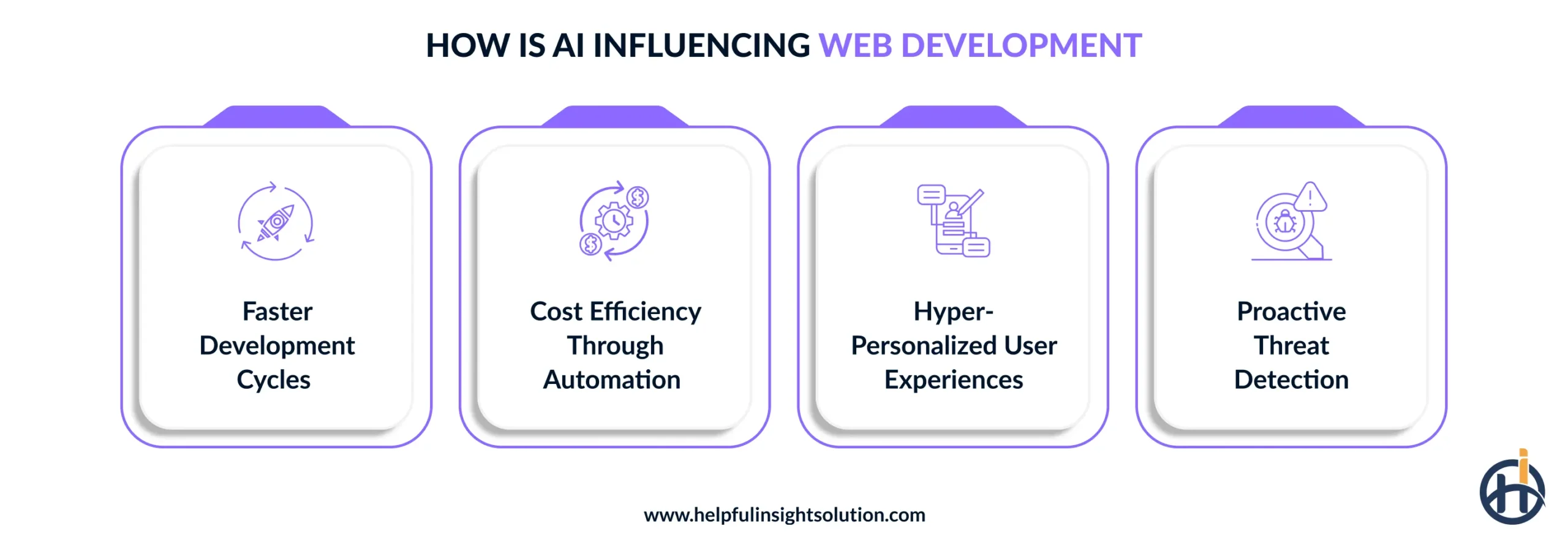
1. Faster Development Cycles
The use of intelligence in development tools is really beneficial in the web development process, making it faster. In fact, entrepreneurs can now get things done 40 percent quicker in 2026. This is because artificial intelligence. All this is possible because AI solutions can do things like write code for us, find mistakes, and help with design.
2. Cost Efficiency Through Automation
Companies are saving a lot of money by using intelligence to automate things. They are saving around 30 percent on development and operational costs. Artificial intelligence can do things like test websites create content keep everything running smoothly and even help with customer support.
3. Hyper-Personalized User Experiences
Various AI-enabled solutions are allowing businesses to connect with their customers. In fact artificial intelligence is increasing customer engagement by 45 percent. AI tools can easily create websites that are tailored to each user’s preferences.
4. Proactive Threat Detection
Artificial intelligence is also helping companies keep their websites safe. It can stop up to 60 percent more threats before they cause any harm. This is because artificial intelligence can watch what is happening on a website all the time and look for anything.
Comparison Between Traditional Development and AI-Assisted Development
Before integrating artificial intelligence in web development, you need to understand the older systems that do not use AI. Here, we will study the difference between the two platforms based on 6 key parameters through the following table.
| Parameter | Traditional Development | AI-Assisted Development |
| Development Speed | Requires extensive manual coding and longer project timelines. | Uses AI tools to automate coding tasks and accelerate development. |
| Code Quality & Error Detection | Bugs and errors are identified mainly through manual testing. | AI-powered tools automatically detect errors and suggest optimizations in real time. |
| Personalization Capabilities | Delivers mostly static user experiences with limited customization. | Uses AI algorithms to provide personalized content and recommendations dynamically. |
| Testing & Maintenance | Relies heavily on manual QA processes and ongoing developer intervention. | Automates testing, monitoring, and predictive maintenance for improved efficiency. |
| Cost Efficiency | Higher long-term costs due to increased manual effort and resource requirements. | Reduces operational costs through automation and faster workflows. |
| User Interaction & Support | Depends on human support teams for customer assistance and engagement. | Integrates AI chatbots and virtual assistants for instant, 24/7 user support. |
Best Use Cases of AI in Web Development
An entrepreneur must know the top use cases of AI in web development before integrating this technology. Here, you will study some of the best applications of AI based on various processes.
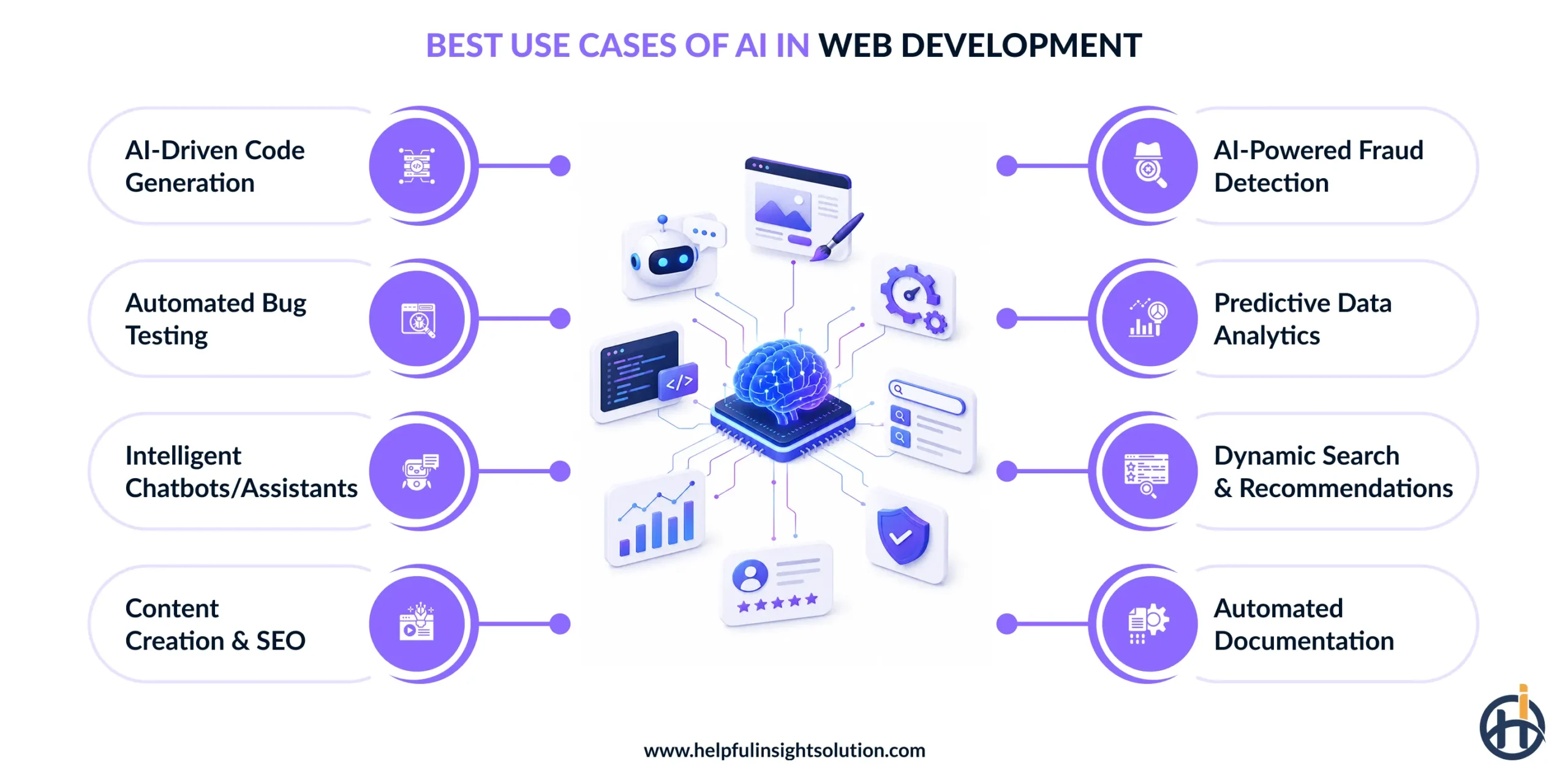
1. AI-Driven Code Generation
AI-driven code generation is crucial to developers who want to build websites and applications quickly. It does this by making code snippets, layouts and complete modules automatically. This means developers do not have to do the tasks over and over again. They can focus on making their websites and applications look good and work well.
Driven code generation also gives developers suggestions and fixes mistakes in real time when they are designing user interfaces. This allows businesses get their projects done faster and saves them money without reducing the quality of web applications. Driven code generation is really useful for developers who want to work more efficiently.
2. Automated Bug Testing
Automated bug testing uses AI to find problems in web applications before they are released. AI can scan multiple codes to find issues that are hard to detect manually, and it can also predict problems before they happen. AI can look at a lot of code. Find issues that are hard to see. It can also predict problems that might happen in the future. Automated bug testing learns from the problems it finds.
It gets better at finding problems over time. This means web applications are more stable and work better. They also do not break down much which makes for a better experience for users. Automated bug testing is a part of making sure web applications work well.
3. Intelligent Chatbots/Assistants
AI-powered chatbots and virtual assistants allow businesses to answer customer questions away. These chatbots can answer different common questions, guide users around websites, and even handle orders. To make chatbots that work well you need to get chatbot development services and understand what users are trying to say.
This makes it seem like users are talking to a person. It makes customers happy. Reduces the amount of work support teams have to do. AI-powered chatbots are a way for businesses to provide good customer service.
4. Content Creation & SEO
People use intelligence tools to make website content make blogs better and improve search engine optimization strategies for different businesses. Artificial intelligence tools can also look at what’s popular suggest good headlines and make content for the people who are looking at the website.
Artificial intelligence helps businesses make their meta tags better fix readability issues and get search rankings more easily than doing it by hand. This helps websites get more people to visit and stay visible online which makes people come back to the website often.
![Speed up development, cut operational costs, and grow faster with AI-powered web solutions. [Book a Free Session]](https://www.helpfulinsightsolution.com/wp-content/uploads/2026/06/Ready-to-leverage-AI-in-Web-Development_-1-scaled.webp)
5. AI-Powered Fraud Detection
Websites use intelligence to find fake activities like fake payments people taking over accounts or strange login attempts. Artificial intelligence monitors user activity on the website in real time, allowing it to stop suspicious behavior before it causes harm. Artificial intelligence looks at what people’re doing on the website in real time so it can stop bad things from happening before they do.
These systems get better at finding activities by looking at what is not working well and finding holes in the system, which makes them work better. This makes the website safer and allows businesses protect important customer information, with AI-driven encryption methods.
6. Predictive Data Analytics
Predictive data analytics uses intelligence to look at what people are doing what is popular and what happened in the past to guess what will happen next. Businesses can use this information to understand what customers like make their marketing better and make decisions.
Artificial intelligence models can also guess if sales will go up or down if customers will stop using the website and if the website will have problems before it happens. These AI & ML solutions enable companies stay prepared and operate more efficiently, ultimately saving money by catching data issues early.
7. Dynamic Search & Recommendations
AI enhances website search functionality by delivering faster, more relevant, and personalized results to users. Recommendation engines analyze browsing history, preferences, and user behavior to suggest products, content, or services that match individual interests.
This creates a more engaging and customized user experience for visitors, increasing overall engagement on the platform. As a result, businesses can easily view higher conversions, longer session times, and improved customer retention.
8. Automated Documentation
Automated documentation tools use AI to generate technical documents, API references, and project summaries directly from code and workflows. This reduces the time developers spend writing manuals and keeping documentation updated manually.
AI can also organize information clearly and ensure consistency across development teams, enhancing operational efficiency. A better documentation process improves collaboration, simplifies onboarding, and makes long-term project maintenance easier.
The Future of AI and Machine Learning in Web Development
The future of AI website development will expand due to technical advancements and modern innovations. Let’s understand these future trends so you can implement them in your business model.
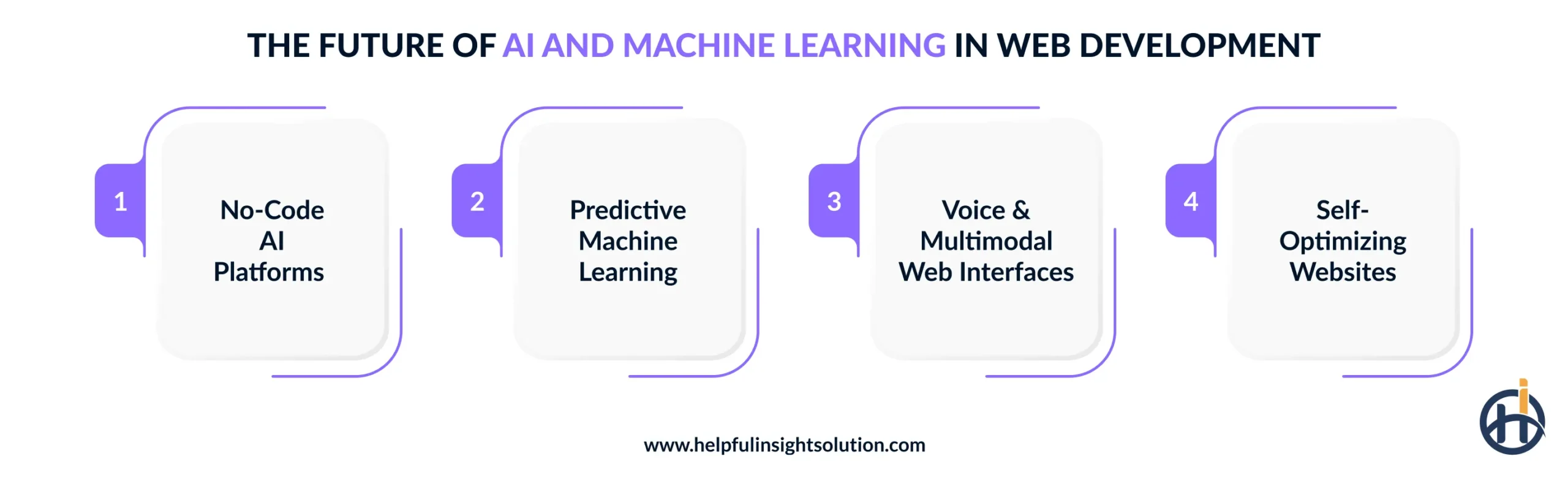
1. No-Code AI Platforms
No-code AI platforms help businesses build websites easily. They do not need to know a lot of code. These platforms make it faster to build websites save money and add features quickly.
2. Predictive Machine Learning
Websites use machine learning to understand what users do. They can guess what will happen next and give users suggestions. This is the future of AI in web development, showing improved results. It assists businesses get customers involved make more sales and make better choices.
3. Voice & Multimodal Web Interfaces
Websites can now understand voice commands, text, pictures and gestures. This makes it easier for users to interact with websites. These smart experiences make websites more accessible and fun to use on any device.
4. Self-Optimizing Websites
Websites can now use AI to improve themselves. They use real-time data to make performance put content in the right place and make users happier. This helps businesses keep users engaged and make their websites work better over time.
How to Build an AI-Powered Website?
You can integrate AI in web development to make smart solutions by following a dedicated process. This section provides you with the key development stages through which developers can make AI websites.
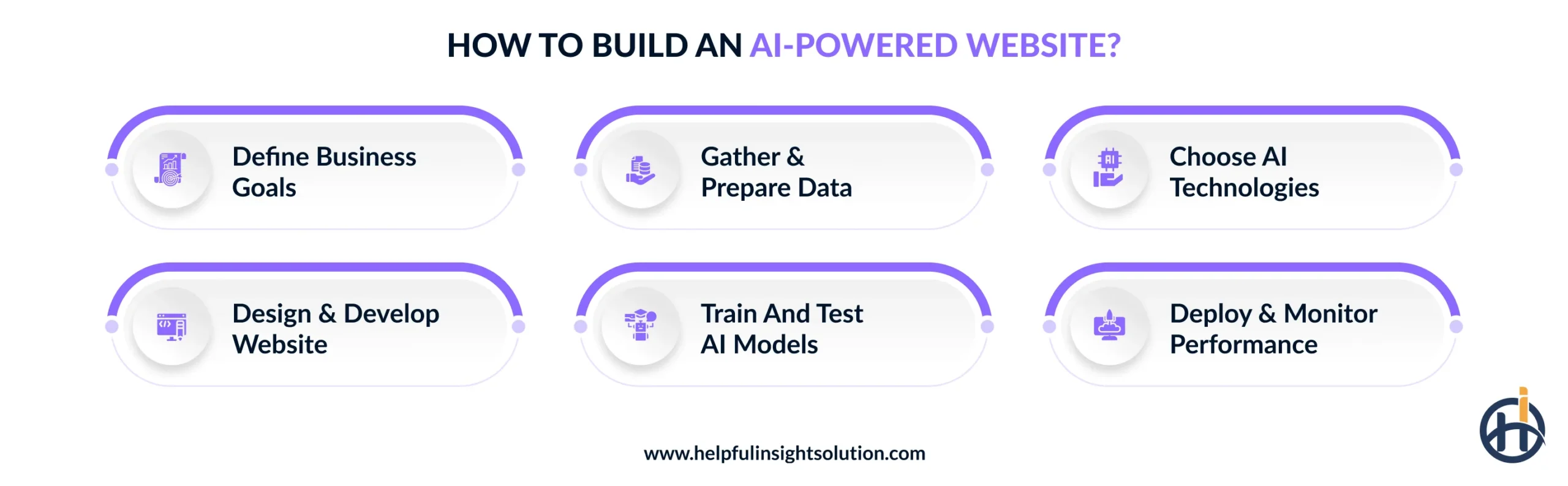
1. Define Business Goals
A business investor must understand their budget requirements, project needs, and user pain points before investing in website creation. This helps them to specify brand objectives, reduce additional expenses, and increase business ROI in a limited duration. It is important to know what challenges you may face by not integrating AI technologies and models in your web platforms.
2. Gather and Prepare Data
Data plays a major role in AI integration because it is extracted to understand business growth and user behaviour through LLMs. First, the raw data is collected and then processed by using advanced AI algorithms that can be easily executed. It can manage both unstructured and structured information, applying data cleaning, transformation, and labelling methods.
3. Choose AI Technologies
Businesses can use an AI website builder, like Wix, or build custom web platforms by using AI-driven APIs. AI tools can handle both design and backend hosting, ensuring no-code deployment and generating user-specific content. You can also use artificial intelligence in web development by integrating automated UI libraries, Python frameworks, and LLMs, like OpenAI APIs.
4. Design & Develop Website
The use of AI in web design helps to automate the user interface by selecting the necessary elements through tools like Figma. You can choose to implement chatbots, recommendation engines, and content generation tools on your website. Additionally, it is important to build databases, cloud infrastructure, and APIs to gather various information in real-time.
5. Train and Test AI Models
By using machine learning frameworks, such as PyTorch or TensorFlow, you can train different AI models on the website data. You can hire dedicated developers who can implement generative, conversational, and predictive AI. It is beneficial to divide the dataset into validation and test sets to ensure accuracy, precision, and transparency in the system.
6. Deploy & Monitor Performance
You can deploy the AI-enabled website on cloud platforms, such as Vercel or Render, which support serverless functions. The experts can use version control platforms, like GitHub, to add system files for public use. For platform monitoring, businesses can use LangSmith or Datadog tools that track backend latency, LLM calls, user feedback, and SEO growth.
Key Challenges in the Development of AI-Enabled Websites
Entrepreneurs must know the challenges that are involved with the use of AI for web development and integration. We will understand those AI-driven obstacles in this section with their respective solutions.
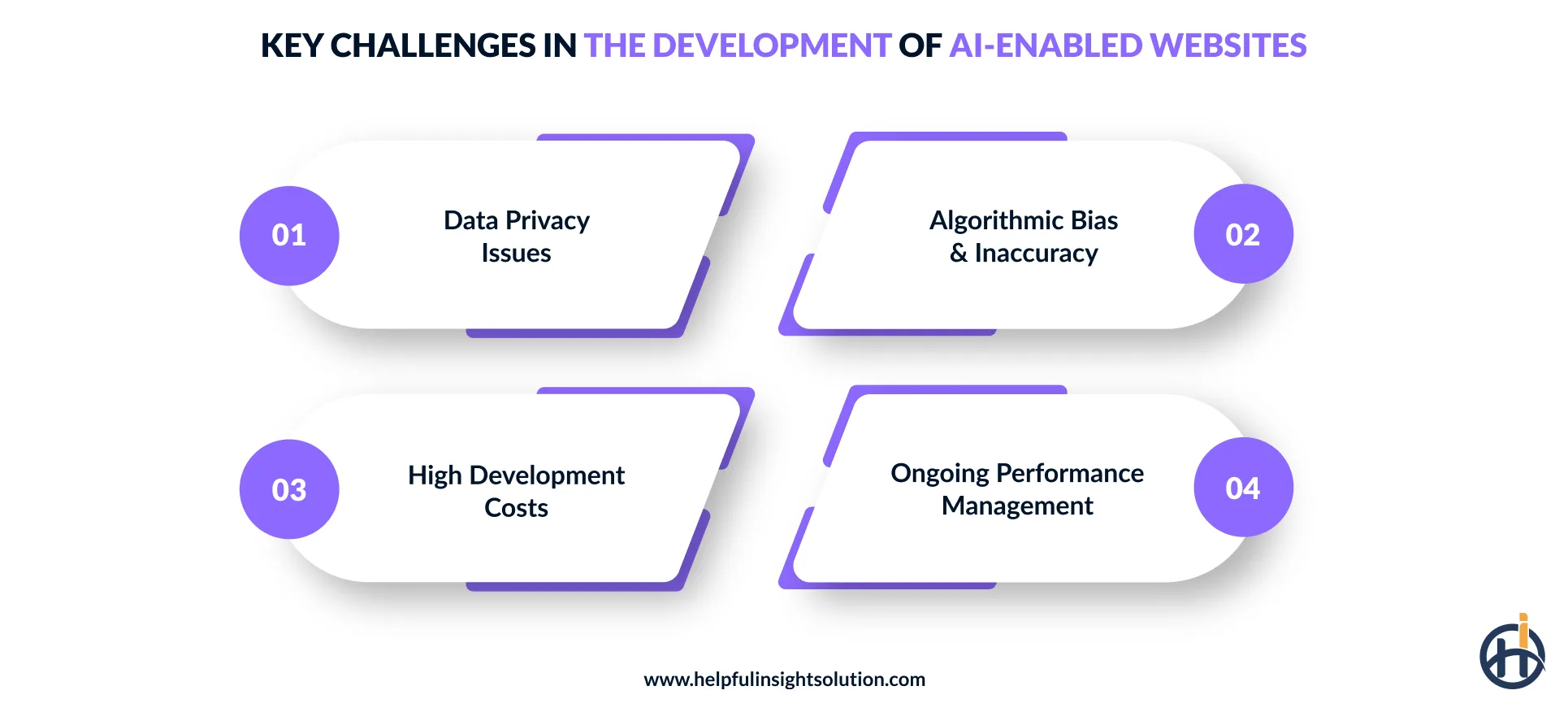
1. Data Privacy Issues
AI tools like chatbots and content generators require user data to deliver the desired results. The over-addition of data can violate minimization rules, which lead to data security and privacy risks.
Solution: You can implement data protection protocols and Explainable AI methods to maintain data transparency on the web platform.
2. Algorithmic Bias & Inaccuracy
Repetitive patterns, proxy information, and false data can affect the accuracy of the results. This can favor particular demographics based on the region, gender, and expert opinions, reducing trust among people.
Solution: To integrate AI and web development, you must review data and evaluate AI models during the data collection and design phases.
3. High Development Costs
Most traditional websites require complex AI models to handle user data, increasing the overall cost. Additionally, generative AI tools are expensive because they need sourcing, labeling, and processing.
Solution: It is beneficial to utilize existing APIs and pre-trained models, which help to evaluate budget metrics and reduce time consumption.
4. Ongoing Performance Management
As the data changes, the old information gets outdated, which is the major cause that affects performance. It can degrade data accuracy and may lead to security threats due to the inefficiency of the AI website.
Solution: Businesses can use production tracking tools and MLOps platforms to monitor latency and ensure data validation in real-time.
Why Choose Helpful Insight for AI-Powered Web Development?
Do you need a partner to start with AI technologies and boost your website services? We help our clients to understand the current market demand, user needs, and growth opportunities, and take action accordingly.
You must know that the role of AI in web development is to reduce human errors, increase throughput, and ensure consistent user retention. Artificial intelligence is there to safeguard user information and prevent fraud by integrating with cybersecurity.
Our experts ensure complete AI development services, from consulting to analytics, for making advanced websites that can predict results. You can invest in this technology to experience the power of machine learning, NLP, and computer vision. All of them ensure that the system is progressing in a positive direction, enhancing revenue generation and user satisfaction.;
FAQs
Machine learning is a broader term that helps to recognize patterns, manage structured data, and build recommendation engines. LLMs are used to generate human languages through neural processing and prompt engineering methods. They both help businesses to easily predict user behavior and automate conversations with real-time features.
Artificial intelligence cannot replace website developers, but it will transform their roles, automating various development processes. AI can speed up coding and testing methods, which help in solving complex problems and ensuring security. Additionally, developers can make architectural designs through AI technologies, enhancing efficiency.
Various startups may use advanced AI-powered coding tools, like Cursor or GitHub Copilot, to integrate it in website development. They can implement intelligent chatbots, AI-based APIs, and automated website builders. With this, it is easy to enhance the development lifecycle, include AI-powered features, and improve user experiences.
AI uses various security algorithms and fraud detection techniques to safeguard sensitive information, reducing human intervention. It can analyze network traffic, identify anomalies, and automate incident response for web security. This technology can also be used to detect vulnerabilities and malware, preventing attacks on the system.
The maintenance cost depends on the AI architecture, which includes API calls, data retraining, cloud-based models, and compliance. The overall cost to maintain AI-driven websites ranges from 15-20% of the total development costs. For a project of $50,000, maintenance typically costs between $7,500 and $10,000 per year, depending on factors like retraining frequency, API usage, and compliance requirements.