

Key Takeaways
- Music streaming app development requires decisions around licensing, tech stack, monetization, and infrastructure that directly determine whether the product scales or falls apart.
- Over 713 million people pay for music streaming globally, with users spending an average of 104 minutes listening every single day.
- The cost of building a music streaming app typically ranges from $15,000 to $250,000 or more depending on complexity, features, and team location.
- Choosing cross-platform development frameworks like React Native or Flutter reduces both development time and cost without compromising the core user experience.
- AI personalization, spatial audio, and blockchain based royalty payments are the trends actively reshaping what a competitive music streaming app is.
Music consumption has gone through a complete transformation. Downloading and storing files was once the norm, now it feels outdated. Users expect instant access on any device, and the businesses that made that possible understood early that music streaming app development was a product strategy decision, not just a technical one.
Today, 78% of people stream music globally, and over 600 million users hold active paid subscriptions to streaming platforms. The global music app market is expected to reach $66.5 billion by 2034. Every business entering the music industry wants to build an app like Spotify but success has never come from replication. The businesses that won picked a direction and committed to it.
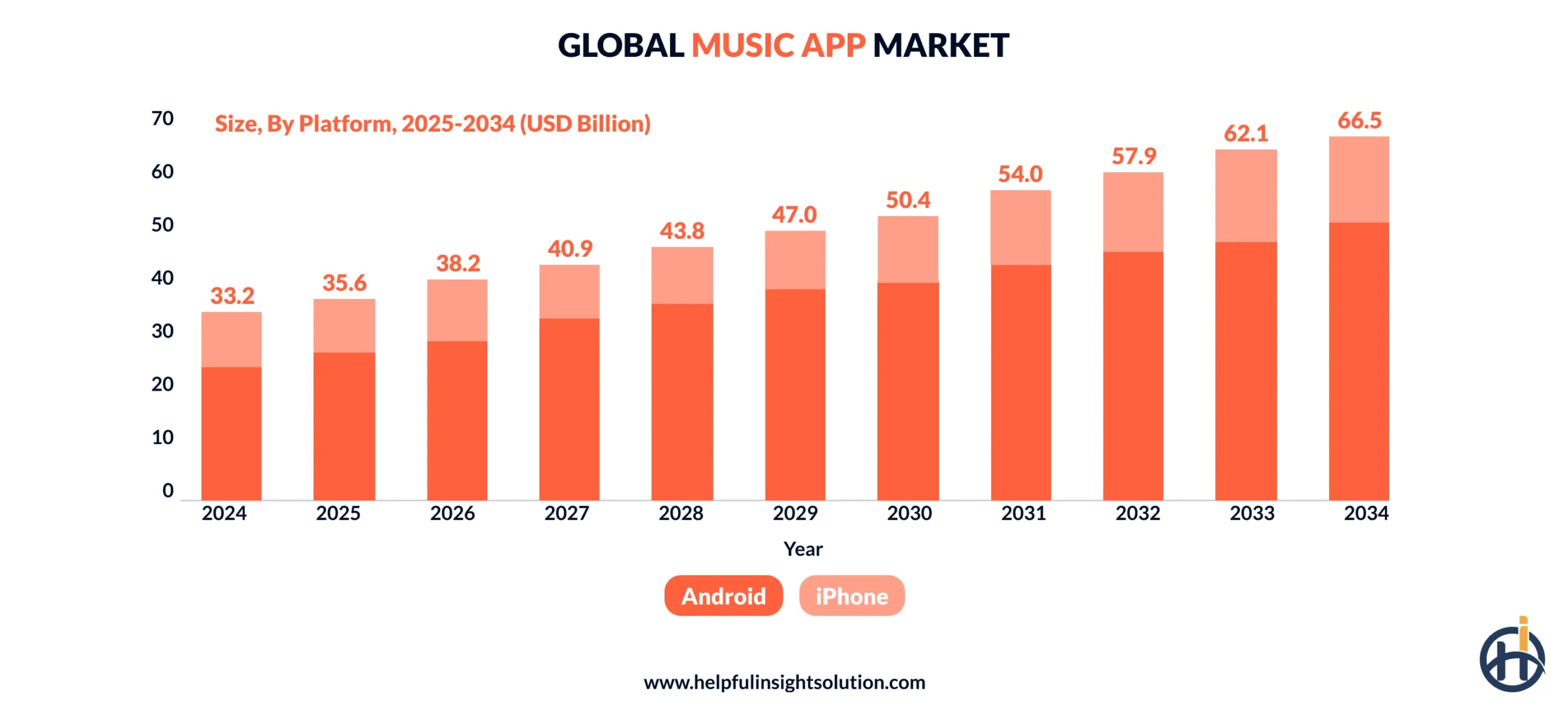
For startups, enterprises and independent artists entering this space, the opportunity has only widened. Niche platforms, regional markets, fitness-focused audio, and artist-direct streaming models are all areas where the right product, built well, can capture real market share.
This guide answers the question businesses ask most; “how to build a music streaming app” and breaks down every critical decision along the way, from features and licensing to tech stack, development process, and cost.
What is Music App Development?
Music streaming app development is the process of designing and building a platform that delivers audio content to users in real time straight from cloud servers, without downloads or local storage.
Building such an app involves so many aspects. From real-time audio delivery, cross-device playback, personalized recommendations, and licensing compliance, all have to work together without friction and those decisions need to be right from the beginning.
Working with a mobile app development company that understands these complexities from the ground up is what gives a product the best chance of being built right the first time.
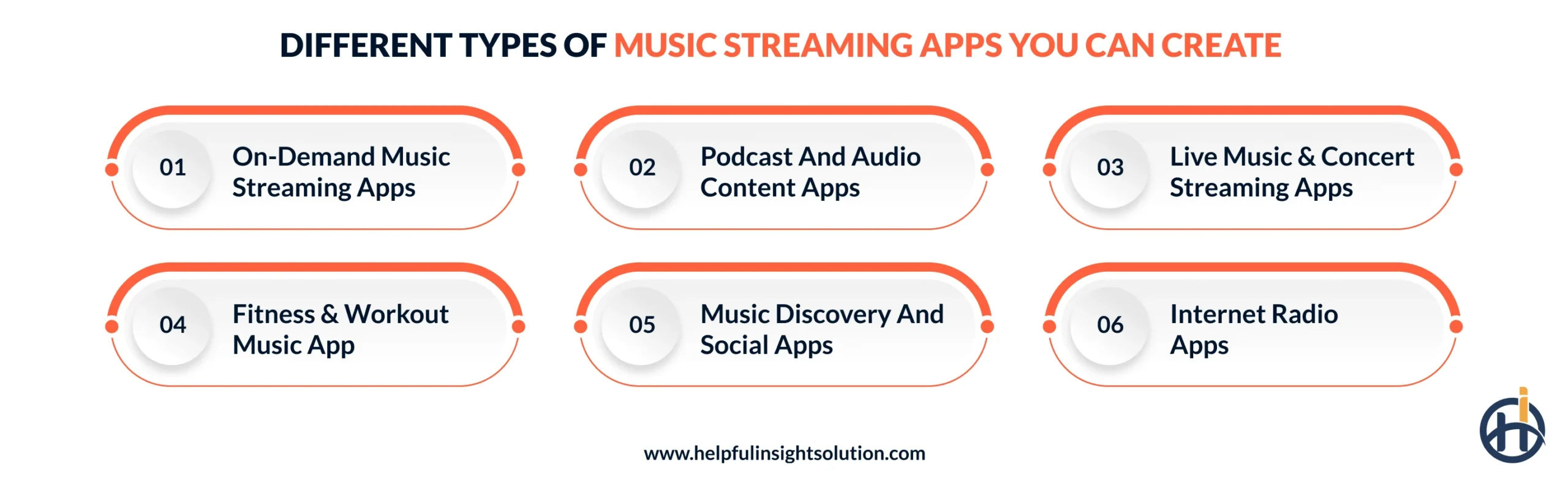
Different Types of Music Streaming Apps You Can Create
Many businesses directly jump into development before deciding what kind of music app they want to build. It is important to understand that not all music streaming apps are built around the same idea. A workout audio platform has entirely different requirements than an on-demand streaming service or a live concert app.
Here is a look at the main types of music apps, helping you choose the right type for your business model.
1. On-Demand Music Streaming Apps
On-demand music apps let users search, play, and download any track instantly, no waiting, no scheduling. Spotify and Apple Music built billion-dollar businesses around this model. Revenue runs on monthly subscriptions and ad-supported free tiers, with offline listening reserved for premium users as a deliberate conversion lever.
It is the most licensing-intensive and infrastructure-heavy model to build, but commercially it has the clearest proven ceiling of any app type.
2. Podcast and Audio Content Apps
Not every audio platform needs a music catalog to build a loyal user base. Podcast and audio content apps prove that consistently, users return daily for shows, interviews, and storytelling formats that music alone cannot replace.
This app helps businesses build a direct content channel that generates advertising revenue, subscription income, and audience data without depending on third-party music licensing agreements. Amazon’s Audible remains the clearest example of how far this model can scale.
3. Live Music & Concert Streaming Apps
Live music streaming app development lets artists perform directly to global audiences without physical venue constraints. What makes this model commercially interesting is the margins, a sold-out virtual concert costs a fraction of a physical production. Platforms like Veeps demonstrated that fans will pay for genuine live access regardless of geography.
4. Fitness & Workout Music app
Fitness audio apps solve a problem that general streaming platforms handle poorly, music that actually matches physical effort in real time. A runner mid-session does not want to manually skip tracks. They want a background music player that reads the moment and keeps pace with it.
Fit Radio app offers workout-specific audio and is monetized through premium subscriptions and fitness brand partnerships, without trying to compete with Spotify on catalog size. For businesses in the health and wellness sector, developing this app is worth paying attention to.
5. Music Discovery and Social Apps
Music discovery and social apps use AI-driven music discovery engines to surface tracks users would never have found manually. SoundCloud built its reputation by giving independent artists a platform while simultaneously solving the discovery of new music fatigue for listeners.
Businesses that invest in this type of on-demand music app development can earn revenue from subscriptions, artist partnerships, and affiliate arrangements with larger streaming platforms.
6. Internet Radio Apps
Internet radio apps deliver curated listening sessions built around genre, mood, and theme, a streaming audio ecosystem that feels familiar to traditional radio audiences but runs entirely through mobile and web. The real-time music streaming experience here is passive by design; users tune in rather than search.
Music licensing for apps in this category is far less complicated and costly, making it one of the more accessible entry points into the broader digital audio consumption market. iHeart is the perfect example of this type of music app.
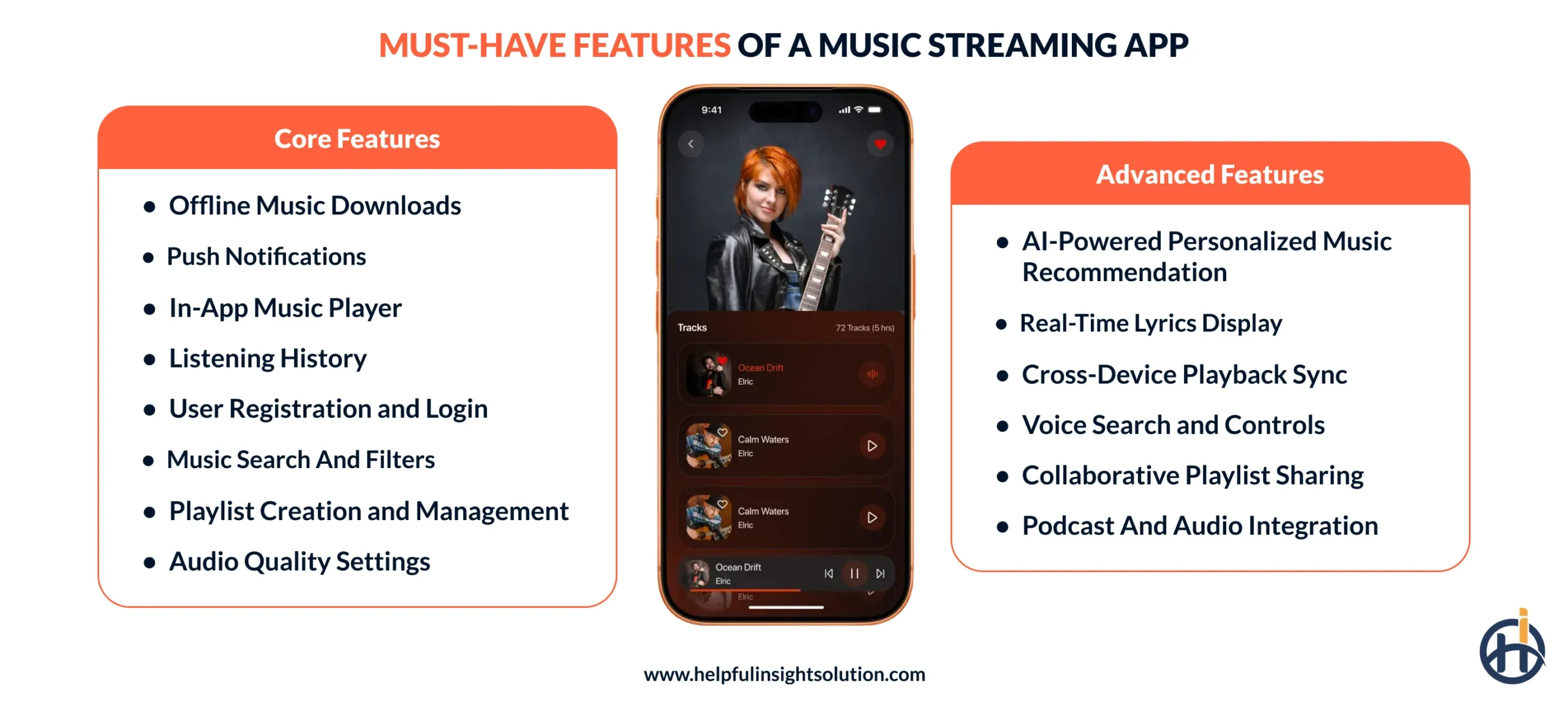
Must-Have Features of a Music Streaming App (Core and Advanced)
Features do not make a music app successful on their own, the right combination of them does. Users decide within the first few sessions whether an app fits their personalized listening experience or not. Getting that judgment in your favor requires working with talented dedicated developers who understand not just what to build, but what to prioritize and in what order.
Let’s have a look at the music streaming app features.
Core Features
In music streaming app development, these core features are not negotiable, they define whether the product works or does not.
1. User Registration and Login
The sign-up flow is where first impressions are made and abandoned. Supporting email, social media, and phone registration reduces drop-off significantly. Easy profile management gives users a reason to stay logged in rather than treating the app as a guest experience.
2. Music Search and Filters
Search is the first thing users test and the first thing they complain about. Results need to surface instantly across tracks, artists, albums, and genres with filters for mood, language, and release period. A search that handles typos, incomplete queries, and voice input without breaking is not a nice-to-have.
3. Playlist Creation and Management
This feature allows users to create custom playlists, organize tracks by mood or moment, and collaborate with others in real time. People who invest time building playlists rarely switch platforms. That is the retention logic behind making this feature work exceptionally well.
4. Audio Quality Settings
Good sound quality is very important in an on-demand music application. Giving them control over streaming quality, from standard to high fidelity music streaming, keeps the experience consistent across different network conditions and devices.
5. Offline Music Downloads
Users who travel frequently or commute daily depend on offline music playback features more than any other functionality. Giving them the ability to save tracks and playlists before they go is what often pushes free users toward a paid plan.
6. Push Notifications
Let users control what they hear from the trending songs app and when. New release alerts, listening reminders, and artist updates that match actual behavior bring people back consistently.
7. In-App Music Player
The player screen is where users spend the majority of their time in any music app. Controls need to feel immediate. Queue management, shuffle, repeat, sleep timer, none of it should require a second tap or a moment of hesitation from the user.
8. Listening History
This feature helps the app understand what a user genuinely enjoys, so users can find their way back to something they heard three days ago but never saved. Every skip, replay, and full listen builds a taste profile that makes the app smarter.
Advanced Features
These are the features that turn a functional music mobile app into one users genuinely cannot imagine switching away from.
1. AI-Powered Personalized Music Recommendation
Most users do not discover new music by searching for it. This feature does the searching for them, analyzing listening patterns, skips, and replays to build an AI powered music recommendation engine that gets more accurate the longer someone uses the platform.
2. Real-Time Lyrics Display
This functionality helps bring synchronized lyrics directly into the player, which lets users follow along, catch words they missed, and actually connect with what they are hearing. Lyrics display turns a background listening habit into something users genuinely pay attention to.
3. Cross-Device Playback Sync
Allow users to start a playlist on their phone and pick it up on a laptop or tablet without losing their place. The queue, listening history and playback position all carry over automatically across every device they use.
4. Voice Search and Controls
Voice search lets users find tracks, skip songs, and control playback entirely hands-free. The more naturally it handles real requests like play something similar to this or skip this one the more indispensable it becomes.
5. Collaborative Playlist Sharing
When you make a music streaming app, a collaborative playlist feature is worth prioritizing. It allows multiple users to build and edit a shared playlist together. Users who create a playlist together on a platform rarely leave it.
6. Podcast and Audio Integration
Most users already switch between music and podcasts throughout their day. Building both into one platform removes the need to jump between apps. A podcast and music streaming platform that handles both earns more than one that does either task alone.
Tech Stack for Music Application Development
Selecting the right and best technology stack is very crucial when building a music streaming app. The stack chosen early affects streaming quality, development timelines, scaling costs, and how much rework becomes necessary when the product starts growing faster.
1. Frontend
The frontend is what users judge the app by in the first few seconds. It controls layout, responsiveness, and how quickly interactions feel. A poorly built frontend makes even a technically strong backend feel broken to the average user.
Key technologies for frontend development are:
- React Native
- Flutter
- Swift
- Kotlin
- Next.js
2. Backend
The backend handles user authentication, music libraries, playlist management, API calls, and every request happening simultaneously across thousands of active sessions.
Key technologies for backend development are:
- Node.js
- Python
- Django
- Ruby on Rails
- GraphQL
3. Database Management
Music streaming apps collect huge amounts of data. Listening history, user profiles, track metadata, search behavior, playlist activity, all of it needs a database that stores and retrieves information fast enough.
Some of the top DBMS for music app development are:
- PostgreSQL
- MongoDB
- Redis
- Cassandra
4. Streaming and Audio Protocols
Getting audio from a server to a listener’s ears without buffering or sync issues is difficult. Different networks, devices and audio formats all behave differently under real conditions. The streaming protocol layer is what prevents that from happening consistently.
Common streaming and audio protocols are:
- HLS
- WebRTC
- MPEG-DASH
- FFmpeg
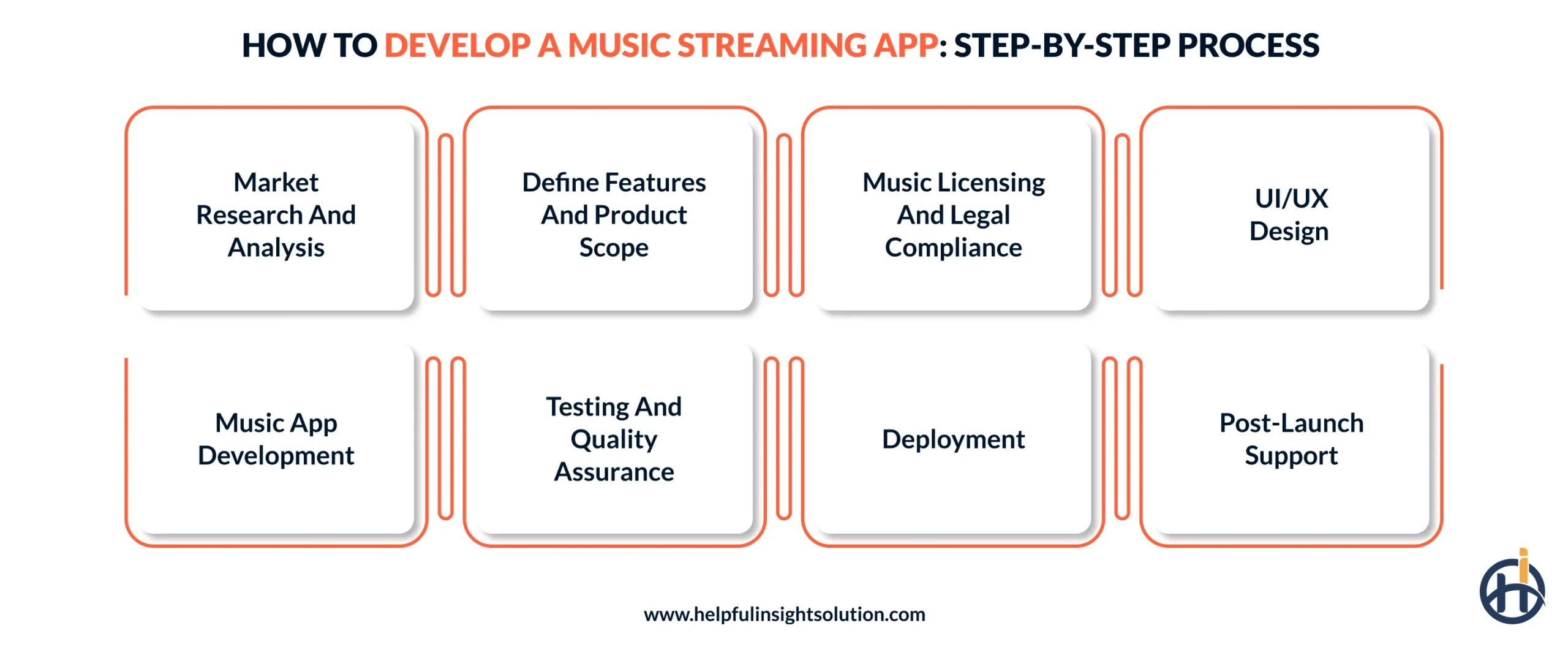
How to Develop a Music Streaming App: Step-by-Step Process
Every phase of creating a music app from discovery to deployment involves decisions that affect the ones that follow. Understanding that sequence before development begins is what keeps timelines realistic and budgets from expanding in directions nobody planned for.
Below is the complete music app development process.
1. Market Research and Analysis
Begin with market research as you cannot make meaningful product decisions without it. Understanding who the target audience is, what existing platforms get wrong, and where listener behavior is shifting gives the entire development process a foundation built on evidence rather than assumption.
- Study competitor platforms and user complaints
- Define target audience and listening habits
- Evaluate subscription and freemium monetization models
- Map emerging trends like AI recommendations
2. Define Features and Product Scope
Before a single screen is designed, there needs to be a clear answer to one question, “what exactly is this app doing in version one?” Therefore, businesses should work with mobile app development teams to decide on scope creep and the features they want to roll out first.
When the feature list is not locked before development begins, every week brings a new priority and hampers the development roadmap.
3. Music Licensing and Legal Compliance
Before any design or development begins, the legal framework around music rights needs to be understood and addressed, from performance rights, mechanical rights, and regional licensing obligations. Using copyrighted music without the right agreements in place exposes the platform to claims that can shut it down regardless of how well it was built.
4. UI/UX Design
In this stage, UI/UX designers build visually appealing and user-friendly interfaces for the music app. Basically, the design team takes the feature list and gives it a visual form. Every screen gets mapped out like the player, search, playlists, and subscriptions, before anything gets built. Stakeholders see exactly what the product looks like and how it flows.
5. Music App Development
This is where the music app like Spotify and Amazon Music gets built. But before starting to write the code, the team needs to agree on the development approach like Native or hybrid. Generally, cross-platform music app development is what most projects go with today as it helps building apps for both Android and iOS using one codebase.
From there, music app developers build the frontend, backend, and streaming layer together. Starting with an MVP is almost always the smarter call. It gives businesses something real to put in front of users before committing the full budget to a complete build.
6. Testing and Quality Assurance
QA teams thoroughly test the music app to identify bugs, glitches, security vulnerabilities and performance issues before anything goes live. A music streaming platform has too many moving parts like streaming performance, cross-device behavior, offline listening and payment processing, so it’s not a great idea to skip this step or rush through it.
Testing carried out at this stage typically covers:
- Performance testing
- Usability testing
- Device compatibility testing
- Security and penetration testing
7. Deployment
In this step, the music app is prepared for launch. That means server configuration, cloud setup, app store submissions and making sure nothing that worked in a controlled environment falls apart the moment real users show up.
8. Post-Launch Support
User behavior in production looks different from anything testing revealed. New devices, unexpected usage patterns, and scaling demands all show up after launch. So, it’s important to continuously monitor the app’s performance and improve it over time.
- Monitoring app performance and fixing post launch bugs
- Releasing updates based on real user behavior and feedback
- Scaling backend infrastructure to support growing demand
- Maintaining platform compatibility with new OS and device updates
Music Streaming App Development Cost Breakdown
One of the first questions every business asks before committing to a music app development is how much it will cost. The honest answer is that it depends on a wide range of factors, so it’s difficult to give an accurate estimate. On average, music streaming app development cost falls somewhere between $15,000 and $250,000. The gap between those figures is wide because the variables that drive costs are significant, which are:
- Project Complexity
- Platform selected
- Features
- UI/UX design
- Tech stack chosen
- Backend infrastructure requirements
- Music content licensing cost
- Location of music app development team, and many more.
In the table below, let’s explore the cost of music apps of different complexity levels.
| App Type | Estimated Cost Range |
| Basic App | $15,000 to $70,000 |
| Mid-Level App | $70,000 to $150,000 |
| Advanced App ( AI-Powered) | $150,000 to $250,000+ |
For a personalized quote, please share your project requirements with our team. For a quick estimate use our free cost calculator.
Music Streaming App Monetization Models: How to Generate Revenue
Understanding how to create music streaming apps and estimating the cost are important starting points. But how the app actually generates revenue is the decision that influences everything else, from pricing structure and content licensing to how the free tier is designed and what it offers.
In this section, we will discuss the different music app monetization strategies.
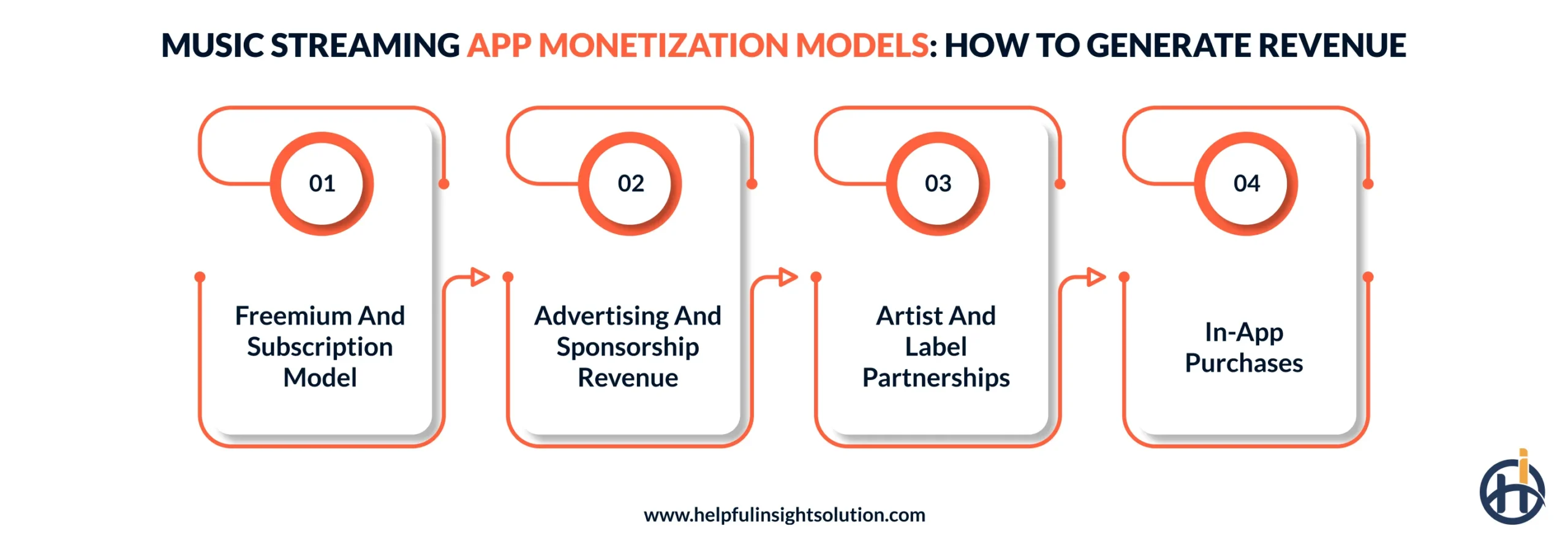
1. Freemium and Subscription Model
This is the most proven model in the music streaming industry. It gives users free access to use the app with certain limitations, like ads and skip restrictions. These limitations make users buy a subscription plan for an uninterrupted experience naturally, with no forced decision.
2. Advertising and Sponsorship Revenue
Not every user converts to a paid plan and advertising revenue makes sure that does not mean losing money. Audio ads and brand sponsorships turn free users into a revenue stream without asking them to spend anything as brands pay to reach the platform’s listeners.
3. Artist and Label Partnerships
This is a growing revenue model that smaller platforms use to differentiate. Exclusive content deals, artist promotions, and label partnerships create revenue streams that do not depend on subscription volume, relevant to startups and entertainment company audiences specifically.
4. In-App Purchases
This model allows users to pay for specific items they want within the music app like premium audio quality and early access to releases. These are sold individually and generate revenue without requiring any recurring commitment from the user.
Key Challenges in Music Streaming App Development and How to Overcome Them
An on-demand music streaming platform development comes with a specific set of challenges that are important for music businesses and developers to know and prepare for before starting the mobile app development process.
This section covers the challenges that arise most often and their solutions.
1. Music Licensing and Copyright Compliance
Music licensing is where many streaming projects hit their first serious wall. Every song on the platform needs permission from record labels, publishers, and performance rights organizations. Streaming without it can have legal consequences.
The Solution
Work with music licensing aggregators that offer pre-cleared catalogs. Starting with independent artists and creative commons music reduces complexity early.
2. Scaling Infrastructure for Growing Users
A music app that works smoothly with five thousand users can start showing cracks at fifty thousand. So, ensuring the platform doesn’t break is a challenge for the music streaming app development team.
The Solution
Starting on cloud infrastructure with auto-scaling built in means the platform grows without the team having to manually upgrade servers every few months. Plugging in a CDN early distributes audio delivery across multiple locations, keeping the listening experience consistent no matter how many people are online at once.
3. Audio Streaming Performance and Latency
Audio latency is one of those problems users feel immediately. A track that takes two extra seconds to load, skips mid-song, or drops quality on a slower connection does not get reported as a technical issue. It gets reported as a one star review.
The Solution
HLS and WebRTC handle audio delivery with minimal delay. What makes the real difference though is adaptive bitrate streaming is that it reads the user’s connection in real time and adjusts quality accordingly.
4. Cross-Platform Consistency
Building for multiple platforms sounds simple until the same feature behaves differently on different devices. A playlist that loads instantly on one device takes time on another. It is a big challenge for developers to make sure the app works perfectly and consistently across devices.
The Solution
Start with Flutter or React Native app development which means one codebase covers both iOS and Android, significantly cutting down platform-specific issues. Also, before launch always test the app with real devices.
Emerging Trends in Music Streaming App Development You Can’t Ignore
Music streaming technology does not stay still for long. A feature that made one platform stand out months ago is something users now expect from every app they try. If you are planning to build a music app, these trends are worth knowing before finalizing what you are building. If you already have one, they are worth knowing before a competitor implements them first.
Below are the latest AI trends to follow for on-demand music app development
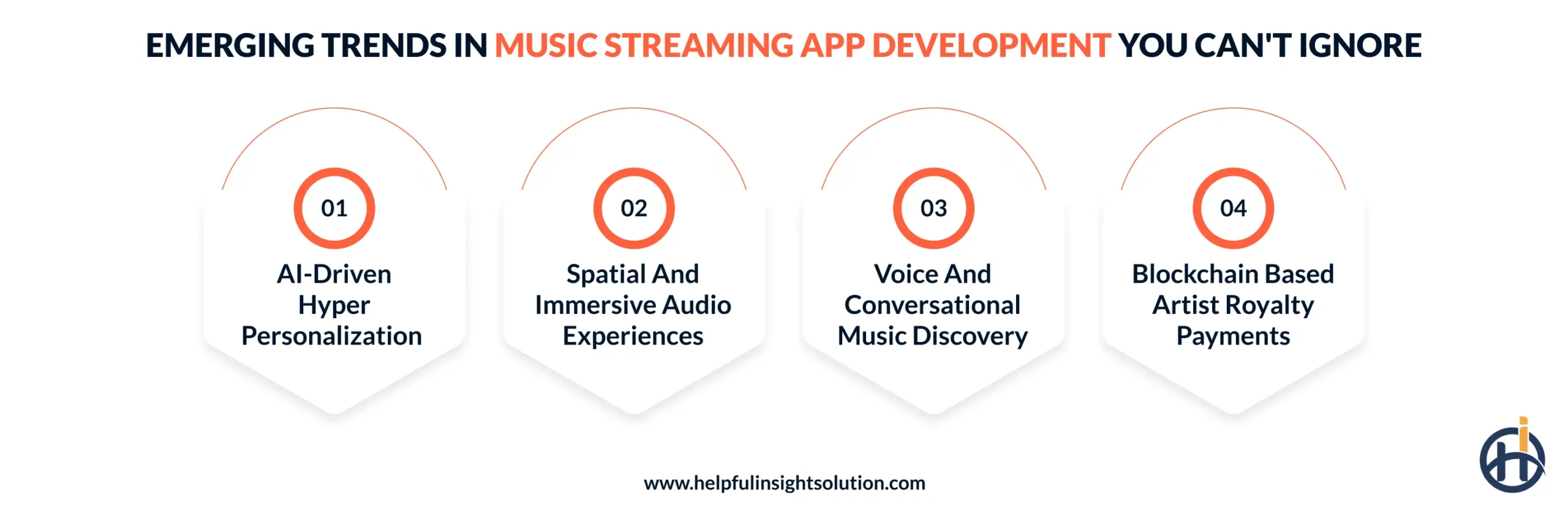
1. AI-Driven Hyper Personalization
Personalization in music streaming has moved well beyond genre-based playlists. Today, 75% of music streaming services use AI algorithms to analyze listening behavior, skip patterns, and mood, increasing listener retention by 40% compared to traditional methods. For an on-demand music streaming platform entering the market now, this is not a future consideration, users already expect it.
2. Spatial and Immersive Audio Experiences
Stereo audio was the standard for decades. That is changing. With spatial audio, sound moves around the listener the way it does in a real room. Apple Music has already made it a selling point.
For music apps now supporting spatial audio is becoming a meaningful differentiator, particularly for users who care about sound quality enough to pay for it. Check out these best music streaming apps to see how leading platforms are approaching premium audio experiences.
3. Voice and Conversational Music Discovery
The next trend on our list is voice and conversational music discovery. Somewhere along the way, asking a device to play music became completely normal. It happened gradually, smart speakers in homes, voice controls in cars, assistants on phones and now users expect music apps to keep up with how they actually behave in real life.
4. Blockchain Based Artist Royalty Payments
Artists have complained about royalty transparency for as long as streaming has existed. Blockchain technology addresses that directly. Every play gets recorded on a ledger that all parties can see, smart contracts trigger payments automatically, and the money moves without a chain of intermediaries taking time and percentage points out of it. Platforms building this in early are positioning themselves as genuinely artist friendly.
Why Partner With Helpful Insight to Build a Music Streaming App?
Music app adoption has grown faster than most industries anticipated and despite how crowded the market looks, new platforms continue to find their audience. The businesses that succeed are not the ones that arrived first. They are the ones that arrived with a clearer product, a smarter strategy, and the right team behind them.
The opportunity in on-demand music streaming app development is real and still open for businesses that approach it correctly. This music app development guide has covered everything from features and tech stack to licensing, cost, and monetization. But knowing what goes into building a music app and having the right team to build it are two different things.
That is where Helpful Insight comes in. We are a trusted music streaming app development company that works with startups, scaleups, and enterprises to build secure, high-performing music platforms. Our team brings hands-on experience across different app types and complexity levels, from focused MVPs to full-scale streaming products. We build around your business goals, not just your feature list.
So, connect with our team today and share your music app idea.
FAQs
The cost to build a music streaming app typically ranges from $15,000 to $70,000 for a standard platform, while a fully featured, AI-powered app like Spotify or Apple Music can cost anywhere between $150,000 and $250,000 or more. The final number depends on several factors including app complexity, feature set, platform choice, UI/UX design, licensing requirements, and the location of the development team.
The timeline for custom music streaming app development takes anywhere between 3 to 12 months depending on the complexity of the project. There are a lot of variables that affect timeline including, customization level, app design, third-party integrations and testing requirements.
Artificial intelligence in music apps is used in many different ways, such as:
- Personalized music recommendations based on listening behavior
- Mood and activity based automatic playlist generation
- Real-time skip and replay pattern analysis
- Voice search and natural language processing
- Predicting user churn before it happens
- Detecting copyright infringement through audio fingerprinting
Yes, any app that streams copyrighted music requires proper licensing. This includes performance rights through regulatory bodies and mechanical rights for reproduction. Operating without these exposes the platform to legal claims that can shut it down entirely.