

Every little detail can make a big difference in sports, right? Whether it’s a tiny second in a race or how an athlete moves, it all matters.
Today, players use real-time data to track their energy and movements during games. Wondering how? It’s all possible because of IoT in sports.
Internet of Things is a powerful technology that connects devices to share data instantly, and in sports, this is a game-changer. It helps athletes improve their skills, coaches manage their teams better, and even lets fans experience the games in new ways.
With all these benefits, it’s no surprise that the global sports IoT market is expected to hit $16.3 billion by 2033, and it will keep growing.

By using sports IoT solutions, athletes can easily track their performance with no need to do it manually, and improve their performance. Meanwhile, coaches gain access to real-time data that helps them make the right decisions, which contribute to uplifting the gameplay of the players.
Want to learn more about how IoT is shaping sports industry, what are its benefits and use cases? Then keep reading this blog till the end.
IoT in Sports: An Overview
Internet of Things means giving smart gadgets the power to connect and exchange data over the internet. When we talk about IoT in sports it simply means using devices like wearables to track things like a sports player speed, heart rate, and movements right during the games or training.
By using this valuable data coaches and athletes, can improve their performance, adjust training, prevent injuries, and make better-informed decisions that favour them during competitions.
Now, let’s have a look at the major components of IoT sports technology:
1. Wearable Sensors
They help in tracking data like heart rate, speed, and movement during sports. They can be built into gear like shoes, clothes, or equipment.
2. Actuators
Actuators use the data from sensors to make changes. For example, they can automatically control lights in a stadium, based on the information collected from the sensors.
3. Connectivity Infrastructure
Connectivity tools like Wi-Fi and Bluetooth allow data from sensors to travel to the cloud or central system. This lets athletes use real-time information for better decisions.
4. Smart Infrastructure
Smart equipment, like smart stadiums use IoT technology for better fan services, including apps for tickets and interactive features in the stadium.
Explore More: How To Build A Fantasy Sports App: A Complete Guide
Top Benefits of Integrating IoT in Sports
Integrating IoT in sports businesses has proven to bring numerous benefits by creating a connected network that improves almost every area of the sports industry. Let’s have a look at the advantages of IoT implementation in sports.

1. Improves Player Performance
Every athlete wants to enhance their game, and with IoT they can do that easily. With IoT they can know how they are performing in terms of speed or biomechanics and monitor things like heart rate and hydration helping create better training plans.
2. Real-Time Data Insights
The Internet of Things in sports has really helped athletes see how they’re doing during games or practices. Sensors and wearables track things like heart rate, helping coaches make quick decisions to enhance performance and keep athletes safe.
3. Boost Fan Engagement
IoT makes sports more exciting for fans by providing real-time data like ball speed. It helps with things like ordering food from your seat, finding parking, and checking restroom availability. It also makes stadiums safer with smart security systems.
4. Health and Safety Monitoring
IoT in sports has greatly helped keep athletes safe by tracking their vital signs, such as body temperature, during the game. This alerts coaches and medical staff to any health risks, helping prevent injuries and keep athletes healthy.
Read Also: IoT App Development: Benefits, Use Cases, And Challenges
Key Use Cases of IoT in Sports
IoT in fitness and sports has been a rage, and for all the good reasons. It creates new levels of connectivity and efficiency, bringing positive transformation. The sports industry is leaving no stone unturned to utilize its capabilities, as there are so many applications of IoT in sports, which are:
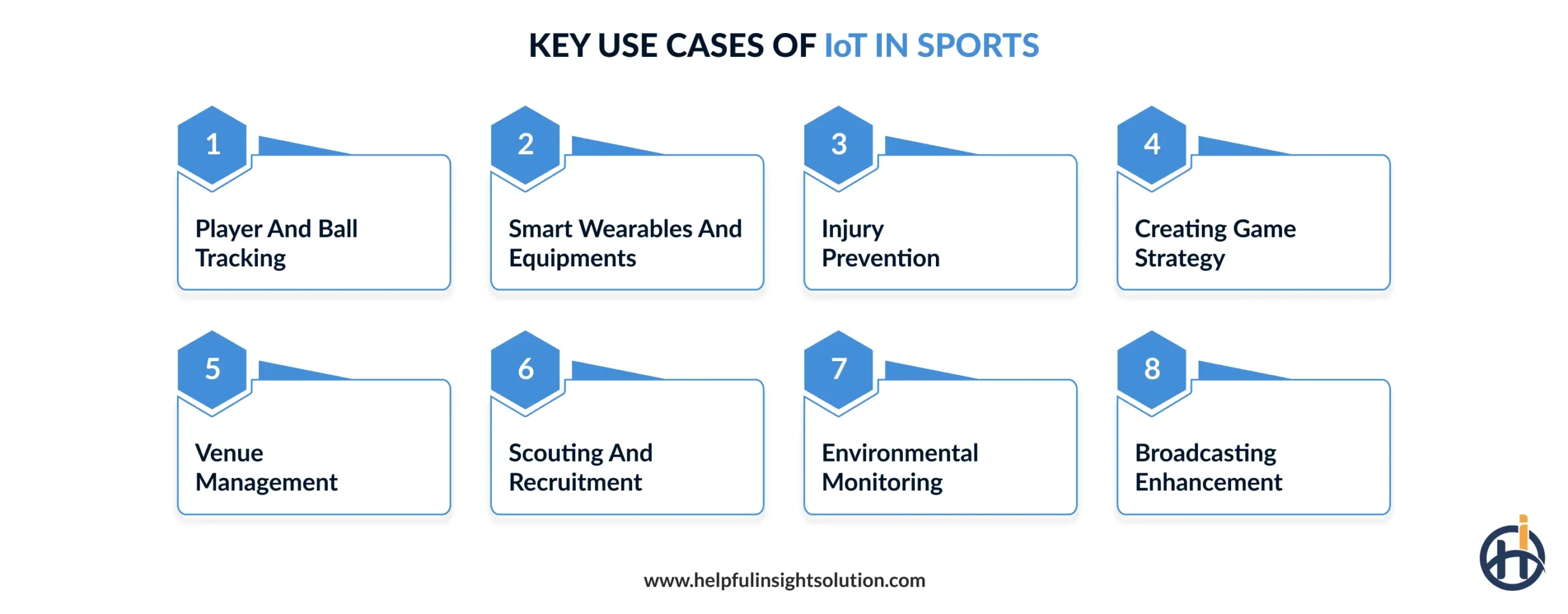
1. Player and Ball Tracking
While watching cricket, have you ever wondered how ball speed and a batter’s running speed are tracked in real-time? All thanks to IoT-powered cameras and sensors. These technologies provide real-time data on player movements, helping coaches understand the game’s flow and decide when to change strategies.
Example: GPS sensors in players’ shirts track their movements, while cameras follow the ball, showing live updates on speed and position.
2. Smart Wearables and Equipments
With IoT wearables for sports, athletes can monitor their heart rate, energy levels, and muscle recovery. These devices help players track their progress, spot weaknesses, adjust strategies, and improve skills. The insights from wearables are key for athletes to stay fit and perform at their best.
Example: A runner wears smart shoes that track speed, distance, and fatigue levels, helping them adjust their pace during a race.
3. Injury Prevention
IoT like smart sports technology use sensors in equipment such as shoes to measures pressure and motion during games or practice to spot harmful patterns and prevent injuries. Wearables monitors player’s health, if negative signs are detected, training can be adjusted to avoid overuse injuries.
Example: Football players wear smart helmets that measure impact force, alerting coaches if a hit is too strong.
4. Creating Game Strategy
No matter what the sport is, every team creates a strategy for how they will play. The Internet of Things in sports transforms how teams develop strategies by providing detailed data on player performance and weaknesses. This helps them stay prepared with tactics to use in different situations during the game.
Example: In tennis, IoT tracks racket head speed, shot frequency, and ball spin, helping players create better game tactics.
Read Also: How to Develop an App Like CBS Sports Fantasy?
5. Venue Management
Creating the best environment for both players and fans is crucial for great performance and enjoyment. IoT apps in sports helps manage sports venues by controlling lighting, temperature, air conditioning, and crowd movement. This ensures stadiums run smoothly and enhances the overall experience.
Example: In a stadium, smart systems adjust lighting and temperature based on the crowd size, while sensors help guide fans to their seats.
6. Scouting and Recruitment
Finding the right players for the team is tough with so much talent out there, right? The selection committee can use IoT sports analytics to analyze key data like strength and movement efficiency of players. This takes away the guesswork and helps identify hidden talent more easily.
Example: Use IoT sensors to track a player’s running speed and agility during training, helping choose the best candidates for the team.
7. Environmental Monitoring
It’s hard for players to perform when the environmental conditions are bad, like poor air quality. IoT applications in sports help assess the environment and surroundings before every match, ensuring athletes play comfortably. It also helps stadiums adjust operations to deal with any sudden changes.
Example: IoT app solutions track the temperature or humidity on a tennis court, ensuring players stay comfortable and hydrated during the game.
Read Also: How to Build a Fantasy Sports App Like Yahoo Fantasy?
8. Broadcasting Enhancement
IoT app development for sports have greatly improved how sports events are broadcast. IoT-powered drones capture unique camera angles, while sensors provide real-time data, giving fans a better view from different perspectives. It also helps presents analysis in the form of graphs and charts.
Example: Drones with IoT sensors provide live aerial views of the game, allowing fans at home to see game from different angles.
Steps to Develop an IoT App Solution for the Sports Industry
If you are planning to build Internet of Things applications for the sports domain, it is vital to understand that it involves a structured approach and technical know-how. So, it’s best to hire dedicated developers to ensure a successful app is developed.
Let’s have a look at the steps to create IoT apps for sports:
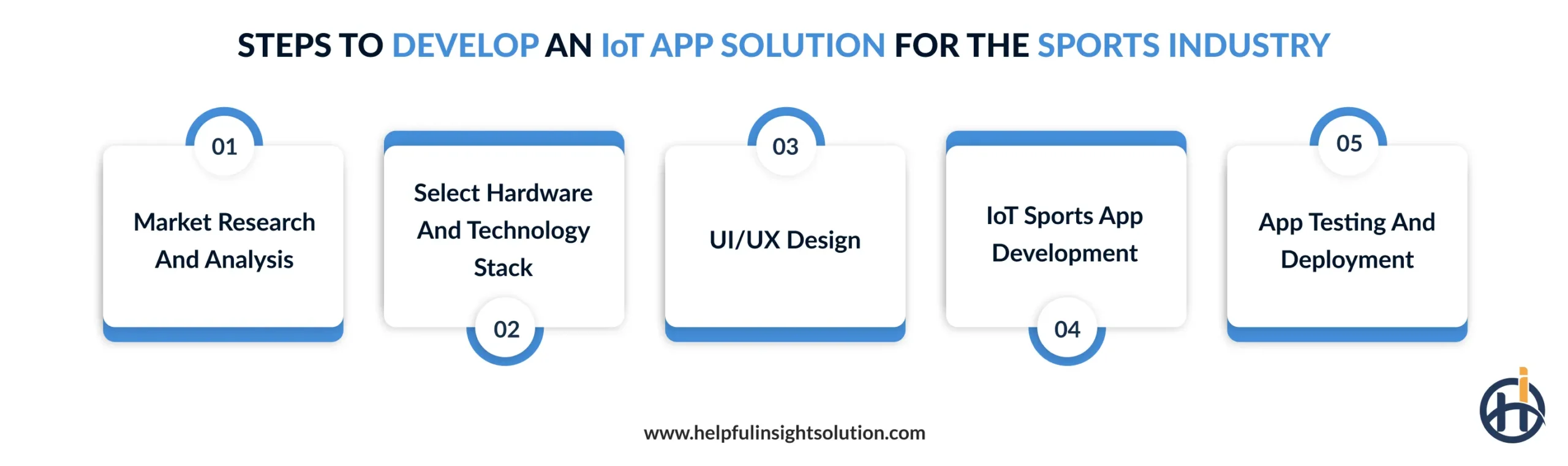
1. Market Research and Analysis
Begin by conducting market research, identifying the target audience, studying competitors, and gaining clarity on the purpose your app will serve. Also, decide the features you will integrate into the IoT app and the business model you will follow.
2. Select Hardware and Technology Stack
Next, choose the suitable IoT devices and sensors as they are the foundation of your IoT system. Also, select the best tech stack for IoT fantasy sports app development. App developers generally use JavaScript and React.js for the frontend, and Python and Node.js for the backend.
3. UI/UX Design
UI/UX designers will craft a user-friendly, attractive and engaging UI/UX for the IoT sports app solution. They will also create an interactive app prototype to better understand the app flow and how users will interact with the application.
4. IoT Sports App Development
In this stage, IoT sports app developers will work to build the frontend and backend of your app. Hardware and software components are smoothly integrated in the app to boost its performance. It’s best to first develop an MVP to validate your app idea.
5. App Testing and Deployment
Once the app is developed, it is passed on to QA engineers for testing. They will thoroughly check the app to identify and fix bugs and other issues. After testing, app is launched in the market. Keep monitoring the app’s performance to ensure it works best at all times.

Challenges in IoT Integration in Sports and Games
Integrating IoT in sports involves certain challenges which is crucial to understand for both businesses and mobile app developers, so they can be prepared.
Some of the main challenges of IoT implementation in sports involve:
1. Security and Privacy Concerns
It is vital to ensure that personal data collected from IoT apps, like player health metrics, stays secure. Implement strong security measures to protect data from hackers and prevent it from being misused.
2. Standardized Interoperability
One of the most common challenges that IoT app developers face is ensuring seamless compatibility between IoT devices, sensors, and wearables. The solution is to adopt standardized protocols and frameworks.
3. Data Management and Overload
IoT app solutions generate a voluminous amount of data; now, the real challenge is to manage that data. Developers must ensure that robust data management systems are created to handle data effectively without causing information overload.
4. Accuracy and Reliability
If the data or readings given by IoT devices are inaccurate, it can lead to some serious consequences. Therefore, it is important to invest in quality sensors and properly install them. Use AI and ML models for real-time anomaly detection.
Explore More: The Rise of Fantasy Sports Apps Market: Key Statistics and Trends
What Is the Future of IoT Applications in Sports
The current use cases of IoT in sports are already so full of potential and exciting that it’s thrilling to consider what the future might hold. With technology advancing rapidly and integration of technologies like AI into IoT sports apps, it’s clear that the possibilities are endless.
IoT sports technology trends we can witness in future may include:
1. AI-Driven Personalization
We can expect artificial intelligence in IoT apps to turn into personal coaches of players. It will keep a close watch on their movements and suggest ways to improve. AI can also create a digital twin of an athlete’s body to run simulations of different training scenarios to predict outcomes.
2. High-Tech Stadiums
In the coming years, it’s likely we will see smart stadiums powered by advanced technology that includes things like AR/VR experiences, IoT parking, and frictionless services like mobile ordering. Easy access to everything will make watching sports more interesting and safe.
3. Health Tracking Biometric Wearables
Wearable devices in the future won’t just track steps. Yes, you read it right. They’ll measure your hydration, muscle fatigue, and more. These devices are also expected to assist doctors in tracking player health remotely, making it easier to stay fit and prevent injuries.
Partner with Helpful Insight to Build Innovative Sports IoT Solutions
Integration of IoT in sports has truly transformed how sports are played and watched. IoT in sports and fitness has embraced innovation, whether by making stadiums smarter or using wearables to monitor player performance.
As a result, more businesses in the sports industry are eager to integrate IoT technology. If you’re looking to create an IoT sports app, our IoT app development company can help.
We are a trusted IoT app development services provider known for delivering secure, scalable, and feature-rich IoT apps for the sports sector. Our team comprises certified IoT app developers who possess years of industry experience in developing sports applications powered by IoT. When you partner with us, you get:
- End-to-end IoT sports app development services
- Affordable solutions
- Access to top-talent
- Dedicated support
Want to know more about how we can help you? Then, get in touch today with our team and share your project requirements.
FAQs
The Internet of Things in sports can be used for a wide range of things like:
- Track player performance in real-time
- Analyze game strategies
- Enhance fan engagement and experience
- Manage stadium operations efficiently
The cost of IoT app development is influenced by a wide range of factors, such as app complexity, number of features, chosen platform, hardware and sensors, UI/UX design, the location of IoT app developers, and many more. This makes it difficult to provide an accurate cost.
But don’t worry; once you share your app requirements with us, we will provide you with a custom quote. For a quick estimate, try our cost calculator.
It is important to understand that the timeline to build and integrate IoT technology with sports is impacted by numerous variables. This covers project complexity, customization level, sensor integration, diversity of devices, and app testing. The team at Helpful Insight is committed to delivering projects on time as promised.
Some of the most prominent real-life IoT in sports examples are:
- NBA’s smart basketballs is used for tracking shooting angles, speed, and accuracy during practice.
- NFL’s smart helmets monitor impact force during collisions to assess concussion risks.
- Wimbledon’s Hawk-Eye System has IoT-powered cameras to track ball and make accurate line calls during matches.