

Key Takeaways:
- AI can adapt various lessons, vocabulary, exercises, and learning paths based on the learner’s skill level, goals, and progress.
- Users get interactive practice sessions and real-time feedback through AI tutors, chatbots, speech recognition, and pronunciation analysis.
- Businesses need robust AI/ML models, cloud infrastructure, APIs, and a scalable mobile app architecture for developing learning apps successfully.
- The overall development cost depends on features, AI model selection, integrations, platform requirements, and customization level.
Artificial intelligence has now become a crucial technology for developing mobile apps, dynamic web apps, and software platforms. It can do a lot of things, from task automation to result prediction, with advanced data analytics.
In the education sector, an AI-powered language learning app not only allows users to learn through adaptive methods but also delivers personalized content based on their progress and skill levels. Various apps like Duolingo, Babbel, Rosetta Stone, Memrise, and ELSA Speak use AI in different parts of the learning experience that vary by product and feature.
According to Mordor Intelligence, corporate learners are increasing at a 23.7% CAGR due to the level of customization offered by these AI-based language practice apps. As adoption grows, businesses are also evaluating AI solutions for personalized and scalable language-learning experiences. To stay motivated and competitive in the market, enterprises aim for suitable guidance that ensures reliability and expertise.
This blog explains the role of AI in language learning apps, its growing market, and benefits for investors. Additionally, we will explore key features, development steps, costs, and major challenges in this content. So, let’s get started with it and understand the key insights.
What is an AI-powered language learning app?
This is an educational platform that uses artificial intelligence and speech recognition for real conversations, corrects mistakes, and adapts lessons. AI language learning applications, which include interactive virtual-tutor features, don’t rely on static flashcards or rigid matching games.
They provide instant pronunciation feedback, adaptive learning paths, and dynamic role-play scenarios according to the user’s personal skill level. The use of AI in mobile apps for language learning has helped people to increase confidence and businesses to enhance productivity.
This platform works in the following manner:
- It tests users’ current skills by monitoring reading, writing, and speaking.
- AI builds a custom study plan based on the learners’ ability to grasp content.
- Chat tools help to practice conversations by listening to voice and checking pronunciation.
- The app spots grammar mistakes during practice and provides real-time suggestions.
- The algorithm tracks missed words and moves them into the long-term memory.
Market overview and business opportunity
Language learning applications own a small but crucial portion of the e-learning sector, creating several opportunities for businesses. In this section, we will observe some interesting and valuable market stats with key advantages that motivate investors on a large scale.
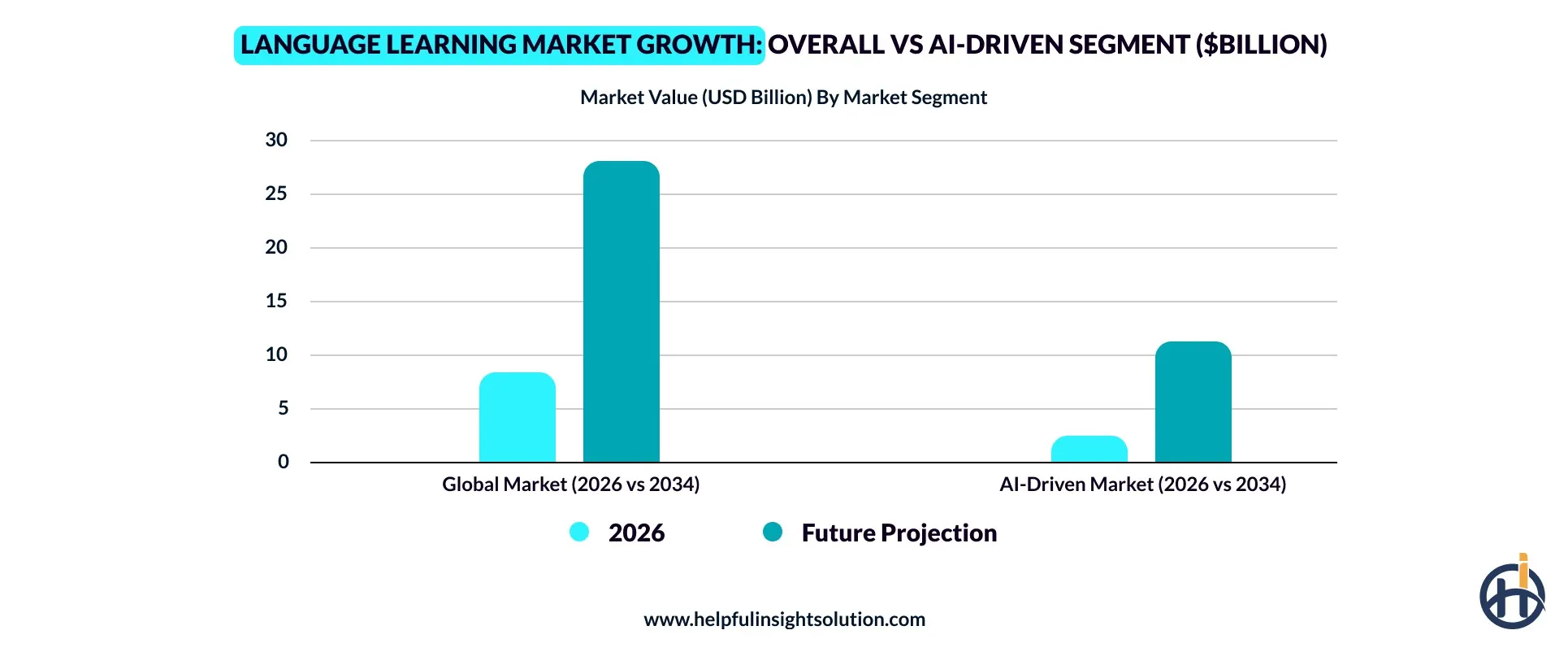
- The global language learning market generates a revenue of $8.6 billion in 2026, with North America having a share of 34.8% in the market.
- The revenue will increase to $28.3 billion by the end of 2034, as the market is growing rapidly at a 16.2% CAGR rate during this period.
- The AI-driven language learning app market generated revenue of $2.1 billion in 2026, reaching $10.9 billion by 2033 with a growing rate of 23.5% CAGR.
- Self-learning apps have a share of 56.4% in the learning mode segment, whereas English holds a 54.9% market share in the language segment.
- The Asia-Pacific region has a share of 45.6% in the market, and learners aged 13-17 have a 34.4% revenue share.
What benefits can enterprises expect from an AI-driven learning platform?
By creating top language learning apps with AI, entrepreneurs can experience multiple benefits that boost employee growth and reduce the skill gap. This segment helps organizations to understand what services an e-learning app delivers to ensure effective training and enhanced knowledge.
- Reliable delivery of language training across employees in numerous countries and time zones.
- Detailed dashboards illustrating competency levels, completion rates, and gaps in the workforce.
- Rapid onboarding of employees to the functional level needed to communicate with clients.
- Reducing training per-employee cost by eliminating expensive instructors.
- Synchronizes training data and certificates directly to enterprise systems.
Basic features of a smart language learning platform
It is better to know the key features of AI language learning apps before starting the real project. They enable businesses to understand how users interact with UI/UX design and get responsive feedback. Some of the core features are discussed in this section through the following table.
| Feature | Description |
| User onboarding & placement test | Assesses a learner’s proficiency level to place them in the right starting course. |
| Interactive lessons | Delivers structured vocabulary, grammar, and sentence-building content through engaging formats. |
| Progress tracker | Shows completed lessons, streaks, and skill growth through a visual dashboard. |
| Flashcard-based vocabulary builder | Uses spaced repetition to help users memorize and retain new words effectively. |
| Pronunciation practice | Lets users record and compare their pronunciation against native speaker audio. |
| Gamification elements | Motivates learners with points, badges, and levels to encourage consistent practice. |
| Offline mode | Enables users to download lessons and continue learning without internet access. |
| Multi-language support | Allows users to learn multiple languages or switch between them within one app. |
| Push notifications & reminders | Sends daily reminders to help users build a consistent learning habit. |
| Community/discussion forum | Provides a space for learners to connect, ask questions, and practice with peers. |
Advanced features of an AI language learning app
A few advanced features of an AI language learning app are described in this section, such as an AI tutor, speech recognition, and more. They provide more accuracy and enhanced learning through improved real-time assistance.
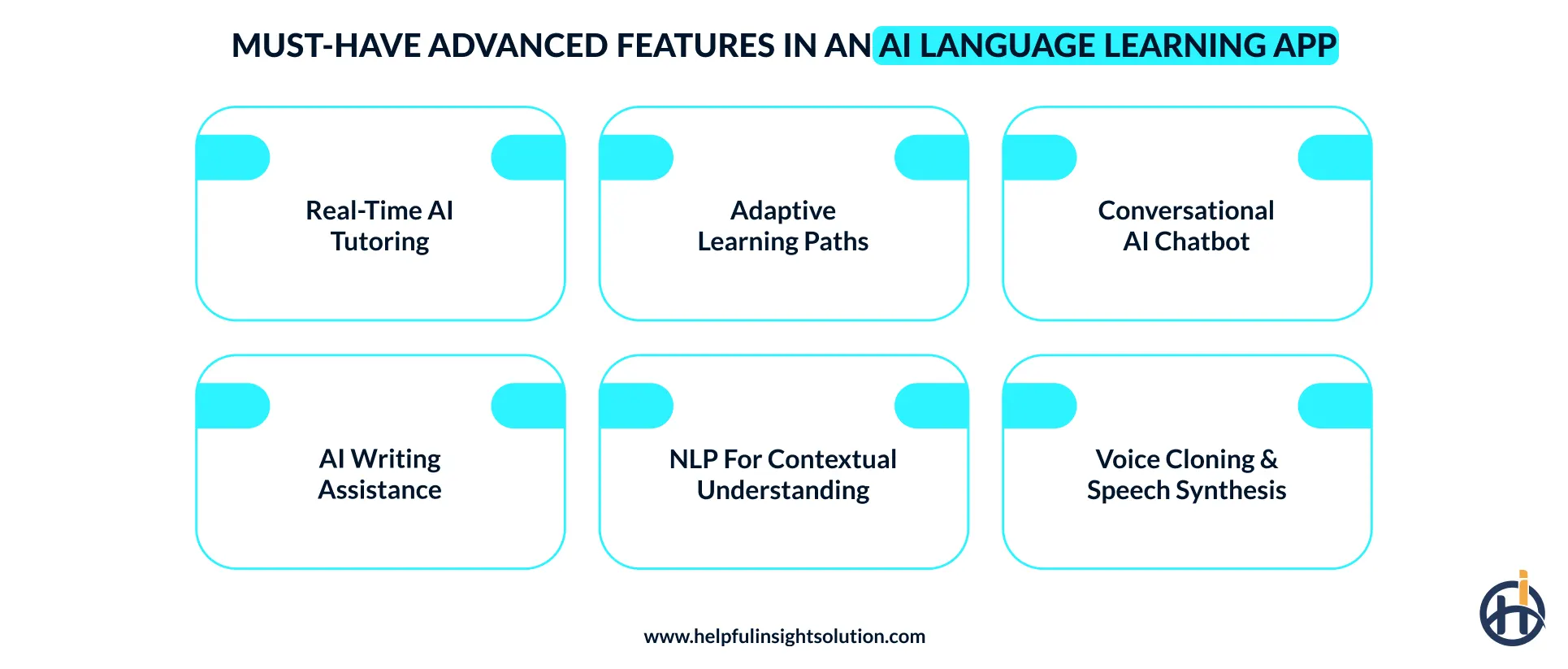
1. Real-Time AI tutoring
AI tutoring offers instant instruction to the student as they practice, identifying any mistakes or omissions in the material and providing live lessons or exercises. The feedback loop can provide immediate practice support and help learners identify errors more quickly.
2. Adaptive learning paths
Adaptive learning paths combine AI technology with the continuous observation of a learner’s behavior to adjust the difficulties, speed of progress, and content of the lessons. This helps to create a unique curriculum based on individual strengths, shortcomings, and rates of learning.
3. Conversational AI chatbot
Conversational AI chatbot development enables realistic practice of target language conversations because they simulate interaction with human-like responses. As a result, a safe environment free of judgment can be formed for improving speaking confidence before using the knowledge acquired with real human beings.
4. AI writing assistance
AI-driven language learning apps provide assessment of a user’s composition exercises, identifying any grammar or spelling mistakes and also suggesting corrections. Learners can progressively enhance their writing ability and will not need to depend on manual teacher feedback.
5. NLP for contextual understanding
It helps the app comprehend user intent through the words they type and the context surrounding them, rather than performing word-for-word matching. This can support context-aware interpretation and more relevant grammar or vocabulary feedback.
6. Voice cloning & speech synthesis
This feature can artificially synthesize multiple audio files in specific voices, tones, or accents, which can enhance the overall listening experience. It can be used to personalize pronunciations and learn how to pronounce words with specific speaking styles.
How to build an AI-enabled language learning app
The process of building an AI-powered language learning app requires planning, tech stack selection, API integration, and model training.
We are going to study all these crucial development stages in detail in this section, along with how AI app development services can help streamline each stage for building intelligent, scalable, and high-performing applications.
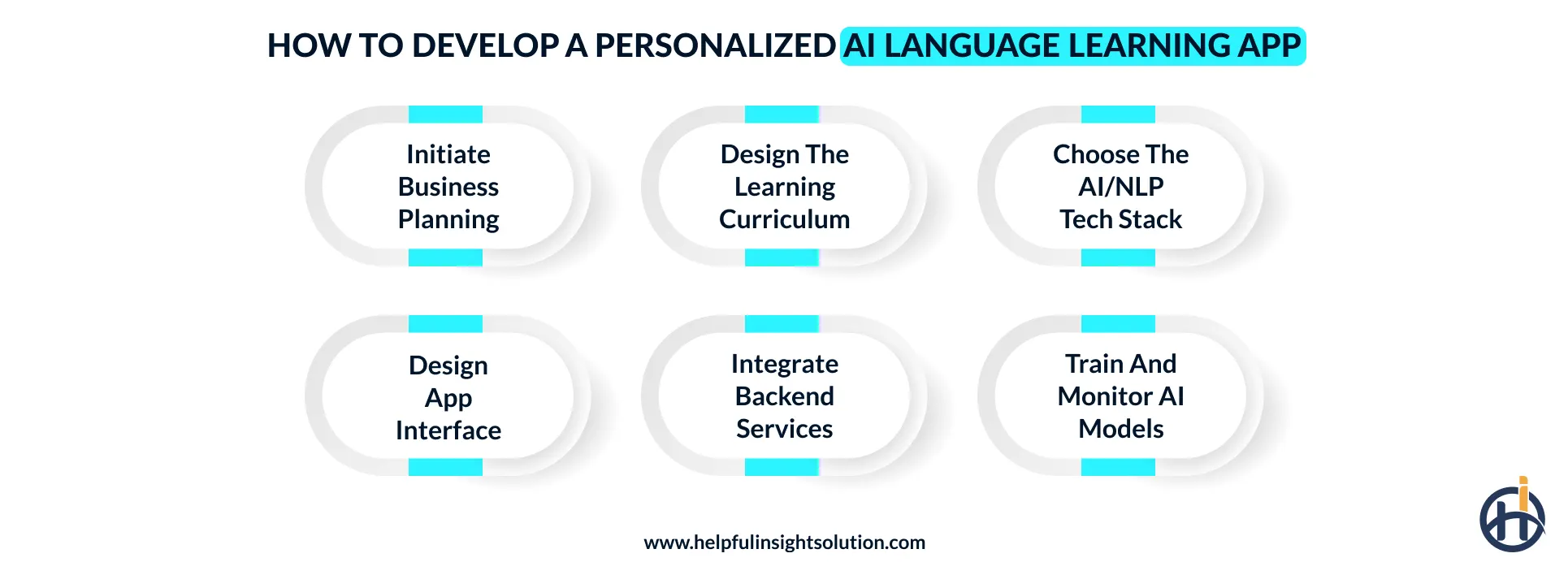
1. Initiate business planning
Before starting development, businesses must set a clear target audience, core value proposition, and monetization model that will lead all future decisions. This will ensure that they create a language learning app with a specific business purpose and not based on a feature checklist.
- Perform a thorough competitor analysis to discover market opportunities and differentiation.
- Define measurable KPIs such as users, retention, or revenue to measure performance after the launch.
2. Design the learning curriculum
In this stage, the course content is organized into various modules and a logical sequence of lessons, drawing from established proficiency frameworks and instructional methodologies. An effective curriculum design enables learners to proceed from simpler language forms to more complex forms in an orderly manner.
- Align content to predefined benchmarks such as CEFR (Common European Framework of Reference).
- Engage linguistic experts or qualified teachers to ensure the accuracy of the lesson and methodology.
3. Choose the AI/NLP tech stack
The selection of the appropriate AI and natural language processing technologies is crucial to provide various functionalities such as speech recognition, adaptive learning, and context-aware feedback. The ideal stack will take into account accuracy, scalability, and long-term maintenance costs.
- Compare pre-trained and custom models depending on budget and required level of specialization.
- Assess the availability of a multilingual data set for all the languages your app supports.
4. Design app interface
The interface design stage addresses user interaction and engagement with learning modules, providing an intuitive and visually appealing interface. UI directly influences retention and daily experiences for lesson delivery, quiz completion, and progress tracking.
- Take care of accessibility features like font size and screen readers.
- Take cultural differences into account with visuals, colors, and design that work across regions.
5. Integrate backend services
Here, all back-end logic, such as user data storage, content publishing, or integrating with any third-party service like a payment gateway, is linked with the frontend of the application. As the user base grows, the application’s reliability is ensured by these back-end facilities through advanced security measures.
- Introduce security measures for users, such as secure login and data protection with OAuth and SSO.
- Use auto-scaling in the cloud to accommodate traffic spikes without degradation in performance.
6. Train and monitor AI models
These AI systems require well-trained linguistic data models during the learning phase and consistent monitoring after they are launched. This helps teams monitor and improve performance in speech recognition, grammatical feedback, and personalization, allowing them to learn through experience.
- Use A/B testing to examine model behavior depending on user groups.
- Set up a system with a feedback loop that analyzes flagged content to be used for further training.
Tech stack for personalized language learning app development
To build an AI language learning app, businesses must implement an innovative tech stack that ensures complete support. They can hire dedicated developers who use various frontend, backend, database, and cloud tools with standard APIs to build a user interface and a strong architecture.
This section provides key technical frameworks and AI-powered technologies that experts use to make smart learning solutions for businesses across various industries.
| Component | Tools/Technologies | Description |
| Frontend Development | React Native, Flutter, Swift, Kotlin | Builds a cross-platform mobile app user interface |
| Backend Development | Node.js, Django, Ruby on Rails | Powers server logic and app functionality |
| Database Management | MongoDB, PostgreSQL, Firebase | Stores user data, progress, and content |
| Speech Recognition | Google Speech-to-Text, Microsoft Azure Speech | Converts spoken language into analyzable text |
| Natural Language Processing | spaCy, NLTK, OpenAI GPT | Analyzes grammar, meaning, and language context |
| Machine Learning Framework | TensorFlow, PyTorch, Scikit-learn | Powers adaptive learning and personalization models |
| Cloud Infrastructure | AWS, Google Cloud, Microsoft Azure | Hosts app data and supports scalability |
| API Integration | RESTful APIs, GraphQL | Connects app features with third-party services |
| Text-to-Speech Engine | Amazon Polly, Google Text-to-Speech | Generates natural-sounding audio for lessons |
| Analytics & Reporting | Google Analytics, Mixpanel, Firebase Analytics | Tracks user engagement and learning performance |
Cost of developing automated language assessment apps
Large-scale enterprises know that the AI-powered language learning app development cost is dependent on several market factors. These include developers’ experience, location choice, platform selection, team hiring model, and project complexity. Additionally, it is also influenced by multiple app-making stages, such as design, integration, testing, and security.
By knowing the cost to develop a mobile app for language learning, businesses can easily adjust their budget, manage resources, and prioritize features. Here is a generalized formula that helps businesses to estimate the average price by simplifying different parameters.
Total initial cost = [𝜮(Hours per feature * Hourly developer rate) * Platform multiplier] + AI asset cost
It is important to understand how various cost-affecting factors influence the overall business investment. With the help of the following table, we will know the average price and the real-time impact of each factor.
| Factor | Cost Range | Description |
| Project Complexity | $25,000 – $80,000 | Advanced AI assessment features increase overall cost. |
| Developers’ Experience | $30,000 – $100,000 | Senior developers charge higher rates, ensuring quality |
| Location Choice | $25,000 – $150,000 | Developer rates vary significantly by global region. |
| Platform Selection | $20,000 – $70,000 | Multi-platform builds cost more than single-platform. |
| Team Hiring Model | $30,000 – $120,000 | In-house teams cost more than outsourced models. |
| Design Charges | $10,000 – $40,000 | Custom UI/UX design adds development time and cost |
| Security Fees | $15,000 – $60,000 | Data encryption and compliance measures increase expenses. |
Challenges in developing an adaptive language learning platform
Common challenges in developing an AI-powered language learning app include data quality, privacy, model evaluation, and user-experience consistency. In this section, you are going to observe these obstacles with their real-time solutions.
1. Handling diverse accents/dialects
ASR models are trained on standard languages like American English and not on regional dialects, which require massive datasets. Additionally, the platform finds it difficult to match the pronunciation of the first language with the second language.
Solution: Train the speech engine by using a hierarchical acoustic model paired with diverse dataset fine-tuning, which reduces errors for all voices.
2. Personalization Without Overwhelming UX
Multiple learning paths or exercises prevent users from starting due to enhanced fatigue, cognitive overload, and interface clutter. Limited visibility into recommendation changes can make personalization harder for learners to understand or control.
Solution: In mobile app development, stealth assessment and layered interfaces help businesses to manage the personalization of features.
3. Data Quality & Availability
Generating high-quality data with error tags increases the cost to develop AI language learning apps, as user text is often too messy for AI models. The collection of learner voice recordings and typing patterns comes under strict privacy laws like GDPR.
Solution: Speech-specific language models can assist with error tagging and analysis, depending on the task, and Human-in-the-Loop (HITL) validation can enhance data quality.
Monetization strategies for AI-powered language education apps
An entrepreneur must develop an AI-powered language learning app to generate consistent revenue and ensure profitability. Some of the major monetization strategies, like subscriptions and in-app purchases, are discussed in this section.
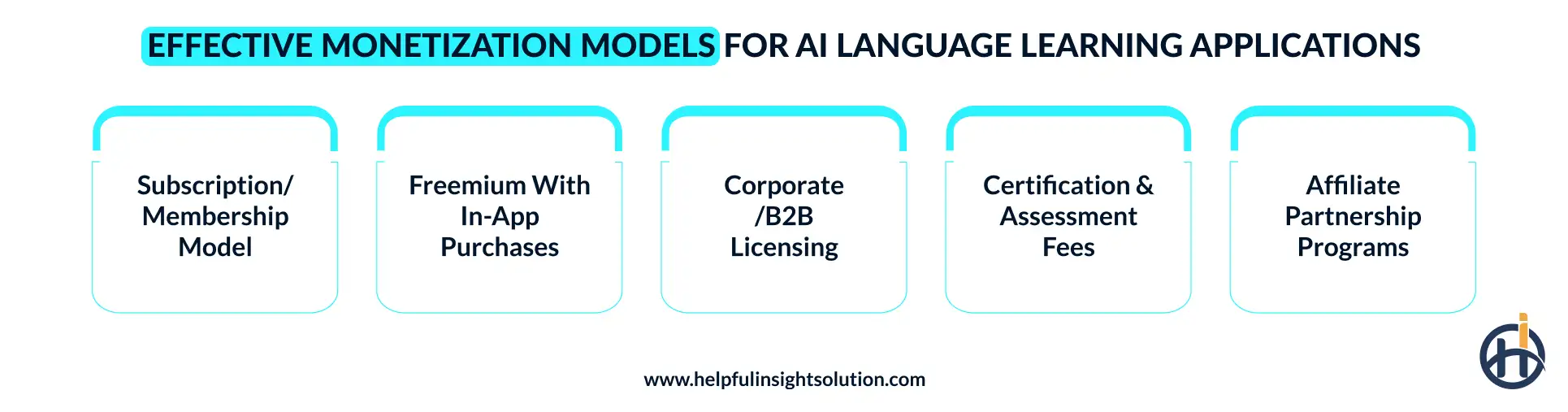
1. Subscription/membership model
This model requires users to pay a fee on a recurring basis, either monthly or annually, offering unlimited access to premium lessons, the AI tutor, and advanced features. It offers predictable revenue streams, flowing on an ongoing basis, for the business itself while also providing consistent value to its users.
2. Freemium with in-app purchases
It provides basic lessons for free and charges users for additional premium content, advanced courses, add-ons, and features like offline viewing. This helps businesses remove the entry barrier, ensuring a massive user base initially and turning enthusiastic users into payers.
3. Corporate/B2B licensing
This strategy involves selling bulk licenses or custom platform access to businesses for employee language training programs. This opens a high-value revenue stream, which requires deeper machine learning development to support enterprise-scale personalization, reporting, and system integrations.
4. Certification & assessment fees
AI-based language learning apps allow learners to pay once to take certified proficiency exams or get the official language certificates. This is an additional source of income that helps attract users seeking academic, immigration, or employment validation of their language proficiency.
5. Affiliate partnership programs
This includes collaborating with educational institutions, colleges, or study-abroad companies that endorse the app and recommend it to their users for learning. In return, the business gets a commission on referrals or profit sharing and obtains a wide customer base through increased retention.
How does Helpful Insight assist businesses in creating smart language-learning apps using artificial intelligence?
Get ready to create an AI-powered language learning app, as the market is already set for modern entrepreneurs. It is highly recommended to approach an experienced and skilled team that delivers smart machine learning, chatbot, NLP, and generative AI development services.
We are one of the leading AI companies, delivering market-ready automated solutions for businesses across the globe. Our experts ensure a safe and scalable environment for developing AI-enabled grammar correction platforms with features like pronunciation practice, adaptive learning, and AI writing assistants.
The integration of AI in language learning software is now a crucial requirement for most enterprises in the education sector. They can hire our experts and create advanced platforms for student learning, employer training, and skill enhancement. This will help them to build trust among users, generate profitable ROI across systems, and retain customers with ease.
FAQs
A simple MVP may take 2 months due to initial stages like planning and feature selection. Key development stages, like design, AI integration, and testing, may take time between 2 months and 7 months. Market launch requires a 1-month duration, but it is beneficial to keep a buffer time.
Various OpenAI and Anthropic LLMs are used with automatic speech recognition (ASR), NLP, and spaced repetition algorithms (SRS). Various frameworks like Keras, TensorFlow, and PyTorch are used to train neural networks. Most apps like Rosetta Stone have already implemented these technologies for better pronunciation and grammar checking.
The choice between pre-built AI APIs and custom LLMs depends on product goals, budget, and scalability. Custom models require additional time and are more expensive than pre-built APIs but offer full control. Also, they have a fixed ongoing infrastructure cost, lower latency, and reduced overhead.
It is beneficial to use various encryption methods, collect necessary data, and provide full user control. The developers must implement TLS/HTTPS and AES-256 techniques to secure data through database encryption. These standards protect the server from various real-time attacks like prompt injection.
Businesses can start with web platforms if they have a low budget, want faster updates, and want to perform instant testing. To deliver services like camera integration, GPS tracking, or offline storage, mobile solutions are suitable. Android is best for people who prefer comfort, whereas iOS is suitable for an expensive audience.