

Key Takeaways:
- Computer vision helps doctors analyze medical images, pathological reports, and patient data with accuracy, making faster clinical decisions.
- Automated patient monitoring, hygiene compliance, and disease detection are the best use cases of this technology in the healthcare sector.
- It reduces operational costs, minimizes errors, improves resource allocation, and enhances patient safety, ensuring increased business ROI.
- Businesses focus on high-quality patient data, regulatory compliance, and seamless medical integration for AI adoption.
Do you regularly monitor medical images, clinical databases, and patient safety? Is your supervision accurate, or does it result in diagnostic delays, increased workload, missed early-stage disease detection, and inconsistent image analysis? If this is the problem, then there is no need to worry, as computer vision in healthcare resolves all these issues with smart AI models.
It is the one-stop solution for all healthcare abnormalities that occur in hospitals or clinics, where data precision matters. From radiology to neurology, it covers all medical departments, ensuring compliance and efficient data quality.
According to a report published by Precedence Research, the computer vision-powered healthcare market will generate $6.4 billion in revenue in 2027. It is growing rapidly at 34.3% CAGR between 2026 and 2035 and will reach $66.8 billion by the end of the tenure. From a regional aspect, North America has a share of 37% in the market, which will grow further in the upcoming years.
This brings more to this industry, creating several opportunities for investors and healthcare providers. In this write-up, you will encounter various computer vision applications in healthcare, key benefits, implementation, and future projections in detail. So, it’s time to move forward and get more insights.
What is computer vision in healthcare?
Using computer vision for healthcare is the process of transforming how medical images are analyzed, diseases are diagnosed, and surgical procedures are simulated. This technology enhances clinical workflow, enabling patient monitoring and safety with real-time AI models.
It uses multiple algorithms to gather and process visual data from cameras or other hardware devices, reducing administrative expenses. The use of AI in healthcare ensures automated data interpretation with precision, seamless data sharing between systems, and detection of various symptoms.
- It helps in faster decision-making through image analysis with speed and accuracy.
- This technology ensures patient safety, preventing medical errors and surgical failure.
- It can automate various clinical operations, reducing costs and staff workload.
How does computer vision work in medical settings?
The working of computer vision in medicine explains what technologies it uses to gather, process, and execute visual data. We will also observe which platforms are highly dependent on the CV technology for image scanning.
Core technologies used
The key computer vision technologies in healthcare include the following:
- U-Net: It is a semantic segmentation architecture that helps to outline pixel-level boundaries of organs and tumors in CT or MRI scans.
- CNN: This provides deep learning networks that analyze grid-like data, such as X-rays, and classify images based on variations.
- Vision Transformers (ViTs): These models capture all parameters across large pathological slides and complex volumetric scans for better results.
Key platforms in healthcare
Some of the best healthcare tools are discussed as follows:
- PACS: This is a medical data management platform that stores, manages, and shares digital images like X-rays, MRIs, and CT scans.
- DICOM: It is also a global standard for storing healthcare images and making sure that different machines can easily work together.
Top computer vision use cases in healthcare
In this section, we discuss the best use cases of computer vision in healthcare that most institutions have adopted. These include medical imaging, patient monitoring, lab management, simulation, and more.
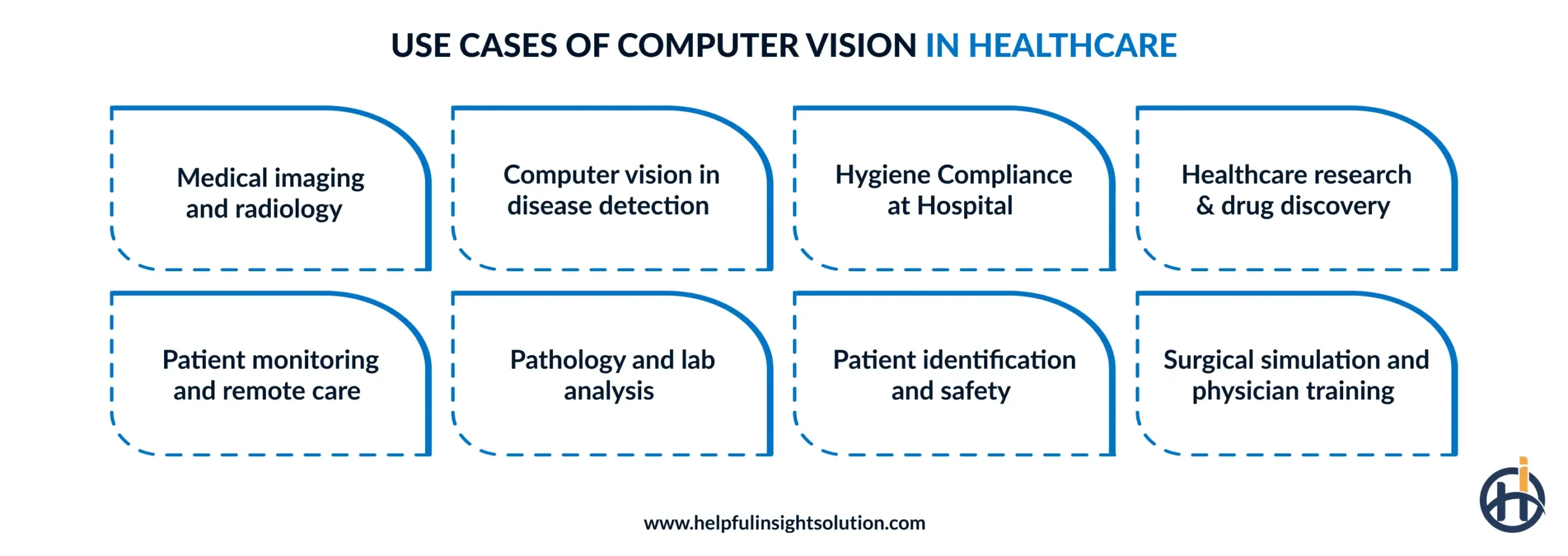
1. Medical imaging and radiology
Computer vision in medical imaging is beneficial for analyzing X-rays, CT scans, MRIs, and ultrasounds. It can find problems like tumors, fractures, and organ damage a lot faster and more accurately than people can. The use of AI in medical imaging helps doctors make diagnoses faster and come up with plans for treating patients.
- Detects abnormalities in medical imaging scans.
- Enhances image quality for accurate diagnosis.
- Reduces radiologists’ manual interpretation workload.
2. Computer vision in disease detection
AI-enabled systems analyze retinal scans, dermoscopy images, and histopathology slides to identify various biomarkers. This includes severe conditions like diabetic retinopathy, melanoma, pneumonia, and cardiac disease, detecting abnormalities at earlier stages than manual clinical review. When doctors can find these diseases early, patients are more likely to get better and have fewer problems.
- Identifies diseases at earlier clinical stages.
- Detects subtle patterns missed by humans.
- Supports faster and more accurate diagnoses.
3. Hygiene Compliance at Hospital
Computer vision-based networks installed near hand sanitization dispensers detect hand movements and personal protective equipment (PPE) usage, flagging non-compliance without manual observation.
They can log violations and generate alerts for infection control teams without requiring manual observation. This helps patients and hospital staff to prevent various diseases and improve their health.
- Monitors hand hygiene compliance automatically.
- Detects improper personal protective equipment usage.
- Reduces hospital-acquired infection risks significantly.
4. Healthcare research & drug discovery
It helps researchers, allowing them to look at pictures of cells and other small things with a lot of accuracy. They use AI models to find things that might mean someone has a disease, to see how well new medicines work, and to look at a lot of pictures from labs all at once. This helps them do their work faster and makes it easier to find medicines.
- Monitors hygiene compliance in hospitals automatically.
- Identifies potential drug response patterns.
- Accelerates biomedical research and discoveries.
5. Patient monitoring and remote care
AI models running on bedside and corridor cameras continuously track patient movement, detecting falls, abnormal posture, and respiratory distress in real time.
Doctors and nurses ensure immediate clinical response without relying on periodic checks. This makes it easier to take care of patients from far away and helps healthcare workers have less to do.
- Tracks patient movements continuously using cameras.
- Detects patient falls and medical emergencies instantly.
- Supports remote monitoring for chronic patients.
6. Pathology and lab analysis
Physicians rely on AI algorithms to examine tissue samples, blood smears, and laboratory slides for cellular abnormalities and early signs of disease. CV and AI technologies support pathologists by highlighting areas of concern, improving diagnostic consistency, and reducing analysis time. As a result, laboratories can operate more efficiently while minimizing errors, even under real-time clinical conditions.
- Automates tissue sample image analysis.
- Identifies abnormal cells with precision.
- Speeds laboratory diagnostic reporting processes.
7. Patient identification and safety
Computer vision in healthcare applications verifies patients by looking at their face, checking their body measurements, or matching pictures with codes to prevent mistakes. It makes sure the right patient gets the medicine, treatment, and surgery, decreasing medical errors. This keeps patients safer, helps hospitals work better, and improves overall engagement.
- Verifies patient identity before treatment.
- Prevents medication and surgical identification errors.
- Improves overall hospital patient safety.
8. Surgical simulation and physician training
AI-driven medical systems enhance surgical training by analyzing hand movements, instrument handling, and procedural techniques during practice sessions.
Artificial intelligence provides real-time feedback, recommends areas for improvement, and evaluates consistency in performance. This enables surgeons to refine their skills and achieve proficiency before performing procedures on actual patients.
- Simulates realistic surgical training environments.
- Tracks surgical instrument handling accuracy.
- Provides AI-powered performance improvement feedback.
Computer vision across medical specialties
You must know that computer vision for healthcare is capable of managing various departments, like Cardiology and Neurology. Here we are going to study key medical specialties that are common in hospitals or clinics.
1. Ophthalmology
Computer vision enables automated analysis of OCT scans and fundus photographs to detect diabetic retinopathy, glaucoma, and macular degeneration at subclinical stages. This helps eye doctors check patients quickly and find serious vision problems before people even notice any symptoms.
2. Dermatology
AI can find skin growths, moles, and rashes by comparing them to a lot of information about known conditions, including melanoma in the early stages. This makes checking skin issues more reliable, which is especially helpful for people in remote areas or using telemedicine for skin care.
3. Cardiology
Computer vision helps look at heart scans like echocardiograms, angiograms, and cardiac MRIs to find problems with the way the heart is shaped, how it works, and how blood flows. It also helps measure numbers like ejection fraction automatically, which saves time for doctors who used to do this by hand.
4. Neurology
In neurology, computer vision accelerates the interpretation of brain MRIs and CT scans, detecting stroke, intracranial hemorrhage, and neurodegenerative diseases like Alzheimer’s or Parkinson’s. Longitudinal analysis tracks disease progression across serial imaging with greater consistency than manual comparison.
5. Oncology
AI-powered image analysis classifies tumors in pathology slides and radiology images, assessing malignancy and staging while monitoring treatment response. This inclusion of AI in Oncology helps to reduce image processing time and find groups of tumors and check if they are cancerous.
Key computer vision benefits in healthcare
The use of computer vision in medical field has increased because of its multiple benefits, such as faster processing and improved quality. You must know these advantages before investing in AI-driven healthcare platforms.
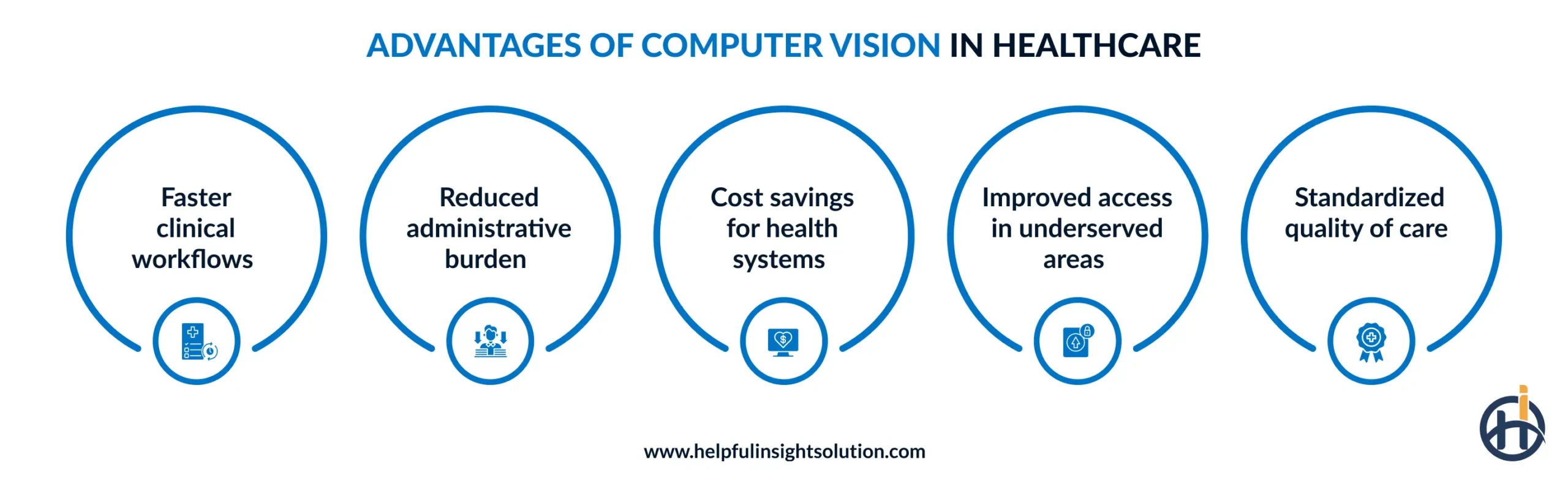
1. Faster clinical workflows
Computer vision really helps doctors and nurses by cutting down the time they spend looking at scans and images. This means that people who are sick can get their results faster, and the doctors and nurses can focus on figuring out the best way to treat them instead of just looking at pictures.
2. Reduced administrative burden
Computer vision does this by taking care of the tasks that doctors and nurses usually have to do, like looking at pictures over and over again. With advanced surveillance systems, doctors and nurses can focus on harder cases and take care of their patients directly instead of just looking at pictures all day.
3. Cost savings for health systems
Using computer vision to look at pictures and diagnose people also reduces the number of times people have to get scanned, and it reduces the number of mistakes that doctors and nurses make. This saves a lot of money for hospitals and clinics, enhancing patient care in real-time.
4. Improved access in underserved areas
In places where there are no doctors and nurses, Computer vision allows local clinics to check on people and then send the results to a specialist who is far away. This helps people who live in areas that’re far away from big cities because they can get the care they need without having to travel a long way.
5. Standardized quality of care
This technology uses the system to look at every picture, so it does not matter who is looking at the picture or where they are. Computer vision helps make sure that people get a consistent level of care everywhere, and that is a good thing for computer vision and for people who are sick.
Challenges of implementing computer vision in medical
There are a lot of challenges in the implementation of computer vision in healthcare, like data privacy and increased costs. We are going to discuss key issues in this section with their respective solutions in detail.
1. Data privacy and regulatory compliance
The handling of sensitive patient data and ensuring strict regulations are the key challenges in healthcare. It involves advanced medical imaging, biometric scans, billing data, and compliance with HIPAA or GDPR.
Solution: The implementation of a decentralized training framework prevents raw PHI from leaving the firewall and exposing the central database.
2. Bias from limited training data
It occurs due to limited data diversity, poor representation of healthcare data, and skewed collection points. This leads to unfair treatment results for patients and increases the risk of chronic diseases.
Solution: Enterprises must follow advanced AI techniques like SMOTE and GANs that create realistic images to counter unbalanced medical data.
3. Integration with legacy systems
This includes data formatting issues, rigid infrastructure, and poor interoperability between systems. Older systems cannot process modern AI models, which can harm EHRs and other medical workflows.
Solution: You must hire an AI development company that helps to build a transition layer through API wrappers, middleware, and real-time cloud servers.
4. . High upfront implementation costs
The use of expensive hardware, software licensing, and large-scale data integration increases the overall costs. EHR systems, edge computing devices, and custom AI algorithms are the key cost-affecting factors.
Solution: It is beneficial to use subscription plans and a cloud-based service model for buying cameras, product licensing, and algorithmic analysis.
5. Explainability & clinician trust
Various deep learning models show outputs without any reasoning and cannot easily align with medical data. This leads to trust issues, as doctors deliver false positives and routines instead of helping patients.
Solution: Businesses can use Grad-CAM (Gradient-weighted Class Activation Mapping), which generates heatmaps to track accurate medical scans.
How to integrate computer vision technology in healthcare?
Computer vision integration in healthcare solutions involves multiple stages, from ideation to AI validation. Here, you are going to observe every step that will help you to manage the budget and trends.
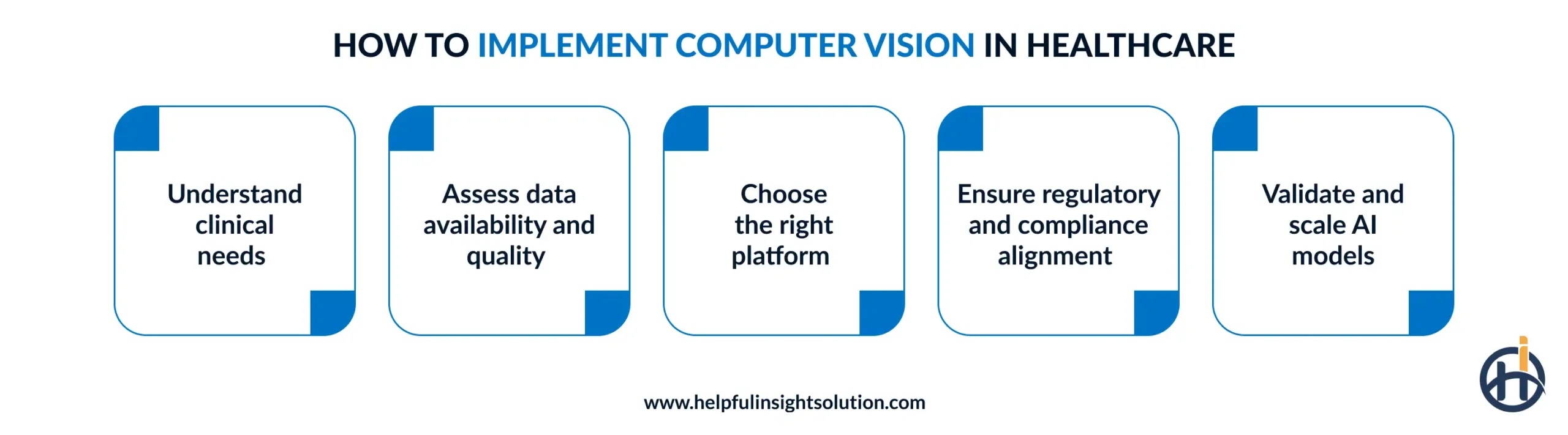
1. Understand clinical needs
Before starting any work, it is crucial to figure out what specific problem computer vision is going to solve in the medical field, like making diagnoses faster or improving the accuracy of detection.
To do this, businesses must work with doctors, radiologists, and hospital administrators to understand where the real problems are in the workflow. If this step is right, investors can make sure the solution actually solves a problem rather than just being about the technology.
2. Assess data availability and quality
The computer vision models are only as good as the pictures and scans we use to train them, so it is necessary to check how different the images are and how good they are. Hospitals need to make sure their data is labeled correctly, that it includes a variety of patients, and that it meets privacy rules. If computer vision development services are not used to resolve biased data, it can make the model’s performance unreliable.
3. Choose the right platform
Choosing the computer vision platform depends on things like whether it can work with the systems, like PACS or EHR, and whether it can handle a lot of information. Healthcare providers have to decide whether to build their solution, use a platform from a specialist company, or adjust existing artificial intelligence models. This decision will affect how flexible, expensive, and easy to adopt the solution is across departments.
4. Ensure regulatory and compliance alignment
Any computer vision solution used in settings has to meet rules like getting clearance from the FDA for diagnostic tools and following HIPAA rules to protect patient data.
This means it is important to document everything, check that it works clinically, and often go through a formal review process before using it. If this step is skipped, it can delay things, which may create legal and safety problems.
5. Validate and scale AI models
Before using computer vision models, businesses have to check that they work well with real medical data with accuracy, reliability, and consistency across different types of patients and imaging conditions.
Once the whole system is checked, enterprises should scale up gradually, starting with a test in one department or hospital before expanding to the whole hospital. They must keep watching and retraining the models to make sure they keep working as new data and medical situations come up.
Best computer vision case studies in healthcare
Various computer vision tools for healthcare allow medical professionals to streamline workflow and reduce expenses. In this section, such platforms are being discussed with their key features and impact.
1. Aidoc
Aidoc’s AI platform looks at CT scans, pointing out serious problems like brain bleeding and blood clots in the lungs. It also helps radiologists focus on the important cases at more than 1,000 hospital locations around the world.
2. PathAI
PathAI makes pathology better by using AI to look at slides, helping pathologists find cancer and other issues quickly. Its AISight system makes diagnoses more accurate and helps with research for drug development in the biopharma industry.
3. Viz.ai
Viz.ai helps in finding strokes using AI by checking CT scans, spotting problems, and telling the team right away. This system makes treatment faster for patients who’re very sick and makes the whole process better for everyone involved.
Regulatory and compliance landscape in healthcare
Businesses implement computer or machine vision in healthcare to ensure regulatory compliance through constant patient data monitoring. With predictive analytics in healthcare, they can easily forecast future trends and apply medical standards according to the needs. Here, we are observing some important healthcare compliance through the following table.
| Regulatory Component | Description |
| HIPAA Compliance | Ensures patient health information processed by computer vision systems is securely stored, transmitted, and accessed only by authorized users. |
| GDPR and Data Privacy | Requires healthcare organizations to obtain patient consent, protect personal data, and maintain transparency when using AI-powered image analysis. |
| FDA/Medical Device Regulations | AI-based computer vision software used for diagnosis or treatment must meet regulatory approval standards before clinical deployment. |
| Data Security & Cybersecurity | Healthcare providers must implement encryption, secure access controls, and continuous monitoring to safeguard medical images from cyber threats. |
| AI Transparency & Clinical Validation | Computer vision models should be explainable, clinically validated, and regularly audited to ensure accurate, unbiased, and trustworthy healthcare decisions. |
The future of computer vision in the healthcare industry
The future of computer vision in healthcare includes multiple innovations and advanced integrations. We will cover every aspect in this section that enables revenue growth, patient engagement, and scalability.
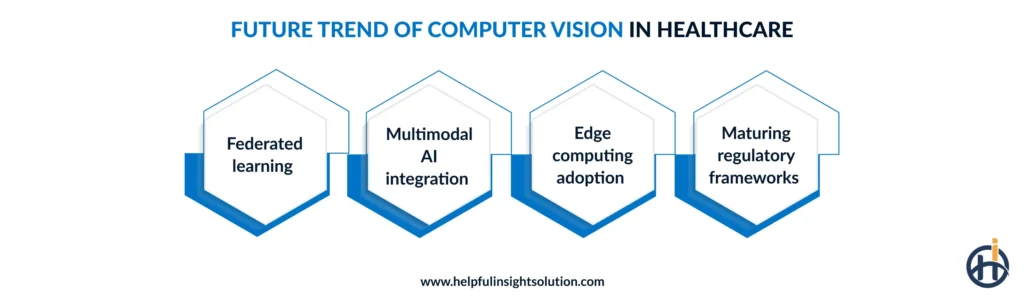
1. Federated learning
Federated learning is a way that Artificial Intelligence models can be trained using data from hospitals without actually moving the sensitive patient data from where it is. This helps the computer vision systems to be more accurate and to work better in general, and it also keeps the patients’ data private.
2. Multimodal AI integration
In the future, computer vision systems will need to combine pictures with patient records, lab results, and genetic information to get a complete picture of what is going on. This helps doctors to use multiple types of data and incorporate more information to make diagnoses more accurate, providing faster treatment.
3. Edge computing adoption
As edge computing gets better, computer vision models can run on medical devices that take pictures instead of sending the information to the cloud. This means that doctors will get the information on time, which is very important in emergencies or in places where it is hard to get online.
4. Maturing regulatory frameworks
As computer vision tools become more common in hospitals, the Food and Drug Administration is making it clearer how these tools should be approved and what rules they need to follow. This will make it easier for healthcare providers to use these technologies and not take risks with patient data and safety.
How does Helpful Insight assist in creating healthcare solutions with computer vision?
Now, you should start creating a plan to hire a reliable and experienced healthcare app development company that can build advanced AI solutions. We are a global leader that ensures complete client assistance and seamless integration of computer vision in healthcare systems.
You can hire a dedicated team that helps you to design, train, process, and execute medically aligned algorithms. Our experts specialize in building deep learning networks, generative AI models, and NLP-driven clinical equipment to help patients with real-time responses.
The computer vision use cases in healthcare that we have studied in this blog are all implemented with legacy medical platforms in our ecosystem.
This is the right time for you to strike the healthcare market with AI-powered patient monitoring and image analysis solutions. It will help you to build trust among patients and enhance brand visibility across the globe.
FAQs
The integration cost is highly dependent on data modeling, software training, hardware complexity, and compliance. For MVP platforms, the average price ranges from $20,000 to $60,000 due to limited AI models and algorithms. The total cost may increase to $300,000 or more for advanced diagnostic and surgical systems.
It uses automatic data encapsulation, local edge processing, and strict encryption frameworks to ensure patient privacy. Healthcare systems blur human faces, send images through localized cameras, and convert body forms to prevent identification. Additionally, zero-trust architecture and MFA allow authorized persons to enter the system.
AI experts use various text, images, audio, and structured medical data to build advanced automated systems for healthcare. It includes both labeled and unlabeled information, which allows AI models to also learn through hidden traits. This enhances the data processing power of healthcare platforms and ensures seamless communication between servers.
The system accuracy in medical diagnosis is highly ensured by strict AI algorithms that regularly optimize healthcare operations. They perform well in cancer detection, disease screening, and image analysis with real-time features. These platforms have limitations in pathology, clinical management, and equipment monitoring.
Multiple issues, like data security, interoperability, and expenses, are the greatest barriers to the adoption of this AI technology in the healthcare industry. It is difficult to share and train visual AI models due to strict patient data protection laws. Additionally, older systems cannot respond to advanced tools, which increases the overall cost and time.